
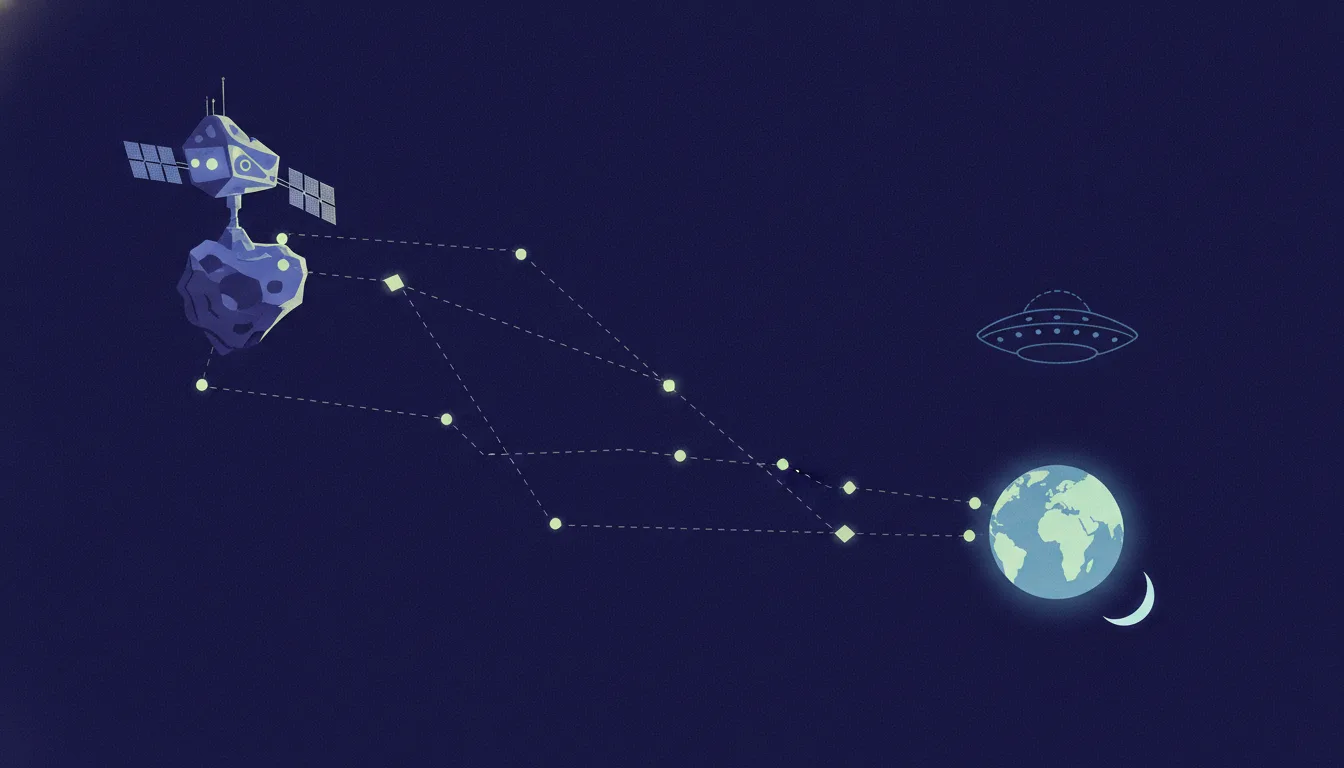
The unidentified flying objects (UFOs) of popular culture are big, bright craft hovering in our skies. Ask an engineer how to study another civilization without being noticed, and you get something very different: a network of probes that is small, quiet, spread out, and mostly nowhere near Earth.
The mental model: a spy network, not a spaceship
Picture the problem from the other side. You have the technology to cross interstellar distances and you want to watch a young technological civilization without it noticing. You would not send a crew. You would send machines, and you would organize them the way we organize any large sensing system: one big hub far away, a few relays in between, many small observers closer in, and the tiniest, cheapest probes right at the target.
Machines win over crews because a probe doesn't need any of the things that make crewed spaceflight heavy and fragile:
- life support, food and water;
- habitable volume and radiation protection for living bodies;
- artificial gravity;
- a way home.
And it tolerates things no crew could: accelerations that would kill a person, journeys of centuries or millennia, massive redundancy, and losses that are simply written off.
The idea has a respectable pedigree. In 1960 the radio astronomer Ronald Bracewell argued in Nature that an advanced civilization would more likely send autonomous probes to nearby stars than wait for radio conversations that take years per exchange[1]. A probe parked in the target system acts as a local intermediary, so nobody has to hold a dialogue across light-years. Such a device is now called a Bracewell probe.
That reframes the usual question. Instead of "what would an alien spaceship look like?", ask:
If we wanted to study an alien civilization without being detected, what probe architecture would we design?
This is a thought experiment in engineering, not a claim that anything of the kind is here. The two most recent official US reviews found no evidence that any unidentified phenomenon is extraterrestrial technology. The National Aeronautics and Space Administration's (NASA's) Unidentified Anomalous Phenomena (UAP) Independent Study Team said so in 2023[2], and the US Department of Defense's All-domain Anomaly Resolution Office (AARO) reached the same conclusion after reviewing government investigations back to 1945[3]. What the exercise can do is tell us what such a network would need, and therefore what it would leave behind.
Why not just send tiny probes?
If machines are the answer, the obvious move is to make them as small as possible: cheaper to launch, easier to hide, and you can send millions. Miniaturization is attractive, but the capabilities a probe actually needs grow with its size.
Power comes from collecting area (solar panels) or volume (batteries, reactors). How far a transmitter reaches depends on the power behind it and the size of its antenna. How sharply a telescope sees depends on the width of its mirror. Shielding against radiation and dust is mass. Shrink the probe and every one of these shrinks with it, while the cost per unit falls and the probe gets harder to spot.
| Size | Natural role | Energy | Communications | Stealth | Cost per unit |
|---|---|---|---|---|---|
| mm–cm | Microprobe at the target | ||||
| 10–50 cm | Observer | ||||
| 0.5–5 m | Relay | ||||
| 10–100 m | Hub |
We already have a real example of where the small end hits its limits. Breakthrough Starshot is a research program studying gram-scale "nanocraft": a chip carrying cameras, power, navigation and a transmitter, pushed by a laser to about 20% of the speed of light towards Alpha Centauri[4]. Getting there is the part people talk about. Reporting back is the harder part. By the time the chip's laser signal reaches us across 4.37 light-years it would arrive as a few hundred photons, and the project's engineers call the power supply "the hardest problem on the chip"[5]. A millimetre probe can carry surprisingly sophisticated sensors. It cannot easily make power, get rid of heat, survive impacts or shout across interstellar space.
No single right size: a hierarchy
For a single general-purpose explorer, something between about 30 cm and a few metres is a sensible compromise. That is roughly the scale of our own small satellites and planetary probes, big enough for optics, a computer, power, a directional antenna, shielding and some propulsion. But a whole network doesn't have to pick one size. The rational design splits the job across tiers, each sized for its function and placed at the distance where that function works best.
Reading the tiers from the outside in:
- The hub. Tens to hundreds of metres, with the energy, computing, repair and manufacturing capacity, large telescopes, and the only antenna powerful enough to talk to the home star. It has no reason to come near Earth. It could sit in the outer solar system, on an asteroid, or in a quiet orbit around the Sun that nobody is watching.
- Relays. Metre-scale nodes that receive data from the smaller probes, aggregate and compress it, and pass it up to the hub.
- Observers. Tens of centimetres across, carrying telescopes, spectrometers (instruments that split light into its component wavelengths to read chemical composition), electromagnetic sensors and enough onboard computing to decide for themselves what is worth recording.
- Microprobes. Centimetre-scale or smaller, the only tier that gets truly close. In principle one could carry a camera, a microphone, electromagnetic sensors, memory, a processor and an optical transmitter.
Distance buys stealth and costs resolution
Why would the network need a close-in tier at all? Because what you can see depends on how far away you are. The finest detail a telescope can separate is set by the diffraction limit: the smallest angle it resolves is roughly θ ≈ 1.22 λ / D, where λ is the wavelength of the light and D is the diameter of the telescope's mirror. Multiply that angle by the distance to the target and you get the size of the smallest feature it can make out on the ground.
The table below works this out for visible light (500 nm) from five vantage points. Two of them need a word first. An AU (astronomical unit) is the average Earth–Sun distance, about 150 million km. L1 and L2 are two of the Sun–Earth Lagrange points, spots where a small object can hold its position relative to Earth and the Sun; they come back when we look at where the tiers would sit.
| Vantage point | Distance | 30 cm telescope | 1 m telescope | What you can make out |
|---|---|---|---|---|
| Outer solar system (Neptune's orbit, ~30 AU) | ~4.5 billion km | ~9,000 km | ~2,700 km | Earth as a few pixels; its atmosphere through spectroscopy |
| Sun–Earth L1 or L2 | ~1.5 million km | ~3,000 km | ~900 km | Continents, clouds, oceans |
| The Moon's distance | ~384,000 km | ~780 m | ~230 m | Cities, airports, ports, large dams |
| Geostationary orbit | ~36,000 km | ~70 m | ~20 m | Runways, stadiums, large ships |
| Low Earth orbit | ~400 km | ~80 cm | ~25 cm | Cars, individual trees |
Two things follow from the table. A hub far out can study Earth as a planet, but it cannot watch a civilization; that takes an observer within roughly lunar distance, and anything finer takes something much closer. That is the physical reason the tiers exist. And lunar distance is already plenty for an observer: from there, a 1 m telescope resolves cities, airports, the larger road networks, crop patterns, large fires and the geography of night-time lighting. Bright point sources like city lights are detectable even when they are smaller than the resolution limit. For understanding a civilization, that is a great deal of information for very little exposure.
There is also a way to beat the diffraction limit without building a giant mirror. In interferometry, several separate telescopes combine their light so that they resolve detail as finely as one telescope as wide as the distance between them. A swarm of small observers spread over many kilometres could, in principle, resolve far finer detail than any single craft. It is not free: combining visible light requires knowing each telescope's position to a fraction of a wavelength, and the swarm collects no more light than its small mirrors add up to. Still, a hundred small, distributed probes can be scientifically more useful than one enormous ship.
Energy is the real constraint
Sensors and computers miniaturize beautifully; energy does not. A small probe has little surface for solar panels and little volume for batteries or a generator, so it has little power for its sensors, its transmitter and its heaters.
Physics piles on here, because sending a signal a long way is expensive. A signal spreads out as it travels, so its strength falls with the square of the distance: double the range and you need four times the power, or a much bigger antenna, to be heard. For a centimetre probe with milliwatts to spare, talking directly to another star is out of the question. The energy budget, more than the sensors, is what forces the network shape.
Talking home: relays and short bursts
The answer to the energy problem is the chain already drawn in the hierarchy: a microprobe only has to reach the nearest observer or relay, far closer than the hub, and each step up the chain is handled by a bigger node with more power and a bigger antenna. The hub alone pays for the interstellar link. That cuts the power each small probe needs by many orders of magnitude.
A network that wants to stay hidden adds a second rule: transmit as little, as briefly and as narrowly as possible. A microprobe's duty cycle might look like this:
Most of the time the probe is only listening and recording. Its onboard computer throws away what it doesn't need and squeezes the rest, then fires it at the relay in a burst lasting seconds. If that burst travels on a narrow laser beam rather than a broadcast radio signal, someone would have to be standing almost exactly in its path, at exactly the right moment, to notice it at all.
Heat gives you away
Even a probe that never transmits leaks one signal it cannot switch off. Every machine that uses energy turns it into waste heat, and waste heat radiates away as infrared light. A busy infrastructure would also show up as reflected sunlight, radio leakage and visible manoeuvres.
Each of those scales with how much power a single object uses and how often it moves. So stealth pushes in the same direction as the energy budget did: towards probes that are small, distributed, intermittent and low-power. A network of millions of silent sensors would be far harder to detect than one large ship.
Build it on site
Shipping millions of probes between stars is expensive. Shipping one factory is not. A single seed probe could arrive, find a suitable asteroid, and mine it for iron, nickel, silicon, carbon and water, the raw materials for structures, sensors, antennas, relays and more probes. Taken to its extreme, this becomes the self-replicating probe: in 1980 the engineer Robert Freitas published a preliminary design, called REPRO, for an interstellar probe that builds copies of itself from local resources[6]. With local manufacturing, the size of the network is limited by the target system's resources rather than by what can be launched from home.
A whole mission might unfold like this:
Almost all of it would be well out of our sight, and only the smallest, cheapest parts would ever come near us.
Where the pieces would sit
Put the tiers and the physics together and some locations stand out:
| Location | Role in the network | Why it suits |
|---|---|---|
| Asteroids | Mining and manufacturing | Raw materials, a solid anchor, natural camouflage |
| Outer solar system | Hub | Far from where we look; room for large antennas and radiators |
| Orbits around the Sun | Discreet observers | Watch from a distance without sharing Earth's crowded orbits |
| Lagrange points | Observatories and relays | Hold position with little fuel |
| Lunar orbit and surface | Watching Earth; passive instruments | Lunar distance already resolves cities |
| Near Earth | Microprobes | The only place fine detail is visible |
| Atmosphere | Occasional close looks | Information that can't be gathered remotely |
The Lagrange points deserve a closer look, because we use them ourselves. In any system of two large bodies, like the Sun and Earth or Earth and the Moon, there are five points where a small object's orbit keeps it in step with both. L1, L2 and L3 lie on the line through the two bodies and are only balanced like a ball on a hilltop, so a spacecraft there needs regular small corrections. L4 and L5 sit 60° ahead of and behind the smaller body and are genuinely stable; material collects there naturally[7].
                              * L4


 L3 *            Sun ··········· L1 *  Earth  * L2


                              * L5
The Solar and Heliospheric Observatory (SOHO), run jointly by the European Space Agency (ESA) and NASA, watches the Sun from Sun–Earth L1. The James Webb Space Telescope works from L2, about 1.5 million km from Earth, where the Herschel, Planck and Gaia observatories went before it[7]. If they are good places for our observatories, they are good places for anyone else's.
Astronomers have actually looked. In 1980 Robert Freitas and Francisco Valdes photographed the regions around all five Earth–Moon Lagrange points for natural or artificial objects and found none[8], and a 1983 follow-up search came up empty too[9]. In 2019 the physicist James Benford proposed a newer target: Earth's co-orbitals, small asteroids that share Earth's path around the Sun. They offer raw materials, an anchor and concealment, yet have barely been studied. The most attractive is 2016 HO3, the smallest, closest and most stable of Earth's known quasi-satellites[10].
What this says about UFO sightings
Now return to the big craft in the sightings. If anomalous objects were alien probes, the enormous ships described in some testimony are exactly the part of the network that would have the least reason to exist.
A civilization able to cross between stars has almost certainly mastered miniaturization, automation, autonomy, advanced sensors, directional communication and automated manufacturing. For such a civilization, repeatedly flying a vessel tens or hundreds of metres long through another planet's atmosphere would be a strange way to observe it: loud, bright, and unnecessary, since orbit already shows almost everything it could want. The shape this analysis points to is lopsided in the other direction:
1 hub → tens of relays → thousands of observers → millions of sensors.
The detectability paradox
The same logic cuts the other way too. The better the technology, the harder it would be to find: small, silent, efficient, autonomous, distributed, possibly tucked into natural objects like asteroids. The absence of spectacular UFOs tells us very little about whether probes exist, and it is not evidence that they do.
That is the uncomfortable edge of the thought experiment. An argument that predicts "you wouldn't see them" explains any lack of evidence, which makes it useless as a claim on its own. To turn it into science, it has to predict something we could see.
The better question
The useful question is not "what would an alien ship look like?" but "what traces would an optimal observation network be unable to avoid leaving?" Physics sets the list. Every tier needs energy, so it sheds heat. Every link carries data, so it emits light or radio, however briefly. Every manufacturing site changes the rock it mines. Every object in a stable orbit reflects sunlight.
That shifts the search away from strange lights in the sky and towards:
- orbital anomalies, objects whose motion doesn't match natural dynamics;
- thermal anomalies, infrared sources that are too warm for their size or position;
- brief laser flashes;
- artificial objects on asteroids, on the Moon, at Lagrange points or among Earth's co-orbitals;
- probes in quiet orbits around the Sun.
These are technosignatures: any observable evidence of technology that isn't ours, the counterpart to the biosignatures astronomers look for as evidence of life. NASA reviewed the field and what it could contribute at a dedicated workshop in 2018[11], and searching our own solar system for physical artifacts even has a name, SETA, the Search for Extraterrestrial Artifacts, set out by Freitas and Valdes in 1985[12]. It complements the older SETI, the Search for Extraterrestrial Intelligence through signals from distant stars.
Framed this way, the speculation stops being about whether you believe a sighting. It becomes a set of observations with specific targets, which can come back empty. That is what makes it the most interesting version of the question.
References
- Ronald N. Bracewell, Communications from Superior Galactic Communities — Nature 186, 670 (1960)
- NASA, Unidentified Anomalous Phenomena Independent Study Team: Final Report (2023)
- All-domain Anomaly Resolution Office, Report on the Historical Record of U.S. Government Involvement with Unidentified Anomalous Phenomena, Volume I (2024)
- Breakthrough Initiatives, Breakthrough Starshot
- Ann Finkbeiner, Inside the Breakthrough Starshot Mission to Alpha Centauri — Scientific American (2016)
- Robert A. Freitas Jr., A Self-Reproducing Interstellar Probe — Journal of the British Interplanetary Society 33, 251–264 (1980)
- European Space Agency, What are Lagrange points?
- Robert A. Freitas Jr. and Francisco Valdes, A Search for Natural or Artificial Objects Located at the Earth-Moon Libration Points — Icarus 42, 442–447 (1980)
- Francisco Valdes and Robert A. Freitas Jr., A Search for Objects near the Earth-Moon Lagrangian Points — Icarus 53, 453–457 (1983)
- James Benford, Looking for Lurkers: Co-orbiters as SETI Observables — The Astronomical Journal 158, 150 (2019)
- NASA and the Search for Technosignatures: A Report from the NASA Technosignatures Workshop (2018)
- Robert A. Freitas Jr. and Francisco Valdes, The Search for Extraterrestrial Artifacts (SETA) — Acta Astronautica (1985)