
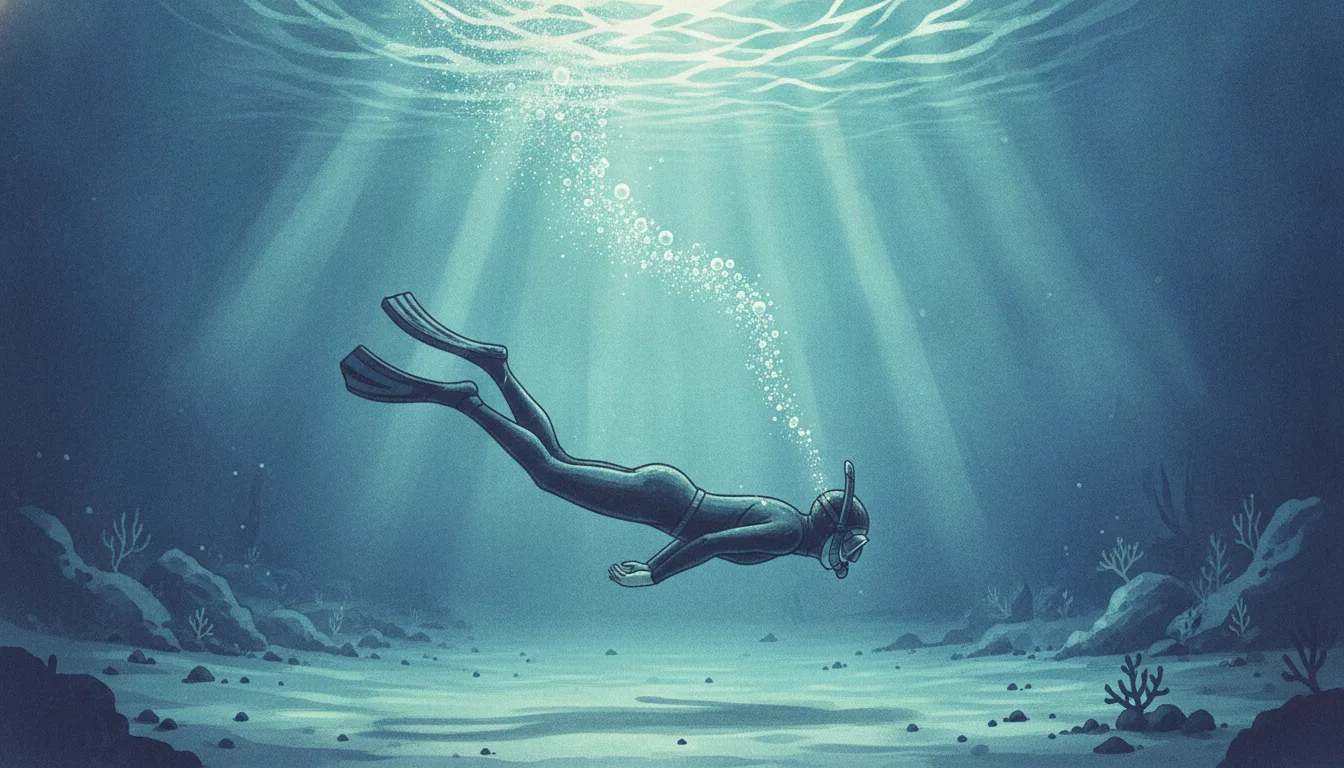
Going from floating on the surface to gliding a few meters down looks effortless when someone else does it — but there's a small sequence of moves, and one counterintuitive safety habit, that make the difference between a smooth descent and a mouthful of seawater.
Breath-hold diving carries a real drowning risk — shallow-water blackout can strike a fit, experienced diver with no warning. This post is an overview, not a substitute for a certified freediving course (AIDA, SSI, Molchanovs, PADI Freediver), and one rule is non-negotiable: never dive alone.
Snorkeling looks like the gentlest thing you can do in the water. Float, breathe, watch fish. But the moment you stop floating and start diving down to get a closer look, you've quietly crossed into breath-hold territory — and the same physiology that lets freedivers do incredible things is the physiology that drowns unprepared snorkelers every summer.
The good news: the risks are well understood, and the habits that keep you safe are simple. Here's what actually matters.
Rule zero: never dive alone
Almost every serious snorkeling and freediving accident has the same line in the report — the victim was diving alone, or the buddy was on the surface not paying attention.
The standard is one up, one down. When you dive, your buddy watches from the surface. They track where you are, when you left, and they're ready to meet you as you come up. You do the same for them. A blackout is survivable if someone gets to you in seconds. It's fatal if nobody notices for a minute.
If you're snorkeling casually and not diving down, buddy discipline can be looser — but the second you start breath-hold diving, this is non-negotiable.
The duck dive: getting down efficiently
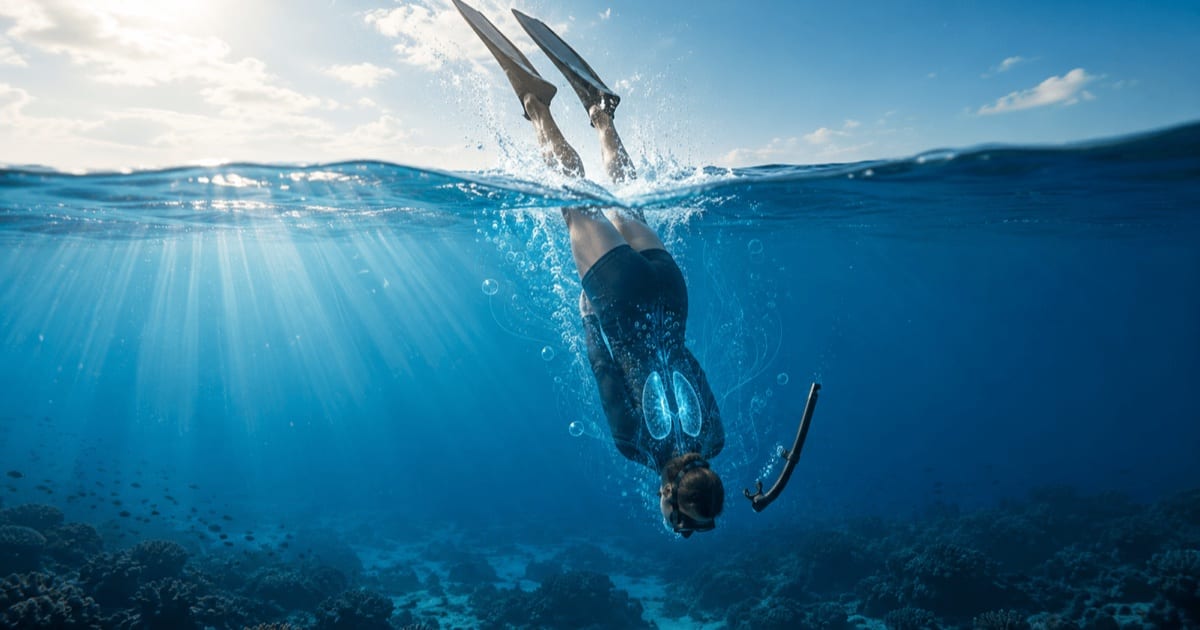
The duck dive (also called a surface dive) is how you get from floating at the surface to descending head-first, using your body weight instead of thrashing. Done well, it's almost effortless and gets you a couple of metres down before you take a single fin stroke. Done badly, you splash around, burn oxygen, and barely submerge.
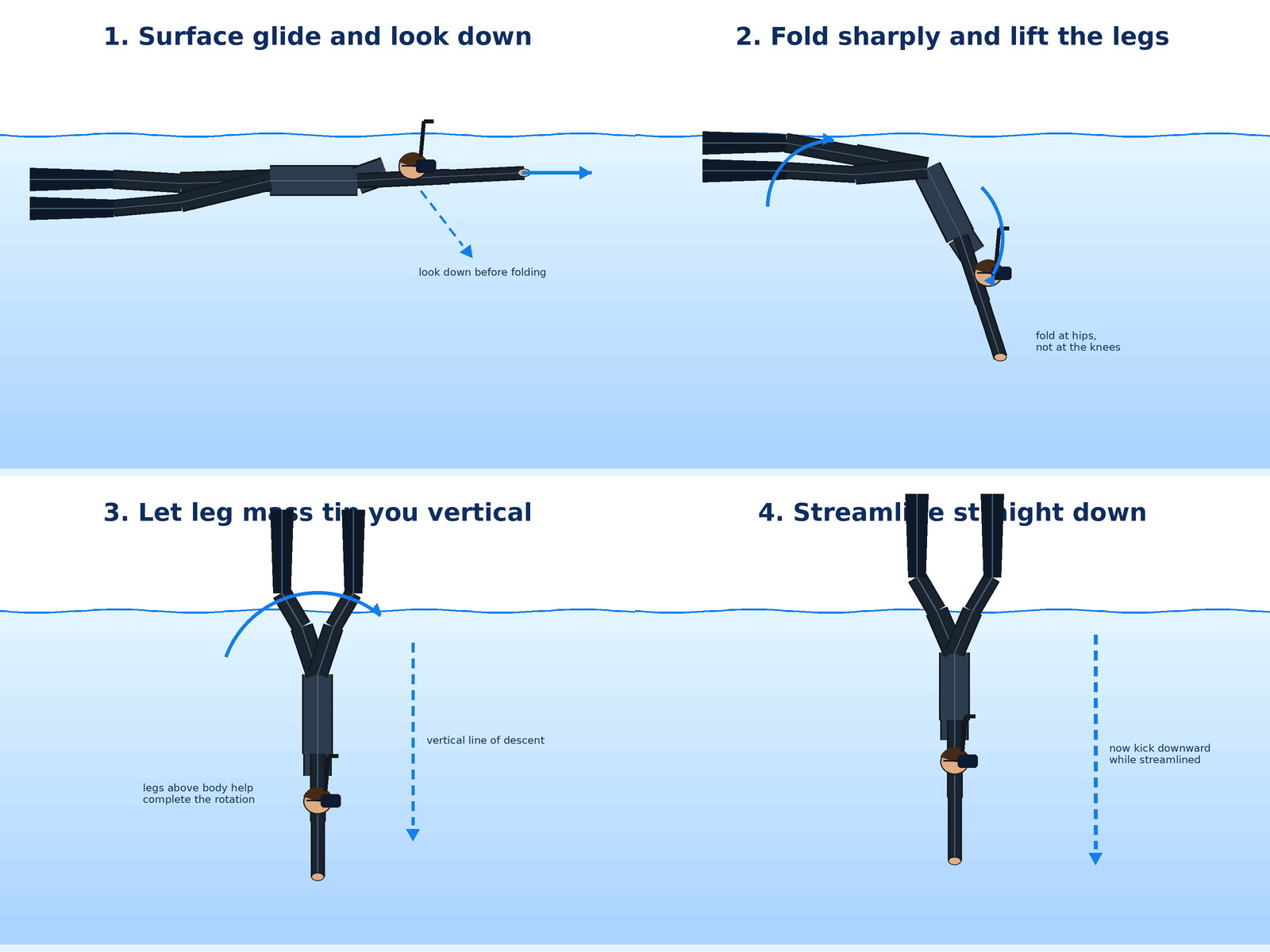
Here's the sequence:
- Breathe up and relax first. Spend time floating calmly, face in the water, breathing slowly through your snorkel. You want to be relaxed, not amped up. (More on breathing below — this part matters more than the technique.)
- Take your final breath and remove the snorkel. Take one comfortable, full-but-not-strained breath, then take the snorkel out of your mouth (yes — see the section on this below). Let it hang on its keeper or your mask strap.
- Bend sharply at the hips. Drop your head and upper body down and forward until your torso is pointing straight at the bottom — aim for a clean 90° fold at the waist. Reach your arms down toward the seabed.
- Lift your legs straight up into the air. This is the trick most people miss. Raise your legs vertically out of the water so they're pointing at the sky. The weight of your legs — now unsupported by water — pushes your upper body down and drives you under smoothly.
- Only start finning once your fins are submerged. Kicking while your fins are still in the air just splashes and wastes energy. Wait until the blades are underwater, then begin slow, full kicks from the hip.
- Streamline. Arms extended ahead or pinned to your sides, body straight, chin tucked. Less drag means less effort means more bottom time.
CO₂, the urge to breathe, and how people get this dangerously wrong
This is the most important thing in the article, so here's the physiology plainly.
Your urge to breathe is triggered by carbon dioxide, not by a lack of oxygen. As you hold your breath, CO₂ builds up in your blood. Sensors in your body detect the rising CO₂ and generate that increasingly desperate "I need to breathe now" feeling — the burning, the diaphragm contractions. That alarm is a safety feature. It usually forces you to the surface while you still have plenty of oxygen left.
Here's the trap. Hyperventilating before a dive — taking a rapid series of deep, forceful breaths to "get more air" — does not meaningfully add oxygen. What it does is flush CO₂ out of your body. With your CO₂ starting artificially low, the alarm takes much longer to go off. You feel comfortable, so you stay down longer... and your oxygen keeps dropping the whole time. If oxygen falls low enough before the CO₂ alarm finally fires, you black out underwater with no warning at all.
This is shallow water blackout (hypoxic blackout), and it's a leading killer of otherwise fit, capable swimmers and spearfishers. There's no gasping, no struggle you'd notice from the surface — the lights just go out. That's exactly why the buddy system exists.
The safe path — calm breathing:
The dangerous path — hyperventilation:
How to avoid dangerous CO₂ manipulation
- Never hyperventilate before a dive. No rapid puffing, no "packing" breaths to psych yourself up. Breathe slowly and calmly. A few relaxed breaths beforehand is fine; a frantic pre-dive routine is a red flag.
- Respect the urge to breathe. When your body tells you to come up, come up. Don't treat the discomfort as a challenge to push through. The people who "train themselves" to ignore it are removing their own safety margin.
- Take long surface intervals. After a dive, rest and breathe normally at the surface for at least as long as you were down — longer is better. Firing off repeated dives with short recovery lets oxygen debt accumulate across dives, which is another quiet path to a blackout.
- Watch your snorkel's "dead space." Every breath through a snorkel re-inhales a little of the air still sitting in the tube — air that's higher in CO₂. That's why snorkels have sensible length and bore limits. Avoid novelty extra-long snorkels; they increase rebreathing and make it harder to clear.
If you feel dizzy, tingly, or lightheaded on the surface, that's a sign to stop, hold onto something buoyant, and breathe normally until it passes.
Why the snorkel comes out of your mouth before you dive
New snorkelers almost always keep the snorkel clamped in their teeth on the way down. It feels natural. It's also the habit every freediving course drills out of you on day one. Here's why you take it out before descending:
1. It's a direct water pathway if you black out. This is the big one. If you have a blackout — near the surface on ascent is the most common place — a snorkel jammed in your mouth is an open pipe leading straight to your airway. Water flows right in. With the snorkel out, an unconscious diver's airway is far more likely to stay sealed by a reflex called laryngospasm, buying critical time for your buddy to bring you up and get you breathing. Snorkel-out is the single practice most likely to turn a blackout into a survivable event instead of a drowning.
2. Clearing it on ascent wastes the air you don't have. When you dive with the snorkel in, it floods. To breathe from it at the surface you have to blast it clear — and that means spending a chunk of your remaining breath at the exact moment you're most oxygen-starved. Surfacing snorkel-out, you simply lift your head, take a breath of open air, then replace the snorkel. Much safer margin.
3. It reduces jaw tension and helps you equalize. A relaxed jaw and face make it easier to equalize your ears and stay calm. Gritting a mouthpiece the whole dive works against that.
4. Less drag, less snag. One less thing sticking out to catch water or catch on kelp, lines, or rock.
The clean habit to build
Final breath in through the snorkel → snorkel out → duck dive → dive and enjoy → ascend looking up, one hand up → break the surface → breathe first, then put the snorkel back and clear it. Rinse and repeat, with your buddy watching every time.
The short version
- Never dive alone. One up, one down, every time you go down.
- Never hyperventilate. Calm breathing only. The urge to breathe is your friend — obey it.
- Rest between dives longer than you think you need.
- Duck dive with your body weight: fold at the hips, lift the legs vertical, fin only once submerged, stay streamlined.
- Take the snorkel out of your mouth before you descend, and breathe before you replace it on the way up.
Snorkeling down to swim alongside a turtle is one of the best things you can do in the ocean. Do it with these habits and it stays that way — a calm, quiet, repeatable pleasure, instead of a gamble you don't realize you're taking.
References
- Shallow Water Blackout — StatPearls (NCBI Bookshelf, NIH) — the physiology behind pre-dive hyperventilation lowering CO₂, delaying the urge to breathe, and causing hypoxic loss of consciousness during breath-hold diving.