
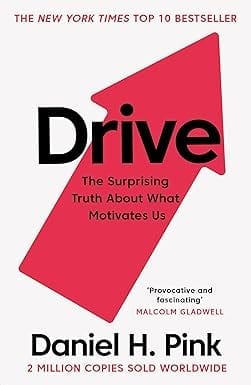
In the quest to understand what truly motivates us, "Drive: The Surprising Truth About What Motivates Us" by Daniel H. Pink stands out as a seminal work. Drawing on four decades of research on human motivation, it challenges the reward-and-punishment model most workplaces still run on and offers a more accurate picture of what actually gets us to do our best work.
TL;DR
The old "if you do this, then you get that" model of motivation is out of step with how people actually work. Real, durable motivation comes from three things: autonomy, mastery, and purpose.
Pink's central argument is that the carrot-and-stick approach — "if you do this, then you get that" — is a poor fit for the creative, open-ended work most of us now do, and often makes it worse. In its place he describes Motivation 3.0, built on autonomy, mastery, and purpose. These principles apply directly to dynamic fields like software development: whether you're deepening your React skills or steering a complex project, they're the difference between a team that merely complies and one that genuinely commits.
The evolution of motivation: 1.0 → 2.0 → 3.0
Pink frames motivation as an operating system that has been upgraded twice — and is overdue for a third release.- Motivation 1.0 — the biological drive: eat, drink, survive, reproduce.
- Motivation 2.0 — the reward-and-punishment drive: seek reward, avoid punishment. This is the "carrots and sticks" model that still runs most organizations.
- Motivation 3.0 — the intrinsic drive: the human need to direct our own lives, get better at things that matter, and serve a purpose larger than ourselves.
Motivation 2.0 isn't wrong so much as outdated. It worked well for the routine, rule-following work of the industrial era. But as more of our work becomes creative and open-ended, the same rewards that once boosted output start to backfire.
Why carrots and sticks backfire
The book's most counter-intuitive claim is that "if-then" rewards can reduce performance on exactly the kind of creative work that matters most today. The evidence starts with a simple puzzle.
The candle problem
In 1945 the psychologist Karl Duncker created a test now known as the candle problem: given a candle, a box of thumbtacks, and a book of matches, attach the candle to a wall so it burns without dripping wax on the floor. The trick is to see the tack box not as a container but as a shelf — a mental leap Duncker called functional fixedness.
Decades later, Sam Glucksberg ran the puzzle as a race and offered one group a cash prize for the fastest solutions. The result was backwards from what Motivation 2.0 predicts: the incentivized group took, on average, about three and a half minutes longer. The reward narrowed their focus and blocked the sideways thinking the puzzle required.
Algorithmic vs. heuristic work
The key distinction is the type of task:
- An algorithmic task has a known path — follow the established steps to a single, correct outcome.
- A heuristic task has no set path — you have to experiment and invent a novel solution.
"If-then" rewards work fine for algorithmic work, where a narrow focus speeds things up. For heuristic work — the design decisions, debugging, and architecture that fill a developer's day — that same narrowing is exactly the wrong response.
| Attribute | Algorithmic task | Heuristic task |
|---|---|---|
| Path to the answer | A known set of steps | No set path; must be invented |
| Developer example | Applying a documented migration | Designing an API from scratch |
| Do "if-then" rewards help? |
The seven flaws of carrots and sticks
Pink summarizes the downsides of "if-then" rewards as seven recurring failure modes. Note the fix is rarely to remove pay — it's to pay people fairly and then get money off the table so it stops distorting the work.
| # | Flaw | What the reward ends up doing |
|---|---|---|
| 1 | Extinguishes intrinsic motivation | Turns play into work you only do for the payout |
| 2 | Diminishes performance | Narrows focus and slows creative problem-solving |
| 3 | Crushes creativity | Discourages the sideways thinking novel problems need |
| 4 | Crowds out good behavior | Replaces goodwill with transactions |
| 5 | Encourages cheating & shortcuts | Rewards the metric, not the real goal |
| 6 | Becomes addictive | Each reward requires a bigger one next time |
| 7 | Fosters short-term thinking | Optimizes for this quarter at the expense of the long game |
One useful nuance: unexpected "now-that" rewards ("now that the project shipped, here's a bonus") do far less damage than dangled "if-then" rewards, precisely because they don't turn the work into a transaction while you're doing it.
The three elements of Motivation 3.0
If external rewards are the wrong fuel, the right fuel is three intrinsic drives: autonomy, mastery, and purpose. This trio echoes the Self-Determination Theory of psychologists Edward Deci and Richard Ryan, whose decades of research argue that humans have innate needs for autonomy, competence, and relatedness.

Autonomy — control over how you work
Autonomy is the desire to direct our own lives. Pink breaks it into four dimensions — the four T's: autonomy over Task (what you do), Time (when you do it), Technique (how you do it), and Team (who you do it with).
Real companies have leaned into this. Some run on a Results-Only Work Environment (ROWE), where people are judged on output rather than hours in a seat. Others give engineers explicit free time to chase their own ideas — Google's "20% time" and Atlassian's "FedEx Days" (ship something in 24 hours) both grew products that mattered out of self-directed play.
Mastery — getting better at something that matters
Mastery is the urge to keep improving at something we care about. Pink describes it with three properties:
- Mastery is a mindset. It requires believing your abilities can grow with effort — a growth mindset, not a fixed one.
- Mastery is a pain. It demands deliberate practice: effort, grit, and long stretches of not-yet-good-enough.
- Mastery is an asymptote. You can approach it but never fully reach it — which is exactly what keeps it motivating.
Closely related is the idea of flow, coined by psychologist Mihály Csíkszentmihályi: the fully-absorbed state you hit when a challenge is perfectly matched to your skill — neither so easy you're bored nor so hard you're anxious. Work that keeps you near that edge feeds mastery.
Purpose — serving something larger
Purpose is the yearning to do what we do in service of something bigger than ourselves. When people can connect their daily work to a goal that matters, motivation stops needing an external push. Pink notes that purpose-driven organizations express it in three ways: in their goals (not just profit, but a mission), their words (talking about "us" and contribution, not just "maximize"), and their policies (giving people real latitude to act on it).
Type I vs. Type X
Pink gives the two resulting styles of behavior names. Type I behavior is fueled by intrinsic drives — growth, mastery, and purpose — while Type X behavior is fueled mainly by external rewards.
| Type I | Type X | |
|---|---|---|
| Fueled by | Intrinsic desire (autonomy, mastery, purpose) | External rewards & pressure |
| Sees work as | Inherently satisfying | A means to a payoff |
| Long-term sustainability | ||
| Over time | Almost always outperforms | Tends to stall and burn out |
Crucially, Type I is made, not born — it's a response to environment, not a fixed personality. A workplace built on autonomy, mastery, and purpose grows Type I behavior; one built on carrots and sticks pushes people toward Type X.
Putting it to work as a developer
The theory maps cleanly onto day-to-day engineering:
- Embrace autonomy. Seek — and, if you lead, grant — real ownership over the four T's: which problems to pick up, how to schedule deep work, which tools and patterns to reach for, and who to pair with. In React terms, that's the freedom to choose your state approach or component boundaries rather than being handed a rigid spec.
- Pursue mastery. Treat skill as a practice, not a destination. Keep a deliberate-practice habit — read code better than yours, take on tasks slightly beyond your reach, balance frontend and backend growth — and protect blocks of uninterrupted time so you can actually reach flow.
- Work with purpose. Connect the ticket to the why. A feature is easier to pour yourself into when you can see who it helps; if you manage, make that line of sight explicit rather than assuming people infer it.
- Get money off the table. Pay people fairly and generously enough that compensation isn't the thing they're thinking about — then let autonomy, mastery, and purpose do the motivating. Save recognition for unexpected "now-that" moments rather than dangled "if-then" bonuses.
Applied together, these shift a team from grudging compliance to genuine engagement — the kind of motivation that survives after the bonus is spent.
References
- Daniel H. Pink — Drive: The Surprising Truth About What Motivates Us (official page)
- Drive — Wikipedia summary
- Dan Pink — The puzzle of motivation (TED talk, 2009)
- The candle problem — Wikipedia (Duncker's functional-fixedness test)
- How Incentives Hinder Innovation & Creativity — Behavioral Scientist (Glucksberg's candle-problem experiment)
- Self-Determination Theory — Wikipedia (Deci & Ryan)
- Best Buy's ROWE experiment — Slate (Ressler & Thompson's Results-Only Work Environment)