
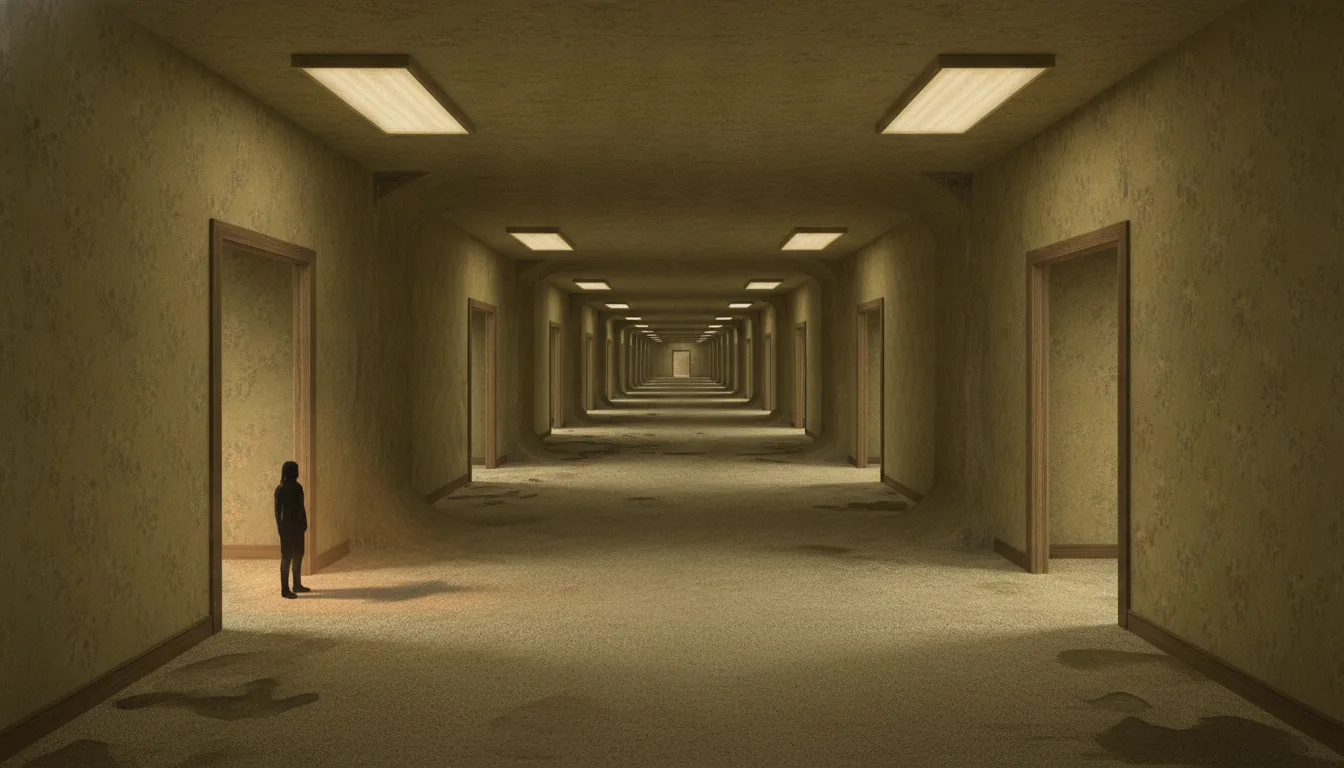
A24's Backrooms turned an internet creepypasta into a film about something far more intimate: what happens to a mind that refuses to process its past. This is a reading of the film's central metaphor — room by room.
This post discusses the full plot of Backrooms (2026), including the ending. If you haven't seen it yet, watch it first — the film works much better when its shape surprises you.
From a 4chan Post to an A24 Film
The Backrooms began as pure internet folklore. In May 2019, an anonymous user on 4chan's paranormal board posted a photo of a slightly wrong-looking yellow room, and another user replied with a caption that became canon: if you're not careful and you noclip out of reality — a video-game term for glitching through a wall — you end up in the Backrooms, endless miles of empty rooms, moist carpet, and the hum of fluorescent lights[1]. The image struck a nerve because everyone half-recognized the place. It looked like an office you'd visited as a child, a hotel corridor at 3 a.m., a memory with the context stripped out. The internet gave that feeling a name — liminal space — and built a whole aesthetic genre around it.
In January 2022, a then 16-year-old filmmaker named Kane Parsons turned the lore into a viral found-footage series on YouTube, and in 2026 that series became a feature film: Backrooms, directed by Parsons for A24, starring Chiwetel Ejiofor and Renate Reinsve[2]. The film could have been a simple monster-in-a-maze movie. Instead, it uses the maze to say something specific about the mind. That something is what this post is about.
The Story, Briefly
Clark (Ejiofor) is a failed architect who now runs a struggling furniture store in San Jose, drinking through the wreckage of a dissolved marriage. Investigating flickering lights in his store, he finds a glowing slit in a wall and falls through it into the Backrooms — the yellow labyrinth of the lore, but populated with things that shouldn't be there: warped copies of his own store, eerily static human figures the film calls Still Life copies, and a towering, monstrous version of Clark himself dressed as the store's pirate mascot[3].
Dr. Mary Kline (Reinsve), his therapist, doesn't believe him — until he disappears and she has to go in after him. Mary carries her own unprocessed history: her childhood home was demolished, and her agoraphobic mother was institutionalized. Meanwhile, a shadowy organization called Async — a company that built magnetic resonance imaging (MRI) machines before it stumbled onto the Backrooms — has been observing the dimension all along. In the climax, Pirate Clark kills Clark; Mary stuns the monster with a piece of concrete from her childhood home, is captured by Async, and, asked to describe what she saw, calls the Backrooms "a faulty, misremembered copy of reality." The film ends inside the Backrooms, on a warped copy of Mary's interrogation room — her own memories are already growing rooms of their own[3].
The Central Metaphor
The Backrooms are the physical architecture of unresolved memory. They represent what happens when someone cannot process the past: memories stop being experiences and become rooms they repeatedly inhabit. The rooms stay familiar — that's the trap — but they lose context and grow distorted, empty, and eventually hostile. This isn't a reading imposed from outside; Parsons has said the film's approach was to let "the interior lives of these characters… dictate and imply a deeper meaning to the space," and that the horror comes from people projecting their own psychology onto the emptiness[4].
The film's emotional logic runs as a chain, and every major plot beat sits somewhere on it:
Pain that is avoided rather than processed gets replayed; replayed pain curdles into resentment; and resentment, given enough time and enough rooms, takes on a body of its own. Pirate Clark is the end of that chain. To see how the film builds it, it helps to decode the elements one by one.
What Each Element Means
| Element | Metaphorical meaning |
|---|---|
| Endless rooms | Repetitive thought patterns: revisiting the same failure without changing anything |
| Familiar but incorrect spaces | Memory itself: recognizable, incomplete, and reconstructed inaccurately |
| No windows or exits | The inability to imagine a different future |
| Still Life copies | People reduced to imperfect memories rather than living individuals |
| Pirate Clark | Clark's defensive persona — resentment and self-pity made physical |
| The furniture store | A simulated life: rooms that resemble homes, but nobody truly lives in them |
| Async | The belief that understanding and mapping the mind is equivalent to healing it |
Two of these deserve a second look. The furniture store is the metaphor in miniature even before anyone noclips anywhere: Clark spends his days arranging fake living rooms — spaces staged to look inhabited — which is precisely what his own life has become. And Async is the film's slyest joke: a company that literally built machines for imaging the inside of people now maps the Backrooms with sensors and hazmat suits, cataloguing the geography of trauma without healing an inch of it. Async embodies the seductive mistake that a map of your damage is the same thing as repair.
Clark: The Architect of His Own Prison
Clark is the film's most pointed irony, because he was an architect — someone trained to design meaningful, intentional spaces — whose inner world has become an accidental, incoherent prison. His tragedy is not that he enters the Backrooms; it's that he finds them comfortable, because they give him purpose and let him avoid responsibility. Inside, he isn't a failed architect or a bad husband — he's an explorer, a builder, a keeper of the Still Life copies he arranges like showroom furniture. The maze rewards him for staying.
That's also why his monster takes the shape it does. Pirate Clark isn't an alien predator that happens to share his face; it's his defensive persona grown enormous — the blustering mascot-self he performed at the store, fed for years on resentment and self-pity until it outgrew him[5]. The Backrooms didn't destroy Clark. Clark's refusal to reckon with himself did; the dimension only gave that refusal square footage.
Mary: The Therapist Is Not Outside the Maze
Mary's arc exists to close the metaphor's escape hatch. If the Backrooms were only Clark's pathology, a competent therapist could stand safely outside and coax him back. Instead, the film insists that Mary — professionally fluent in other people's loops — carries rooms of her own, built from the demolition of her childhood home and the loss of her mother. She can name Clark's patterns with clinical precision and still be claimed by her own: by the end, the dimension has absorbed her psychological landscape, and her memories are materializing as new rooms[5]. Intellectual understanding does not automatically produce emotional escape.
It matters that her one effective weapon is a chunk of concrete from her demolished home — a processed piece of the past, small enough to carry, used deliberately. It stuns the monster; it doesn't slay it. The film is careful there: confronting your history buys you a way out of the room you're in, not immunity from the maze.
A Faulty Copy of Reality
At its broadest, the film scales the metaphor up from one mind to all of them. Mary's closing description — the Backrooms as "a faulty, misremembered copy of reality" — recasts the dimension as the universe's defective memory: nothing completely disappears, but everything returns fragmented and incorrectly reassembled[3]. Read that way, the Backrooms become a kind of collective unconscious — an infinite warehouse holding humanity's abandoned experiences, identities, and pain (the term is Carl Jung's, for the layer of the psyche made of inherited, shared material rather than personal history)[5].
The structure of the ending makes the warehouse literal: Clark's rooms and Mary's rooms sit in the same dimension, side by side, each leaking in from its owner's avoidance.
That final image — Mary's own deformed simulacrum sitting still and silent in a warped interrogation room — is the whole thesis in one shot: the warehouse has already started shelving her.
The Message
Strip away the yellow wallpaper and the fluorescent hum, and the film's message is stated with unusual clarity:
You cannot permanently escape the past by refusing to confront it. Avoided memories do not remain static; they expand, distort, and eventually begin controlling you.
The horror of the Backrooms was never the monster — it's the comfort, the fact that an unexamined life is endlessly, recognizably furnished. That's what elevates the film above its meme origins: the original creepypasta was about a place you fall into by accident; the film is about a place you stay in by choice.
Don't ask "what is this room?" — ask "which emotional loop does this room represent?" Every space in the film answers the second question.