
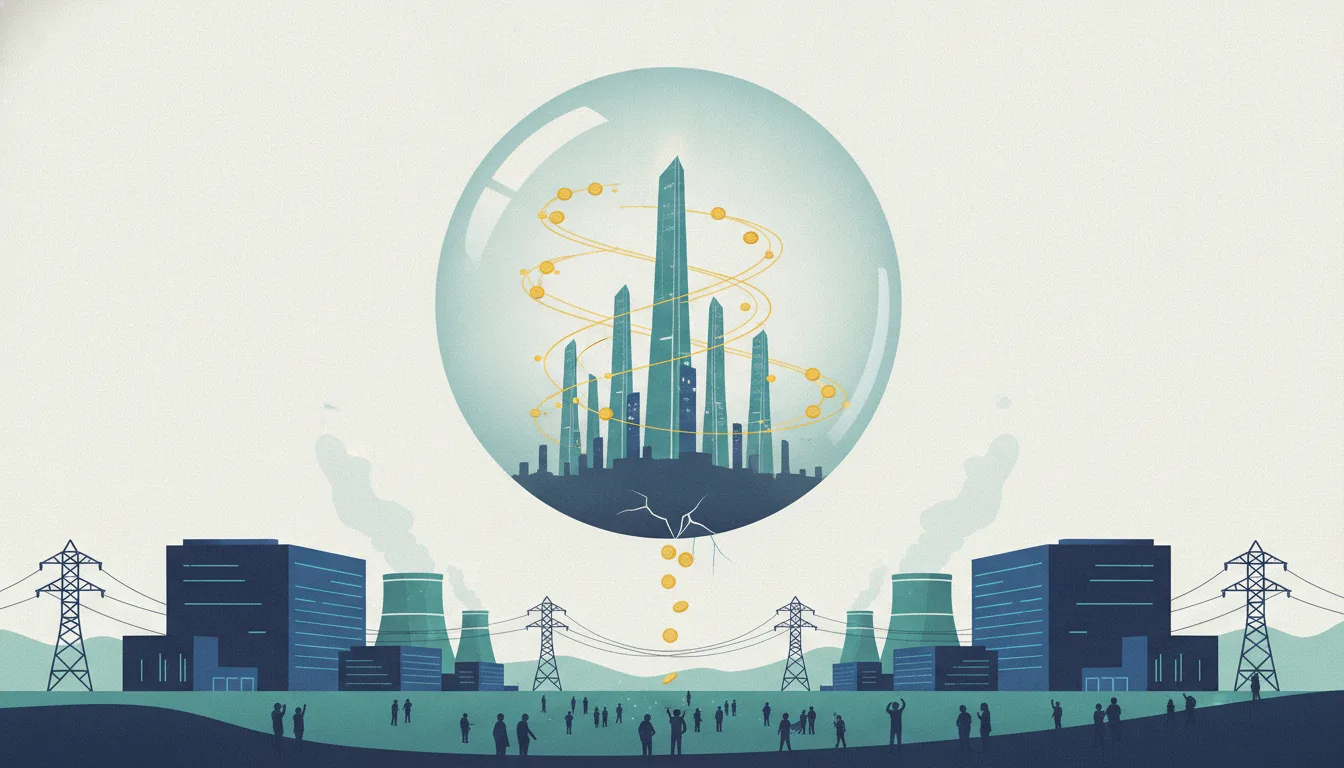
Artificial intelligence (AI) is real, but a handful of companies are spending far more on it than it earns, often with each other's money and more and more with borrowed money. This post maps who pays whom, separates what is true from what is hype, and ends with a forecast.
This post reflects the situation in early November 2026. The numbers change every quarter, and many of them are company statements or press reports, not audited accounts. It is an explanation, not investment advice.
The picture in four answers
Four questions explain most of the story.
- Is AI real? Yes. Hundreds of millions of people use it every week, and the companies that sell it are growing faster than almost any business in history.
- Does AI earn enough to pay for what is being built? No, not yet. The biggest technology companies will spend well over half a trillion dollars on buildings and chips in 2026. The two biggest AI labs earn at a rate of about $115 billion a year.
- So how is the spending paid for? In four ways: the profits of the biggest technology companies, investors, deals where companies fund their own customers, and more and more debt.
- Will it burst? Probably not as a sudden end of AI. The more likely risk is that some of the borrowers cannot pay, lenders stop lending, and spending falls hard for a year or two. The technology survives; some investors lose.
The rest of the post builds this picture step by step. It starts with what the word "bubble" actually means.
What "bubble" means
A bubble is a period when the price of something rises much faster than the real value behind it, because people expect the price to keep rising. When that expectation breaks, the price falls fast.
There are two different kinds, and the AI debate often mixes them up:
- A price bubble. Shares of a company cost far more than its future profits can justify. When the bubble ends, shareholders lose money, but the company may be fine.
- A building bubble. Companies build far more of something (railways, telephone cables, data centres) than people will pay to use in the near future. When it ends, the builders cannot pay back their loans, and the extra capacity sits empty for years.
History shows that a technology can be real and still produce both kinds of bubble.
In the 1840s, Britain built far more railway lines than it needed and many railway investors were ruined, but the railways stayed and changed the country. Around the year 2000, telephone companies laid huge amounts of glass cable (fibre optics) for the internet. In 2002, carriers used only about 2.7% of the capacity of the cables that were switched on[1]. Many of those companies went bankrupt. The cables stayed in the ground and, ten years later, carried YouTube and Netflix. The people who built the internet lost money; the people who used it later got it almost for free.
With these two kinds in mind, the next step is to meet the companies.
Who is who
The AI business is a stack of layers, and money flows down the stack. People and businesses pay the AI companies; the AI companies pay the clouds; the clouds pay the chip makers.
- AI labs build the models, the programs behind chat assistants. The biggest are OpenAI (maker of ChatGPT), Anthropic (maker of Claude) and xAI (maker of Grok). Google and Meta also build their own models.
- Clouds own the data centres: huge buildings full of computers that they rent out. The biggest are Microsoft, Amazon (through Amazon Web Services, AWS), Google and Oracle. Meta builds data centres only for itself. CoreWeave is a newer company that does only AI data centres, one of the so-called "neoclouds".
- Chip makers design the processors that train and run the models. Nvidia sells the graphics processing units (GPUs) that dominate the market. AMD (Advanced Micro Devices) makes rival GPUs. Broadcom builds custom chips for others, such as Google's tensor processing units (TPUs). Almost all of these chips are manufactured by one company in Taiwan, TSMC (Taiwan Semiconductor Manufacturing Company).
- Power and buildings: utilities, grid operators and builders who provide electricity, land and cooling.
- Money: the profits of the biggest technology companies (often called "Big Tech"), investors such as the Japanese group SoftBank and the Abu Dhabi fund MGX, and lenders: banks, bond buyers and private credit funds (investment funds that lend directly to companies instead of through a bank).
The important detail is that some companies sit in more than one layer. Google, for example, is a lab, a cloud and a chip designer at the same time. That is why the money does not only flow down. The next section shows how much of it there is.
How much they are spending
The key word here is capital expenditure, usually shortened to capex: money spent on things that last for years, such as buildings, machines and chips. For the big technology companies, almost all new capex now goes to AI data centres.
The numbers grew very fast. Alphabet (Google's parent company) spent $52.5 billion in 2024 and $91.4 billion in 2025[2]; for 2026 it expects $195–205 billion[3]. Amazon went from $83 billion to $131.8 billion[4] and expects about $220 billion in 2026[5]. Meta went from $39.2 billion to $72.2 billion[6] and expects $135–145 billion[7]. Added together, these three companies roughly tripled their spending in two years:
Microsoft and Oracle are not included in these numbers. Microsoft spent $45.2 billion in the three months from July to September 2026 alone[8]. Oracle spent $55.7 billion in its last financial year, 162% more than the year before[9]. All the big companies have said they will spend even more in 2027.
These sums are now big enough to change the growth of the whole United States (US) economy. Gross domestic product (GDP) is the total value of everything a country produces in a year. The bank Wells Fargo estimated that AI capex was 2.4% of US GDP in early 2026, and that it caused 42% of the economy's growth in that quarter[10].
A study for the Brookings Institution compared the AI build-out with earlier booms, as a share of GDP per year[11]:
If the projections hold, the AI build-out will be bigger, relative to the economy, than the railways or the internet. That alone does not make it a bubble. It does mean that a lot of money has to come from somewhere, and that it has to earn a lot to be paid back. The next section follows where it comes from.
The money map: who pays whom
The most unusual feature of this boom is the circular deal. In a circular deal, company A gives money to company B, and company B uses that money to buy products from company A. Company A then reports the purchase as sales.
This is not illegal, and it is not new: suppliers have long lent money to customers. The risk is that it makes demand look bigger and safer than it is, because part of the demand is the supplier's own money coming back.
The OpenAI web
OpenAI is at the centre of the biggest web of these deals. The main ones are:
- Microsoft owns about 27% of OpenAI. As part of the same deal, OpenAI promised to buy $250 billion of Microsoft's cloud services[12].
- Nvidia announced in September 2025 that it would invest "up to" $100 billion in OpenAI. In February 2026 Nvidia's boss, Jensen Huang, said "it was never a commitment"[13]. Nvidia then put $30 billion into a $122 billion funding round that valued OpenAI at $852 billion (the price of the whole company implied by the deal), next to Amazon (up to $50 billion) and SoftBank ($30 billion)[14]. Nvidia also guarantees rent (lease) payments for OpenAI data centres of up to $105 billion: if OpenAI does not pay the rent, Nvidia does[15].
- AMD agreed to supply 6 gigawatts (GW) of chips, and gave OpenAI the right to buy up to 160 million AMD shares for almost nothing if targets are met[16]. In other words, the supplier pays its customer in its own shares.
- Broadcom will build 10 GW of chips designed by OpenAI, from 2026 to 2029[17].
- Oracle signed a contract reported at about $300 billion over five years, starting in 2027[18].
- CoreWeave has contracts with OpenAI worth $22.4 billion, and Nvidia owns part of CoreWeave and bought another $2 billion of its shares in January 2026[19].
A gigawatt is a unit of power: one billion watts, roughly what a large power station produces. It has become the industry's way to measure the size of a data centre.
All these promises together are enormous. In late 2025 OpenAI's boss, Sam Altman, spoke of about $1.4 trillion of computing commitments. In February 2026 OpenAI reset the plan to "around $600 billion" by 2030. Its revenue in 2025 was $13 billion[20].
The Anthropic triangle
Anthropic has a smaller web, built around three clouds at once:
- Amazon invested $8 billion, then $5 billion more, with up to $20 billion more later. Anthropic promised to spend more than $100 billion on Amazon's cloud over ten years[21].
- Google and Broadcom will supply about 3.5 GW of TPU chips from 2027[22].
- Microsoft and Nvidia invest up to $5 billion and up to $10 billion. Anthropic promised to buy $30 billion of Microsoft's cloud[23].
The International Monetary Fund (IMF), the global body that watches financial stability, counted 14 circular deals since 2023. Together they involve about $300 billion of investment and $650 billion of debt, backing $1.4 trillion of promised future purchases[24]. Much of what looks like customer demand for AI is the same few companies promising to buy from each other.
These promises still have to be paid in real money. The next section looks at who provides it.
Who is putting money in
The money comes from four places, from the safest to the riskiest.
1. The profits of the biggest technology companies. Microsoft, Alphabet, Amazon and Meta earn huge profits from advertising, software and cloud services. Most of their AI spending still comes from this cash. This is the healthiest source: if the bet fails, their shareholders lose, but nobody else has to be repaid.
2. Investors. AI labs lose money, so they sell shares. Besides the OpenAI round above, Anthropic raised money at a valuation of $965 billion in May 2026[25]. Abu Dhabi's MGX closed a $49 billion fund and co-led funding rounds for both OpenAI and Anthropic[26]. Gulf states see AI as a way to turn oil money into a future industry.
3. Debt. This is the part that grew fastest in 2026, and it matters most, because debt has to be repaid on time whatever happens.
- Bonds. A bond is a loan split into pieces that investors can buy and sell. The big technology companies and Oracle sold more than $180 billion of bonds in US dollars in the first eight months of 2026[27]. Alphabet even sold a bond that will be repaid in 100 years[28]. The Bank of England counts about $450 billion of AI-related debt so far in 2026, more than double the whole of 2025[29].
- Oracle borrowed $43 billion in a year[9] and now has about $125 billion of debt. Its credit rating fell to BBB-, the lowest level that large funds still treat as safe ("investment grade")[30].
- Loans backed by chips. CoreWeave borrowed $8.5 billion with its Nvidia chips as the guarantee[31]. It has about $30 billion of debt in total[32].
- Debt that stays off the books. Meta's Hyperion data centre in Louisiana is owned by a separate company, created for that one project and financed together with the investment firm Blue Owl with $27 billion. Meta keeps about 20% of it and rents the rest[33]. The debt does not appear as Meta's own debt, even though Meta is the only tenant.
4. Ordinary people, without knowing it. Much of people's pension savings sits in index funds, which simply buy every company in a stock market index. The seven biggest US technology companies (Apple, Microsoft, Alphabet, Amazon, Meta, Nvidia and Tesla, often called the "Magnificent Seven") are about 35% of the S&P 500 (Standard & Poor's 500), the main index of the 500 biggest US companies[34]. US life insurers hold $85.2 billion of AI-linked investments, up 24% in 2026[35].
So the money is real, and much of it comes from strong companies. That is the first thing the critics often miss. The next section lists what else is true.
What is true
The numbers do not support the idea that AI is a passing fashion.
- People use it. ChatGPT had 900 million weekly users and 50 million paying subscribers in February 2026[36].
- Revenue grows very fast. Companies this young usually report a revenue rate (or "run-rate"): the revenue of the latest month multiplied by twelve. It shows the direction, but it is not what the company earned in a year, and it says nothing about profit. Anthropic's revenue rate passed $65 billion a year in July 2026, up from about $30 billion in April[25]. OpenAI's was about $50 billion at the end of September[37]. Companies spent $37 billion on generative AI in 2025, more than three times the $11.5 billion of 2024[38].
- The clouds are growing again. Microsoft's cloud, Azure, grew 48% in a year[8], and Amazon's cloud 39%[5]. Nvidia's data-centre sales were $89 billion in one quarter, more than double a year earlier[39].
- Businesses are adopting it. In the US Census Bureau's survey, the share of firms that used AI doubled, from about 10% in late 2025 to about 20% in early 2026[40]. Part of the jump comes from a wider question: since November 2025 the survey asks about AI in any part of the business, not only in making products.
- It gets much cheaper. The price of getting the same quality of answer falls between 9 and 900 times per year, depending on the task[41].
- Some gains are measurable. The Stanford AI Index 2026 reports gains of about 26% in software development and 50% in marketing output where AI is used[42].
- Share prices are high, but not crazy like 2000. In 2000, investors paid about 135 times Cisco's expected yearly profit for its shares[43]. In October 2026 they paid about 25 times Nvidia's[44]. Different sources give between 17 and 48 for Nvidia, but all are far below Cisco in 2000.
The technology is real, the demand is real, and the biggest buyers can afford to lose a lot. That is why "AI is a bubble" and "AI is the future" can both be partly true. The next section looks at the claims that the evidence does not support.
What is hype or misleading
Some popular claims are wrong in one direction, some in the other. Three terms help to read them.
- Commitment: a promise to buy in the future. Some are binding contracts; many are letters of intent that can be changed.
- Operating loss: what a company loses from its normal business, before interest and taxes.
- Pilot: a small trial of a tool inside a company, before deciding whether to use it everywhere.
| Claim | What the evidence says | Verdict |
|---|---|---|
| "95% of AI projects fail" | A Massachusetts Institute of Technology (MIT) report said 95% of company pilots showed no measurable profit[45]. It counted any pilot not fully deployed as a failure, and its data was never published[46] | |
| "AI already makes everyone much more productive" | Workers who use it save about 5% of their hours, but across all workers it is 1.4%[47]. Only 39% of firms see any profit effect, and most of those see under 5%[48] | |
| "AI makes developers slower" | A 2025 study found experienced developers 19% slower[49]. Its 2026 update pointed to about 18% faster, with wide uncertainty, and its authors now call the old result out of date[50] | |
| "OpenAI has $1.4 trillion of deals" | Reset to about $600 billion by 2030[20]; Nvidia's "$100 billion" was "never a commitment"[13] | |
| "AI revenue is $X billion" | Usually a revenue rate. OpenAI's was about $20 billion lower once counted a different way[51]. In April–June 2026 it earned $6.7 billion and had an operating loss of $12.3 billion[52] | |
| "It's just the dot-com bubble again" | The buyers are profitable giants and share prices are far lower relative to profits. But the debt is new, and so is the circular money | |
| "There is no bubble" | The Bank of England, the IMF and the bosses of OpenAI and Google all say parts of the market are overheated[29][24][53][54] |
Even the insiders say it. In 2025 Sam Altman said: "When bubbles happen, smart people get overexcited about a kernel of truth"[53]. Google's boss, Sundar Pichai, said that "no company" would be immune if it burst[54]. JPMorgan's boss, Jamie Dimon, spoke of "too much exuberance" in May 2026[55].
The honest summary is that AI is real and the revenue is real, but the revenue is far smaller than the spending. The next section asks how a gap that large is kept open.
How the spending is kept going
The gap is the centre of the whole debate. In 2026, Alphabet, Amazon and Meta alone plan to spend about $560 billion. OpenAI and Anthropic, the two biggest AI labs, have a combined revenue rate of about $115 billion.
The comparison is rough: the clouds also earn from AI, and chips last more than a year. But it shows the size of the gap. The consulting firm Bain calculated that AI companies need $2 trillion of yearly revenue by 2030 to pay for the computers being planned, and that they will be about $800 billion short even counting the money AI saves[56].
Four mechanisms keep the spending going while the gap stays open.
1. Profits from other businesses. Advertising and cloud pay for most of the capex at Alphabet, Amazon, Meta and Microsoft. Oracle shows the limit of this: its spending went far beyond its cash, and in its last financial year it spent $23.7 billion more than it brought in[9]. Companies without a big profitable business behind them have to borrow.
2. The loop of share prices. Nvidia sells chips and reports record sales. Its share price rises, which makes the company worth nearly $6 trillion[57]. A high share price makes it easy to invest in customers and to guarantee their debts, as Nvidia does for OpenAI's leases. Nvidia's own promises to buy parts and supplies grew from $119 billion to $279 billion between January and July 2026[15]. The loop works in both directions: if the share price falls, the investments shrink too.
3. Debt that looks safe. Lenders accept the chips as a guarantee, and the contracts with big names (Microsoft, OpenAI, Meta) as proof that the money will come back. When the guarantee is a contract with a lab that loses money, the safety depends on the lab raising more money in the future.
4. Generous accounting. When a company buys a chip, it does not count the whole price as a cost at once. It spreads the cost over the years it expects to use the chip, which is called depreciation. The longer the expected life, the smaller the yearly cost and the higher the profit. Meta now expects its servers to last 5.5 years instead of 4, which lowered its 2025 costs by about $2.9 billion[58]. The investor Michael Burry estimated that the big companies will count about $176 billion less cost than they should between 2026 and 2028, because AI chips become out of date in two or three years[59]. That is his estimate and nobody has confirmed it, but the question is fair: Nvidia releases a new, much faster chip every year.
None of these mechanisms is a fraud, but all four make the spending look safer than it is, and all four work only while money keeps arriving. Even if the money keeps arriving, there are physical limits, which the next section covers.
The physical limits: electricity, chips and memory
Money can be raised in a week. A power station takes years.
The International Energy Agency (IEA) expects data centres to use about 950 terawatt-hours (TWh) of electricity in 2030, more than double the 415 TWh of 2024[60]. A terawatt-hour is a billion kilowatt-hours; 950 TWh is close to the whole yearly electricity use of Japan.
The bottlenecks are physical:
- Connections to the grid. New large users wait 5 to 10 years to be connected in many places[60].
- Equipment. Large transformers take 2 to 3 years to deliver, gas turbines about 5[60]. Siemens Energy alone has 69 GW of turbines waiting to be built[61].
- Capacity on the grid. PJM (named after Pennsylvania, New Jersey and Maryland), the operator of the electricity grid for 13 states in the eastern US, held its auction for 2027–2028 power. The price hit the maximum allowed, and it still came out 6,623 megawatts short of what it needs to be reliable. Almost all of the expected growth in demand comes from data centres[62].
- Memory. Prices for memory chips rose about ten times between late 2024 and early 2026, and the special memory that AI chips need is now the main limit on how many AI servers can be built[60]. Amazon raised its 2026 spending plan by $20 billion mainly because of memory prices[63].
- Water. US data centres used about 64 billion litres of water directly in 2023, and that could double or quadruple by 2028[64].
These limits have two effects. They slow the building down, which makes overbuilding less likely. But they also raise the cost of each data centre, and they push part of that cost onto everyone else, which leads to the blind spots.
Blind spots
Most of the debate is about share prices: is Nvidia overvalued, will the Nasdaq fall? These are the questions that get less attention.
- The risk is in the debt, not in the shares. A fall in share prices hurts shareholders. A debt that cannot be paid spreads to banks, funds and insurers. Credit default swaps (CDS) are a kind of insurance against a borrower not paying; their price shows how risky the market thinks a borrower is. In October 2026 the price of this insurance on CoreWeave's debt implied a more than 60% chance of default within five years[32]. Oracle's reached a record in August[30]. The first signs of trouble in this boom are appearing in the debt markets, not in the stock market.
- Your pension and your insurance already own it. With a third of the S&P 500 in seven companies, a large part of the savings of anyone with an index fund depends on AI. The IMF warns that pension funds and insurers depend on the same few asset managers (firms that invest other people's money) that finance the data centres[24].
- Your electricity bill pays part of it. The US Energy Information Administration expects household electricity to cost about 5% more in 2026 and more again in 2027[65]. How much of that comes from data centres is disputed, but the PJM auction shows that data centres raise the price of reserve power for everyone on the grid[62].
- Cheaper AI is bad news for the builders. Falling prices are great for users. But the data centres were financed on the assumption that AI will earn a lot per answer. In one week of September 2026, models from Chinese labs, which are free to download, handled 69% of the traffic on OpenRouter, a popular service that sends requests to many models[66]. OpenRouter is not the whole market, but if good-enough AI becomes almost free, the money to repay the debt has to come from somewhere else.
- Chips age faster than buildings. A data-centre building lasts 25 years or more; a chip is out of date in a few years. A loan backed by the building is fairly safe; a loan backed by last year's chips is much less so. Much of the new lending is backed by chips.
- The US economy depends on it. If AI capex is between a third and a half of US growth[10][67], a sharp cut in spending would slow the whole economy, even if AI itself keeps working well.
- Young workers feel it first. Workers aged 22 to 25 in the jobs most exposed to AI are 19% behind similar workers in less exposed jobs[68]. The Stanford AI Index counts almost 20% fewer software developers of that age than in 2024[42].
- States have other goals. Gulf funds invest for strategic reasons, not only for profit, so they may keep paying when private investors stop. But they also have limits: Saudi Arabia's fund told its companies, including the AI company Humain, to rely less on it as oil money gets tighter[69].
- Europe is mostly a customer. The European Union's (EU) plan for AI "gigafactories" expects up to €10 billion of public money to attract €20 billion or more of private money[70]. That is less than what Amazon alone spends in one quarter. If there is a crash, Europe loses less; if there is not, it owns less of the result.
These blind spots shape the forecast. The question is not "is AI real?" but "can the debt be repaid on time?".
How we got here
The timeline shows how fast the story moved, and that worries started early. Already in October 2025, the IMF and the Bank of England warned that AI share prices could fall sharply[71].
In June 2024 the investor David Cahn, at Sequoia Capital, asked who would earn the $600 billion of revenue needed to pay for the AI data centres being built[72]. In January 2025 the Chinese lab DeepSeek released a cheap model nearly as good as the best American ones, and Nvidia lost about $600 billion of value in one day[73]. Its shares recovered later that year. In late July 2026, chip makers lost $1.3 trillion in four days[74], and by October global credit markets were at their most nervous since May 2025[75]. In the same month, fund managers in Bank of America's survey ranked an "AI bubble" as the second biggest risk to markets, and 45% expect it to burst in 2027[76].
Each scare so far ended with prices recovering and spending going up. That is what makes the next two years hard to predict.
A forecast
What follows is my own reading of the evidence, not a certainty. I see three scenarios for 2027 and 2028.
1. A slow cool-down (about 50%). AI revenue keeps growing quickly, but spending grows more slowly from 2027. The weakest builders are bought by stronger ones. Share prices stay roughly flat for a few years while profits catch up, as Microsoft's did after 2000 even though the company kept growing. Most people barely notice.
2. A credit crash (about 35%). A big borrower, such as a neocloud or a lab that misses a funding round, cannot pay. Lenders get scared, the price of debt rises for everyone, and the big companies cut capex by a quarter or more for a year or two. AI shares fall 30–50%, the US economy slows, and some data centres stand half empty. The technology keeps improving, and a few years later the cheap, idle capacity gets used, just like the fibre after 2002.
3. The boom keeps going (about 15%). AI agents (programs that do whole tasks on their own) start to produce clear profits in many companies, revenue gets on Bain's $2 trillion path, and the debt is repaid on time. The spending will then have been justified.
The signals worth watching, in the order I would check them:
- The price of debt insurance on Oracle, CoreWeave and other AI borrowers. It rises before shares fall.
- The 2027 capex plans of the big companies. All of them currently plan to spend more; a cut by one of them would change the story.
- The losses of OpenAI and Anthropic compared with their revenue, not only the revenue.
- The rental price of old chips. If the chips of two years ago still rent well, the accounting is fine; if prices fall fast, the chip-backed loans are in trouble.
- Power connections. Delays push revenue further away, while the loans keep costing interest.
My bet is that AI will be bigger in ten years than its biggest fans say today, and that many of the people paying for it now will not be the ones who profit from it. That is what happened with the railways and with the internet.
References
- Light Reading, What Fiber Glut? (2002)
- Alphabet, Q4 and fiscal year 2025 results — SEC filing
- CNBC, Alphabet Q3 2026 earnings (28 Oct 2026)
- Amazon, Q4 and full year 2025 results — SEC filing
- CNBC, Amazon Q3 2026 earnings (29 Oct 2026)
- Meta, Q4 and full year 2025 results — SEC filing
- Meta, Q3 2026 results — SEC filing
- CNBC, Microsoft Q1 fiscal 2027 earnings (28 Oct 2026)
- CNBC, Oracle Q4 fiscal 2026 earnings (10 Jun 2026)
- Fortune, Wells Fargo on the AI boom (13 May 2026)
- Stijn Van Nieuwerburgh, The $10 trillion question: financing the AI buildout — Brookings
- Al Jazeera, OpenAI restructures; Microsoft takes 27% stake (28 Oct 2025)
- Fortune, Jensen Huang: the OpenAI investment was "never a commitment" (2 Feb 2026)
- Bloomberg Law, OpenAI valued at $852 billion after closing $122 billion round
- Nvidia, Quarterly report (10-Q) for the quarter ended 26 Jul 2026 — SEC filing
- AMD, AMD and OpenAI announce strategic partnership to deploy 6 gigawatts of AMD GPUs (6 Oct 2025)
- OpenAI, OpenAI and Broadcom announce strategic collaboration (13 Oct 2025)
- Data Center Dynamics, OpenAI signs $300bn cloud deal with Oracle — report (Sep 2025)
- CNBC, Nvidia invests $2 billion in CoreWeave (26 Jan 2026)
- Reuters via Yahoo Finance, OpenAI sees compute spend of around $600 billion (20 Feb 2026)
- Amazon, Amazon invests additional $5 billion in Anthropic (Apr 2026)
- Data Center Knowledge, Anthropic secures multi-gigawatt TPU deal with Google and Broadcom (Apr 2026)
- Reuters via Yahoo Finance, Anthropic commits $30 billion to Microsoft (18 Nov 2025)
- IMF blog, Global financial markets face rising risks from AI, bond yields and cyberattacks (Oct 2026)
- Quartz via Yahoo Finance, Anthropic revenue run rate hits $65 billion (18 Aug 2026)
- CNBC, UAE's MGX closes $49 billion AI fund (1 Jul 2026)
- Vontobel, How hyperscaler issuance is reshaping the Treasury curve (3 Sep 2026)
- CNBC, Big Tech's AI bond binge (23 Feb 2026)
- Bank of England, Financial Policy Committee record, September 2026
- Cestrian Capital Research, Oracle Q1 FY2027: record CDS spreads, $88B net debt (14 Sep 2026)
- CoreWeave, CoreWeave closes $8.5 billion financing facility (31 Mar 2026)
- The Next Web, Huang on CoreWeave as its default insurance hits a record (15 Oct 2026)
- Reuters via Yahoo Finance, Meta's $27 billion financing deal with Blue Owl (21 Oct 2025)
- The Motley Fool, Magnificent Seven share of the S&P 500
- The Royal Gazette, Life insurers' investment exposure to AI spikes 24% (25 Oct 2026)
- TechCrunch, ChatGPT reaches 900M weekly active users (27 Feb 2026)
- Bloomberg via Yahoo Finance, OpenAI expects $70 billion annualized revenue (9 Oct 2026)
- Menlo Ventures, 2025: The state of generative AI in the enterprise
- Nvidia, Financial results for the second quarter of fiscal 2027 (26 Aug 2026)
- Federal Reserve Bank of Minneapolis, AI adoption in business grows steadily but unevenly (2026)
- Epoch AI, LLM inference prices have fallen rapidly but unequally across tasks
- Stanford HAI, AI Index 2026 — Economy
- Yardeni Research, Morning Briefing (14 Mar 2024)
- The Motley Fool, Nvidia in October (8 Oct 2026)
- Fortune, MIT report: 95% of generative AI pilots at companies are failing (18 Aug 2025)
- Arnon Shimoni, MIT's 95% AI failure rate is wrong
- Federal Reserve Bank of St. Louis, The impact of generative AI on work productivity (27 Feb 2025)
- McKinsey, The state of AI (2025)
- METR, Measuring the impact of early-2025 AI on experienced open-source developer productivity (10 Jul 2025)
- METR, Uplift update (24 Feb 2026)
- Yahoo Finance, OpenAI's annualized revenue $20 billion lower than prior investor estimates (8 Oct 2026)
- Enterprise AM, OpenAI's Q2 revenue growth trails Anthropic as losses widen (20 Aug 2026)
- NBC News, Sam Altman sees an AI bubble forming (18 Aug 2025)
- CTV News, Google boss warns no company immune if AI bubble bursts (18 Nov 2025)
- Fortune, Jamie Dimon on exuberance in the stock market (22 May 2026)
- Bain & Company, $2 trillion in new revenue needed to fund AI's scaling trend (23 Sep 2025)
- Quartz via Yahoo Finance, Nvidia stock approaches $6 trillion (6 Oct 2026)
- The Stack, Meta extends server life again, saving it $2.9 billion (30 Jan 2025)
- Fortune, Michael Burry's AI depreciation argument explained (13 Nov 2025)
- International Energy Agency, Key Questions on Energy and AI (Apr 2026)
- Utility Dive, Siemens gas turbine backlog nears 70 GW (10 Aug 2026)
- PJM, Auction procures 134,479 MW of generation resources (17 Dec 2025)
- CNBC, Amazon Q2 2026 earnings (30 Jul 2026)
- The Conversation via Civil Beat, Data centers consume massive amounts of water (25 Aug 2025)
- US Energy Information Administration, Short-Term Energy Outlook: electricity (Oct 2026)
- OpenRouter, The token state of play (22 Sep 2026)
- IndexBox, AI investment drives one third of US GDP growth in 2026 (20 Aug 2026)
- Stanford Digital Economy Lab, Canaries in the Coal Mine (revised 12 Aug 2026)
- Fortune, Saudi Arabia's Humain turns to outside investment (9 Sep 2026)
- European Commission, EU launches AI Gigafactories call (30 Jul 2026)
- CNBC, IMF and Bank of England join growing chorus warning of an AI bubble (9 Oct 2025)
- David Cahn, AI's $600B question — Sequoia Capital (20 Jun 2024)
- CNBC, Nvidia sheds almost $600 billion in market cap (27 Jan 2025)
- CNBC, Chip selloff (29 Jul 2026)
- Bloomberg via Yahoo Finance, AI tech fears push global credit spreads wider (23 Oct 2026)
- Seoul Economic Daily, Wall Street warns of AI bubble but keeps buying tech stocks (25 Oct 2026)