
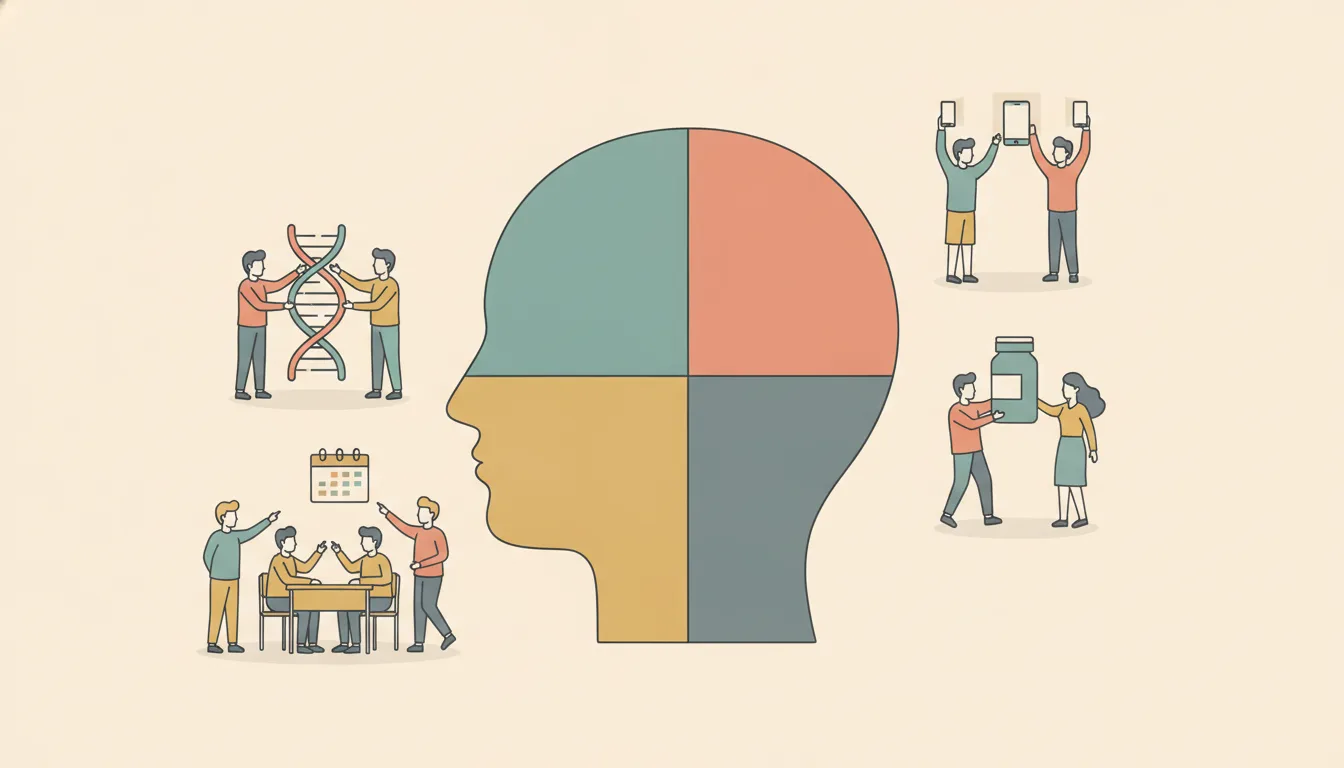
Some people say ADHD (attention deficit hyperactivity disorder) is one of the best-studied conditions in psychiatry. Others say it is a label that turns normal restless children into patients. This post looks at why the argument never ends: it is really four different arguments, and the evidence is strong for some of them and weak for others.
This post is general information about a public debate. It is not medical advice. If you think you or your child may have ADHD, talk to a doctor or a psychologist who can do a proper assessment.
One argument that is really four
When two people argue about ADHD, they often answer different questions without noticing it. One says "ADHD is real, it runs in families". The other says "too many children take pills". Both sentences can be true at the same time, because they answer different questions.
The public fight mixes four separate questions:
- Is ADHD a real condition, or a social label?
- Do too many people get the diagnosis, or too few?
- Are the medicines good for people, and for how long?
- Why are so many adults now diagnosing themselves?
Each question has its own evidence. For some of them, the research gives a fairly clear answer. For others, the research does not have an answer yet. Most of the confusion comes from people who take a clear answer to one question and use it to "win" a different one.
The rest of the post takes the four questions in this order. But first, we need to agree on what the word means.
What ADHD is
ADHD is a pattern of attention problems, restlessness or impulsive behaviour that starts in childhood and causes real trouble in daily life. In Spanish it is called trastorno por déficit de atención e hiperactividad, and in Catalan trastorn per dèficit d'atenció i hiperactivitat. Both use the short form TDAH.
Doctors diagnose it with two official lists of criteria. The first is the DSM-5 (the Diagnostic and Statistical Manual of Mental Disorders, fifth edition, from the American Psychiatric Association). The second is the ICD-11 (the International Classification of Diseases, eleventh edition, from the World Health Organization). Both describe three kinds of symptoms:
- Inattention. Losing focus, losing things, not finishing tasks, not seeming to listen.
- Hyperactivity. Moving all the time, not being able to stay seated, talking a lot.
- Impulsivity. Acting or speaking before thinking, interrupting, not being able to wait.
A person can have mostly the first kind, mostly the second and third, or a mix. Having some of these traits is not enough. The symptoms must be many, must last, must appear in more than one place (for example at home and at school), and must cause clear problems.
There is no blood test and no brain scan that can show ADHD. A doctor makes the diagnosis by interviewing the person, talking to family or teachers, and using questionnaires. This detail matters a lot, because much of the fight comes from it.
How common is it? A large consensus statement signed by 79 experts from 27 countries puts it at about 5.9% of children and teenagers, and about 2.5% of adults[1]. A big review of studies from around the world found that, when researchers use the same method, the share of children with ADHD did not grow over three decades[2]. The number of diagnoses grew a lot in many countries. The number of children who meet the criteria in careful studies did not. Keep that difference in mind: it comes back in almost every section below.
Is it a real condition or a social label?
The research says ADHD is real in one important sense: the traits are measurable, they are strongly inherited, and they predict real problems. But it is also true that the line between "ADHD" and "normal" is drawn by people, not found in nature. Each side of this fight is right about one half.
The case that it is real
The strongest evidence comes from twin studies. Identical twins share all their genes, and non-identical twins share about half. If identical twins are much more alike in a trait, genes must play a big part in it. For ADHD, these studies estimate that about 74% of the differences between people come from genetic differences[3]. That is higher than for most psychiatric conditions, and not far from height.
The same consensus statement lists more evidence[1]. People with ADHD have, on average, more accidents, more school failure, more job loss and more problems with drugs and alcohol than people without it. These are not just opinions from teachers. They show up in large national health records.
The case that it is a label
Critics do not usually say that restless or distracted people do not exist. They say something more careful. The British child psychiatrist Sami Timimi, for example, argued in a published debate that ADHD is best understood as a cultural idea. His opponent in that debate, the ADHD researcher Eric Taylor, argued the opposite[4]. In Timimi's view, modern schools and societies expect children to sit still and focus for long periods. When a child cannot do that, we call it an illness instead of asking whether the expectation is reasonable.
This criticism uses the same fact that doctors accept: there is no test. If the diagnosis depends on how much a behaviour bothers teachers and parents, then culture, school rules and patience all affect who gets it.
Where the two sides meet: a smooth scale
The most useful fact for this fight is that ADHD traits form a continuum (a smooth scale with no natural break). A study of almost 3,000 children and teenagers looked for a clear gap between "people with ADHD" and "people without it". It found no gap. ADHD behaved like a scale that everyone sits somewhere on, like height[5].
This explains why both sides feel right. The traits are real and mostly inherited, so ADHD is "real". But the point on the scale where we say "this is a disorder" is a decision. Height is real too, yet the height at which we call someone "very tall" is a choice. So the honest answer to the first question is: the traits are real, and the line is a human decision. And once you see that the line is a decision, the next question is obvious: are we drawing it in the right place?
Too many diagnoses, or too few?
The evidence says both problems happen at the same time, to different groups of people. Some children get the diagnosis when their behaviour is normal for their age. Other people, especially girls and women, have clear ADHD and are missed for years.
Signs of too many diagnoses
In 2013, the psychologist Keith Conners, one of the people who worked most to make ADHD accepted as a real condition, called the rising numbers in the United States "a national disaster of dangerous proportions"[6]. At that time, about 15% of American children of high-school age had received the diagnosis. That is far above the 5 to 6% that careful studies find.
The clearest evidence of over-diagnosis is the relative age effect (the youngest children in a school class get diagnosed more often). Every school year has a cut-off date. A child born just before it is almost a year younger than a classmate born just after it. At age six, one year is a big difference in how well a child can sit still.
- In British Columbia, Canada, the cut-off is 31 December. A study of almost one million children found that boys born in December were 30% more likely to be diagnosed than boys born in January[7].
- In the United States, many states use 1 September. A study of insurance records found that children born in August were diagnosed more often than children born in September, but only in states with that cut-off[8].
Birthdays do not cause ADHD. So when the month of birth changes the chance of a diagnosis, the most likely explanation is that some teachers and doctors are mistaking normal immaturity for a disorder.
Signs of too few diagnoses
At the same time, many people who clearly have ADHD are missed. Girls are the best-known example. Boys more often show hyperactive behaviour that disturbs a class. Girls more often show the inattentive kind: quiet, dreamy, disorganised. A quiet child who does not finish her homework is less likely to be sent to a doctor than a boy who runs around the classroom. A 2024 review in The Lancet Psychiatry looked at why girls are diagnosed less often and later than boys[9]. It weighed several explanations. Girls often show the symptoms differently and work hard to hide them. Doctors may also explain a girl's problems as anxiety or depression and never check for ADHD. Many of these girls get the diagnosis only as adults.
Both at the same time
These two findings do not cancel each other. They show that the diagnosis goes to the people whose behaviour is most visible, not always to the people who need it most. A loud, young boy is at risk of a wrong diagnosis. A quiet girl is at risk of getting no diagnosis at all. So the question "too many or too few?" has a clear answer: both, in different groups. And the reason the number of diagnoses matters so much is what often comes next: medicine.
The medicines: helpful, harmful, or both?
The research is clear that ADHD medicines reduce symptoms in the short term. It is much less clear about what happens after years of use. Much of this fight comes from mixing up those two time frames.
The main medicines are stimulants. The two families are methylphenidate (sold as Ritalin, Concerta and other names) and amphetamines (sold as Adderall, Elvanse and other names). There are also non-stimulant medicines, such as atomoxetine and guanfacine, which work more slowly.
The short term: strong evidence that they work
A large 2018 analysis combined 133 trials with more than 24,000 children and adults[10]. It compared the medicines with a placebo (a pill with no active drug) over a few weeks. The main medicines all reduced symptoms more than the placebo. The authors recommended methylphenidate as the first choice for children and amphetamines for adults. A 2026 study by a group that included some of the same researchers added that, above a certain dose, a higher dose brings no clear extra benefit[11].
The Cochrane dispute: how good is that evidence?
Cochrane is an independent network known for strict reviews of medical evidence. Its review of methylphenidate in children, last updated in 2025, found that the medicine may improve symptoms and general behaviour, as rated by teachers. It found no clear effect on quality of life[12]. But it rated the certainty of the evidence as very low. The reason is that almost all the trials had a high risk of bias (a weakness in the design that can make a medicine look better than it is). Most trials were short. In many of them, children and parents could probably guess who got the real pill, because stimulants have clear effects such as less appetite. The review also found that children on the medicine had about 23% more mild side effects, such as sleep problems and less appetite, than children on the placebo.
Many ADHD experts strongly disagreed with the first version of this review, from 2015, and the same argument continues today. One critic pointed out that the review rated 96.8% of the trials as having a high risk of bias, while Cochrane's standard method would have rated about 37% that way[13]. Defenders of the medicine also note that, even in Cochrane's own numbers, the average improvement (about 10.6 points on a 72-point symptom scale) is bigger than the 6.6 points usually counted as a change people can notice[12]. This is a real disagreement between serious researchers, not a fight between science and non-science.
The long term: much less clear
The best-known long-term study is the MTA (Multimodal Treatment Study of ADHD). It started as a 14-month trial with 579 children, who were randomly given medicine, behavioural therapy, both, or normal care. After 14 months, the families chose freely, and researchers followed the children for 16 years. In that later, non-random phase, children who kept taking stimulants for years had no fewer symptoms as young adults, and they were on average about 2.5 cm shorter than those who took little or no medicine[14].
Defenders of the medicines point out that this later phase was not a trial. Families that kept using medicine may have had children with more severe ADHD. They also point to other kinds of evidence. A Swedish study of more than 25,000 people with ADHD compared each person with themselves over time. The same people committed fewer crimes in the periods when they were taking medicine than when they were not[15]. That is a strong design, because the person's genes and family do not change between periods.
The table below puts the medicine evidence by time frame.
| Question | What the research shows | Strength of evidence |
|---|---|---|
| Do symptoms improve in the first weeks? | Yes, in children and adults, for all main medicines | |
| Are side effects common? | Yes, but mostly mild: appetite, sleep, headaches | |
| Do higher doses always help more? | No, benefit stops rising above a certain dose | |
| Do people do better in real life while on medicine? | Fewer crimes in the periods on medicine, in large national records | |
| Are people better off after many years? | Unclear, the best long study found no clear benefit |
So the third question has a split answer: the medicines clearly work for weeks and months, and nobody can yet say for sure what they do over a decade. That uncertainty matters even more now that a very different group is asking for them: adults.
Adults, TikTok and self-diagnosis
In the last few years, the number of adults asking for an ADHD assessment has risen very fast. Part of this is people who were missed as children, such as the girls in the earlier section. Part of it is harder to explain, and this is the newest and angriest part of the fight.
Does ADHD even start in adulthood?
The official criteria say ADHD starts in childhood. But a study in New Zealand followed more than 1,000 people from birth to age 38. Of the 31 adults who met the criteria for ADHD, only 3 had had ADHD as children. And the adults did not have the genetic profile linked to childhood ADHD[16]. Some experts replied that childhood symptoms may have been hidden by a supportive family or a clever child. Others think "adult ADHD" may often be a different problem that looks similar, for example anxiety, depression, poor sleep or burnout. The question is still open.
The social media loop
Social media changed how people learn about ADHD. A 2022 study looked at the 100 most popular TikTok videos about ADHD. About half of them were misleading. Most of the misleading ones described common feelings, such as anxiety, mood swings or trouble in relationships, as if they were signs of ADHD only. None of the misleading videos told viewers to get a professional assessment[17].
In the United States, stimulant prescriptions for adults were already rising before 2020. During the COVID-19 (coronavirus disease 2019) pandemic, new rules let doctors prescribe these medicines by video call, and prescriptions rose faster, especially for women aged 15 to 44 and men aged 25 to 44[18]. In October 2022, the FDA (Food and Drug Administration, the United States medicines regulator) announced a shortage of Adderall[19]. For months, many patients, including children who had taken the medicine for years, had trouble filling their prescriptions.
These pieces connect into a loop:
Where the loop goes wrong
Two cases show where this loop can go wrong.
- In the United States, the founder of the online company Done Global was convicted in 2025 and sentenced in 2026 to six years in prison. The company had spent more than 40 million dollars on social media advertising and distributed more than 37 million Adderall pills through quick online appointments, according to the Justice Department[20].
- In the United Kingdom (UK), a BBC (British Broadcasting Corporation) programme in 2023 sent a reporter to three private online clinics. All three diagnosed him with ADHD, even though a psychiatrist from the NHS (National Health Service, the UK's public health system) had found he did not meet the criteria. The programme was also strongly criticised. The charity ADHD Foundation called it poorly researched and sensationalist, and said it ignored why people turn to private clinics in the first place. The Royal College of Psychiatrists said it felt sympathy for people facing very long NHS waits, and asked for more NHS resources and high standards in both public and private clinics[21].
The other side of the loop is just as real. An independent report for NHS England in 2025 found that some people wait more than two years for an assessment, and that waits of 10 to 15 years have been reported in some parts of the UK[22]. When the public system cannot see people, many of them turn to fast private clinics instead. So the fourth question has an uncomfortable answer: the rise in adult diagnoses is partly people who were missed, partly misinformation, and partly a business, and right now nobody can say how big each part is.
What is settled and what is still open
After the four questions, we can put the whole fight on one page. The ratings show how strong the evidence is, not which side is right.
| Question | What the research says | Strength of evidence |
|---|---|---|
| Are ADHD traits real and inherited? | Yes, about 74% of differences come from genes | |
| Is there a clear line between ADHD and normal? | No, the traits form a smooth scale | |
| Are some children diagnosed for being young? | Yes, the youngest in class are diagnosed more often | |
| Are girls and women missed? | Yes, they are diagnosed later and less often | |
| Do the medicines reduce symptoms in the short term? | Yes | |
| Do the medicines help over many years? | Not clear | |
| Is most adult ADHD the same condition as childhood ADHD? | Not clear, some studies suggest it is often different | |
| How much of the rise in adult diagnoses is over-diagnosis? | Unknown, the data is poor |
The pattern is clear. The oldest questions, about whether ADHD exists and whether there is a clear line, have fairly solid answers. The newest questions, about long-term medicine use and the rise in adult diagnoses, are exactly where the evidence is thinnest. That is why the fight is so angry today.
Why both sides are partly right
The ADHD fight lasts because each side is holding a true fact and using it to answer the wrong question. "ADHD is strongly inherited" is true, but it does not prove that every diagnosis is correct. "Too many young children are diagnosed" is true, but it does not prove that ADHD is invented. "The pills work" is true for the short term, and "we don't know the long-term effects" is also true.
A better conversation starts by asking which of the four questions we are talking about. Then we can ask the question that really matters for a person or a family: is this particular person, at this point on the scale, having problems serious enough that a diagnosis and treatment will help more than they harm? No short slogan can answer that question. It needs a careful assessment, time, and a doctor who listens.
References
- Faraone, S. V. et al., The World Federation of ADHD International Consensus Statement: 208 Evidence-based conclusions about the disorder — Neuroscience & Biobehavioral Reviews, 2021
- Polanczyk, G. V. et al., ADHD prevalence estimates across three decades: an updated systematic review and meta-regression analysis — International Journal of Epidemiology, 2014
- Faraone, S. V. & Larsson, H., Genetics of attention deficit hyperactivity disorder — Molecular Psychiatry, 2019
- Timimi, S. & Taylor, E., ADHD is best understood as a cultural construct — The British Journal of Psychiatry, 2004
- Haslam, N. et al., The latent structure of attention-deficit/hyperactivity disorder: a taxometric analysis — Australian & New Zealand Journal of Psychiatry, 2006
- Schwarz, A., The selling of attention deficit disorder — The New York Times, 2013 (reprinted by the Austin American-Statesman)
- Morrow, R. L. et al., Influence of relative age on diagnosis and treatment of attention-deficit/hyperactivity disorder in children — Canadian Medical Association Journal (CMAJ), 2012
- Layton, T. J. et al., Attention Deficit–Hyperactivity Disorder and Month of School Enrollment — The New England Journal of Medicine, 2018
- Martin, J., Why are females less likely to be diagnosed with ADHD in childhood than males? — The Lancet Psychiatry, 2024
- Cortese, S. et al., Comparative efficacy and tolerability of medications for attention-deficit hyperactivity disorder in children, adolescents, and adults — The Lancet Psychiatry, 2018
- Nourredine, M. et al., Pharmacological interventions for ADHD: a systematic review and dose–effect network meta-analysis — The Lancet Psychiatry, 2026
- Storebø, O. J. et al., Methylphenidate for children and adolescents with attention deficit hyperactivity disorder (ADHD) — Cochrane Database of Systematic Reviews, 2025
- Methylphenidate for ADHD: have Cochrane got it wrong? — The Mental Elf (National Elf Service)
- Swanson, J. M. et al., Young adult outcomes in the follow-up of the multimodal treatment study of ADHD: symptom persistence, source discrepancy, and height suppression — Journal of Child Psychology and Psychiatry, 2017
- Lichtenstein, P. et al., Medication for Attention Deficit–Hyperactivity Disorder and Criminality — The New England Journal of Medicine, 2012
- Moffitt, T. E. et al., Is Adult ADHD a Childhood-Onset Neurodevelopmental Disorder? Evidence From a Four-Decade Longitudinal Cohort Study — American Journal of Psychiatry, 2015
- Yeung, A., Ng, E. & Abi-Jaoude, E., TikTok and Attention-Deficit/Hyperactivity Disorder: A Cross-Sectional Study of Social Media Content Quality — The Canadian Journal of Psychiatry, 2022
- Danielson, M. L. et al., Trends in Stimulant Prescription Fills Among Commercially Insured Children and Adults — United States, 2016–2021 — Centers for Disease Control and Prevention (CDC), Morbidity and Mortality Weekly Report, 2023
- FDA Announces Shortage of Adderall — U.S. Food and Drug Administration, 2022
- Founder/CEO and Clinical President of Digital Health Company Sentenced to 72 Months and 24 Months, Respectively, for $90 Million Scheme to Distribute over 37 Million Pills of Adderall — U.S. Department of Justice
- RCPsych responds to BBC Panorama programme on ADHD assessments — Royal College of Psychiatrists, 2023
- Report of the independent ADHD Taskforce: Part 2 — NHS England, 2025