FC Barcelona's leaders made some very expensive mistakes, yet the club's youth academy, La Masia, is producing world-class players again. Its story shows how the people who do the daily work can keep an institution or a company good when the people at the top fail.
Two groups of people in every institution
Every institution has two groups of people, and they do different jobs.
The first group is the people at the top: a president, a board, the managers of a company. They decide where the money goes and what the rules are. They usually stay for a few years and then leave.
The second group is the people who do the daily work: coaches, scouts, teachers, nurses, engineers, families, volunteers. They usually stay much longer. They know how the work is really done, and they teach it to the people who come after them.
Most of the time we judge an institution by the first group, because they are the ones in the news. This post argues that the second group often matters more. When the people at the top make bad decisions, the people who do the daily work can keep the institution good for a long time. They can't do it forever, and they can't fix everything. But they can do much more than we usually think.
The example in this post is La Masia, the youth academy of FC Barcelona (often called Barça). The club went through a serious crisis at the top, and its academy came out of it producing some of the best young players in the world.
What La Masia is
La Masia is the name of FC Barcelona's youth academy: the system that finds talented children, trains them, and tries to turn some of them into professional players.
The name comes from a building. La Masia de Can Planes is an old masia, the Catalan word for a traditional country house, next to the club's stadium. On 20 October 1979, the club opened the masia as a home for young players who came from outside Barcelona. The idea was proposed to the president of the time, Josep Lluís Núñez, by Jaume Amat. A club employee, Oriol Tort, was put in charge[1].
In 2011, the young players left the masia and moved to a new building at the club's training ground. It is named after Oriol Tort, the man who ran the masia.
Most young players who enter an academy never play for the first team, and La Masia is no exception. Between 1979 and 2009, about 40 of its 440 residents reached Barça's first team[1]. What makes La Masia special is not that every child succeeds. It is that, for long periods, enough of them became the core of one of the best teams in the world.
A popular story says the Dutch star Johan Cruyff suggested La Masia, copying the academy of his old club, Ajax. The sources do not support it. Wikipedia credits Jaume Amat with the proposal, and links Cruyff to the style of play, not to the building[1].
A building is not a method, though. The method came from a few coaches.
The coaches who built the method
La Masia's way of playing was not designed by a president. It was built by coaches, over many years, and passed from one group of children to the next.
The first important coach was Laureano Ruiz. He arrived in 1972 and coached the youth teams for several years. At that time, the club preferred tall, strong boys. Ruiz remembers a sign at the club that turned away boys shorter than 1.80 metres[2]. He preferred players who were good with the ball. He said: "If we dedicate ourselves to running, when are we going to learn to play?"[3] His teams won five national youth titles in a row[3]. He got the youth teams he coached and Barça Atlètic (the club's reserve team) to play his system, but not the whole club[4].
The person who spread the style through the whole club was Johan Cruyff, who coached the first team from 1988 to 1996. Ruiz himself says it was Cruyff who made all the club's teams play the same way[2]. Cruyff's team won four league titles in a row and, in May 1992, the club's first European Cup[5][6]. He also gave first-team places to young players from the academy, including Pep Guardiola[5].
Cruyff was a boss in one sense: he had authority over every team. But he was not a president or a board member. He was a coach, working every day on the training pitch. That difference is the whole point of this post.
The players who grew up in this system describe it as a way of thinking, taught from childhood. Xavi Hernández, who arrived at 11, said in 2010: "the football philosophy of this club was drilled into me from the off… We were taught to play triangles and move the ball around."[7] A club director described Cruyff's idea as "always about the technique of the children, the speed of the pass, the speed of the mind"[8].
The method also outlived the people who started it. Coaches who came through it trained the next coaches. Joan Vilà, the club's director of methodology from 2011 to 2018, described what Ruiz and Cruyff left behind: "They made it clear we had to trust ourselves"[9]. And he summed up the method in one line: "join the players' talent with an idea of play. Talent cannot go alone"[9].
This loop is why the method survives when a president leaves. The idea of play is not written in a contract or a board decision. It lives in the heads of coaches who learned it as children.
The results came at the end of the 2000s, under Guardiola, by then the first-team coach:
- In 2009, the first team won six titles in one calendar year, the first club to do so[10].
- The Ballon d'Or is the most famous individual prize in football. In the 2010 vote, the top three were Lionel Messi, Andrés Iniesta and Xavi. It is the only time all three places went to players trained in the same club's academy[11].
- On 25 November 2012, against Levante, Barça played for about 45 minutes with eleven academy players on the pitch at the same time[12].
That is the success. The next question is what the people at the top did while it was being built.
What the people at the top did
The people at the top of Barça did not create La Masia's method, but they did not only damage it either. The record is mixed, and it is fair to show both sides.
FC Barcelona is not owned by a company or a rich family. It is owned by its members, called socis, who pay a yearly fee and elect the president[13]. The president and the board run the club's money, sign players and hire coaches. Some of their decisions helped the academy:
- In 1968, president Narcís de Carreras said the club was "more than a club" (més que un club). It became the club's motto and part of its identity[14].
- In 1979, Núñez's board opened the masia as a residence[1].
- In 1988, the same board hired Cruyff as first-team coach[5].
Many of their decisions damaged it:
- 1996: Cruyff is sacked. Núñez had already been talking to a replacement. His vice-president, Joan Gaspart, went to see Cruyff, the meeting turned into an argument, and Cruyff was sacked on the spot. Cruyff said: "They did not even let me say goodbye."[15]
- 2014: a ban from FIFA (Fédération Internationale de Football Association), the body that governs world football. It found that Barça had broken the rules on signing players under 18 from abroad, in the cases of ten children, from 2009 onwards. The club could not sign any player for two transfer windows[16].
- 2017–2019: huge spending on players from other clubs. Under president Josep Maria Bartomeu, the club paid €105 million for Ousmane Dembélé, €118.4 million for Philippe Coutinho and €120 million for Antoine Griezmann[17].
- 2018: the head of the method leaves. Joan Vilà's contract was not renewed. Xavi said: "I am very worried about him leaving the club."[18]
- 2020: "Barçagate". The club paid a company €980,000 for social media campaigns that protected Bartomeu's image and attacked his critics[19]. Bartomeu and his whole board resigned in October 2020[20].
- 2021: the bill arrives. The new president, Joan Laporta, said the club had a debt of €1.35 billion and that salaries cost 103% of the club's income[21]. That same month, Lionel Messi left, because the club could not afford to keep him under the league's rules[22].
- 2022: selling the future. To get money quickly, the club sold 10% of its league television (TV) income for the next 25 years for €207.5 million. The members approved it in a special assembly[23].
Talent also left along the way. Cesc Fàbregas, Gerard Piqué and Jordi Alba all left the academy young, became stars elsewhere, and were later brought back[24]. Dani Olmo left at 16 and came back in 2024 for a reported €60 million[25].
| Year | Decision at the top | Effect on the academy |
|---|---|---|
| 1968 | "More than a club" becomes the motto | |
| 1979 | The masia opens as a residence | |
| 1988 | Cruyff is hired as coach | |
| 1996 | Cruyff is sacked | |
| 2014 | FIFA bans the club from signing players | |
| 2017–2019 | Over €340 million on three players from other clubs | |
| 2018 | The head of the method leaves | |
| 2021–2022 | Debt revealed, Messi leaves, future TV income sold |
The pattern is clear. The good decisions mostly gave the coaches a place to work and room to do it. The bad decisions were mostly about money, image and short-term results. And the worst crisis, at the end of the table, turned out to be the academy's best chance.
The crisis that proved the point
When the money ran out in 2021, the club could no longer buy finished stars. It had to look at what it already had. The academy was ready, because the coaches had kept working through the bad years.
The best-known result is Lamine Yamal. He joined La Masia in 2014 and played his first first-team match on 29 April 2023, at 15 years old. At Euro 2024 he won the European Championship with Spain and was named the tournament's best young player. He won the Kopa Trophy, the prize for the best player under 21, in 2024 and 2025, the first player to win it twice[26]. In the 2025 Ballon d'Or vote, he finished second[27].
He is not alone:
- In the 2024/25 season, the club won the league, the cup and the Spanish Super Cup. Seven academy players made their first-team debut that season, and the coach, Hansi Flick, gave real playing time to young players such as Gavi, Fermín López, Pau Cubarsí and Alejandro Balde[28].
- By May 2026, thirteen academy players had made their first-team debut under Flick[29].
- In 2025/26, players born in Catalonia played 49.2% of the first team's minutes, the highest share since 1970–71[30].
- In July 2026, Yamal and Cubarsí started for Spain in the World Cup final, which Spain won 1–0 against Argentina[31].
Outside experts see the same thing. The CIES Football Observatory, part of the International Centre for Sports Studies (CIES, from its French name) in Switzerland, ranks academies by how many professional players they produce and at what level. In October 2025, it ranked La Masia second in the world[32]. In January 2026, it calculated that the players trained at La Masia were worth €738 million together, more than any other academy[33].
None of this was planned by the board that created the debt. The crisis did not build the academy. It removed the alternative, and the academy that the coaches had kept alive was there to fill the gap.
Why the people who do the work can carry an institution
The La Masia story is not unusual. Research on organisations explains why the people who do the daily work often matter more than the people at the top. Three reasons stand out.
1. The most important knowledge lives in people, not in documents. The philosopher Michael Polanyi wrote that "we can know more than we can tell"[34]. He called this tacit knowledge: knowledge you have but cannot fully write down, like how to ride a bike. How to teach a ten-year-old to see a pass before the ball arrives is tacit knowledge. A new president cannot change it with a decision, and cannot buy it either. It moves from coach to child, one training session at a time.
2. Culture is stronger than any single leader. Culture is the shared habits and beliefs of a group: "this is how we do things here". Edgar Schein, one of the best-known researchers on organisational culture, wrote: "If you do not manage culture, it manages you."[35] At La Masia, the culture of "play the ball, think fast" was strong enough that boards had to live with it, even when they did not understand it.
3. The people at the top explain less than we think. Researchers have measured how much of the difference between companies' results comes from their chief executive officer (CEO), the person who runs the company. A 2015 study by Timothy Quigley and Donald Hambrick looked at sixty years of data from thousands of American companies[36]. The share explained by the CEO grew from about 6 to 8% in the 1950s and 1960s to about 25% today[37]. That is a real effect, and it is growing. But it also means about three quarters of the difference comes from other things: the industry, the economy, and the company itself, with its people and its habits.
There is a fourth reason that is special to Barça: the people at the top can be removed. The club has 151,787 members (as of June 2026)[38]. They elect the president, and the club's history shows they use that power. Bartomeu resigned under pressure in 2020[20]. Laporta was re-elected in March 2026 with 68% of the votes[39]. Members who care about the club are part of the second group too. They are the ones who stay.
Other places that work the same way
La Masia is a football example, but the same pattern appears in factories, cooperatives and village traditions. Each example below gives the people who do the daily work real power, and each has lasted for decades.
- Toyota's factories. Toyota, the Japanese car maker, gives every worker on the production line the power to call for help or stop the line when they see a defect, using a cord called the andon[40]. Its method of small, constant improvements, kaizen, involves everyone "from the CEO to assembly line workers"[41].
- Mondragon. In the Basque Country, a priest, José María Arizmendiarrieta, helped start a group of cooperatives in 1956. A cooperative is a company owned by the people who work in it. Today Mondragon has about 70,000 workers[42].
- Common resources. The economist Elinor Ostrom won the Nobel Prize in 2009 for showing that communities can create lasting rules to manage shared resources, such as fishing grounds or forests, without depending only on the state or on private owners[43].
- Athletic Club. Since 1911, the Bilbao football club has played only with players born or trained in the Basque Country[44]. It has never been relegated from the Spanish top division, with a rule that forces it to trust its own academy.
- Castellers. The Catalan human towers are on the list of the Intangible Cultural Heritage of Humanity of UNESCO (the United Nations Educational, Scientific and Cultural Organization) since 2010. "Anyone is welcome to form the pinya", the crowd of people at the base that holds the tower up[45].
| Example | Who keeps it working | Can they stop a bad decision? |
|---|---|---|
| La Masia | Coaches, scouts and members | |
| Toyota | Workers on the line | |
| Mondragon | Worker-owners | |
| Shared resources (Ostrom) | The local community | |
| Castellers | Everyone in the pinya |
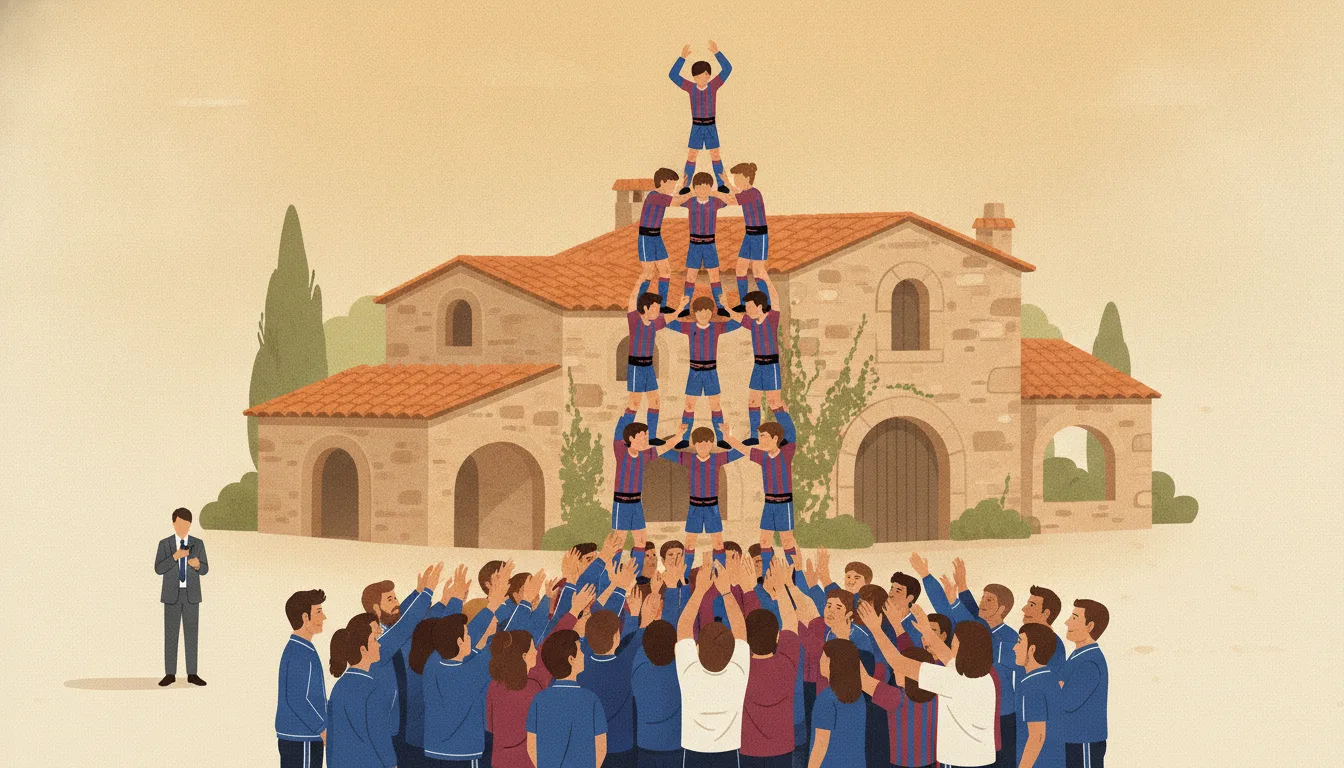
The castellers are the clearest picture of the idea. The people at the top of a human tower are the ones in the photo. But the tower stands because hundreds of people at the bottom hold it up, and nobody can buy their place.
Where the comparison stops
The people who do the daily work can keep an institution good, but they cannot do everything. The La Masia story shows the limits too.
- They cannot fix the money. No youth coach could stop €340 million being spent on three players, or the club selling a share of its TV income for 25 years.
- They cannot stop bad decisions about people. The coaches could not keep Cruyff in 1996 or Vilà in 2018.
- They cannot keep every talent. When the top makes the academy look like a dead end, the best children leave, as Fàbregas, Piqué and Olmo did.
- They need the top to give them a place to work. The masia in 1979, the new building in 2011 and the hiring of Cruyff were all decisions of a board.
So the lesson is not "leaders don't matter". Leaders matter a lot. The best thing a leader can do is protect the people who carry the knowledge, give them what they need, and not interfere with their work. The worst thing a leader can do is use up, in a few years, what those people built over decades. And because the knowledge lives in people, it can disappear if they leave and nobody replaces them. A culture can survive a bad president. It may not survive ten years of them.
What this means for any institution
The same two groups exist in every company, school, hospital and public service. The people at the top decide the money and the rules. The people who do the daily work carry the knowledge of how the work is really done.
When the top fails, an institution does not stop working at once. Classes are still taught, patients are still treated and products are still made, because the people who do the daily work keep doing it. That is the La Masia effect, and it explains why some institutions stay good for years under weak leadership.
But it has a cost, and it has an end. The people who do the work cannot sign a budget, choose a strategy or stop the best people from leaving. If the top keeps failing, they get tired and leave, and the knowledge leaves with them. In La Masia's words, talent cannot go alone. It needs an idea, and it needs someone at the top who protects it.
Barça's members have one tool that many workers, owners and citizens also have: they can remove the people at the top. The academy survived the bad years because people who cared kept working, and the club recovered because members who cared kept voting. Both groups have to keep caring for an institution to stay good. When the top fails, the people who do the daily work can keep the institution alive, but only for a while.
References
- Wikipedia, La Masia
- Los Andes, "El método Barsa lo inventé yo; Cruyff y Guardiola lo copiaron" (2014)
- Vozpópuli, interview with Laureano Ruiz (2014)
- Público, interview with Laureano Ruiz (April 2013)
- Wikipedia, Johan Cruyff
- Wikipedia, 1992 European Cup final
- UEFA, Xavi gives secrets of Barcelona's success (October 2010)
- Sid Lowe, La Masia — Sports Illustrated (December 2010)
- Toni Padilla, Una final para situar La Masia en el centro del mundo — Ara (July 2026)
- Wikipedia, 2009–10 FC Barcelona season
- FC Barcelona, 10 years since a unique Ballon d'Or podium
- FC Barcelona, 10 years since 11 from La Masia appeared in the line-up
- Wikipedia, FC Barcelona
- FC Barcelona, 50 years of 'More than a club'
- ESPN Deportes, El polémico despido de Johan Cruyff del Barcelona cumple 25 años (2021)
- Daily Maverick, Barcelona transfer ban: beyond the jargon (April 2014)
- Wikipedia, List of most expensive association football transfers
- Football España, Xavi Hernández concerned by Joan Vila departure from Barcelona (November 2018)
- Wikipedia, Barçagate
- Wikipedia, Josep Maria Bartomeu
- Catalan News, Very worrying situation for FC Barcelona as debts soar to €1.35 billion (August 2021)
- Catalan News, Lionel Messi to leave FC Barcelona due to financial obstacles (August 2021)
- Sixth Street, FC Barcelona and Sixth Street reach an agreement for a 10% share of the club's LaLiga TV rights (June 2022)
- FC Barcelona, Barça's returning youth players
- Wikipedia, Dani Olmo
- Wikipedia, Lamine Yamal
- Wikipedia, 2025 Ballon d'Or
- FC Barcelona, Hansi Flick's Barça: league champions
- FC Barcelona, Álvaro Cortés, thirteenth La Masia debutant under Hansi Flick (May 2026)
- Ara, The most Catalan Barça of the last 50 years (May 2026)
- Wikipedia, 2026 FIFA World Cup final
- Inside World Football, Benfica tops ranking of academy football factories; Barça and River Plate make top three (October 2025)
- Inside World Football, Barcelona academy continues to create elite talent at scale, suggests CIES (January 2026)
- Wikipedia, Tacit knowledge
- Wikiquote, Edgar H. Schein (quoting Organizational Culture and Leadership, 1985)
- Quigley and Hambrick, Has the CEO effect increased in recent decades? — Strategic Management Journal (2015)
- University of Georgia News, story on the Quigley and Hambrick study
- FC Barcelona, Barça membership surpasses 150,000 (2026)
- Catalan News, Joan Laporta re-elected president of FC Barcelona (March 2026)
- Wikipedia, Andon (manufacturing)
- Wikipedia, Kaizen
- Wikipedia, Mondragon Corporation
- Wikipedia, Elinor Ostrom
- Wikipedia, Athletic Bilbao
- UNESCO, Human towers