There's a question the physicist Enrico Fermi supposedly blurted out over lunch in 1950, somewhere between the soup and the punchline of a joke about flying saucers. The galaxy is old — around 13 billion years. It's enormous — hundreds of billions of stars, a large fraction with planets. Even at sluggish, sub-light speeds, a single expansionist civilization could colonize the whole thing in a few tens of millions of years. That's a rounding error on cosmic timescales.
So Fermi asked the question that still hasn't gone away:
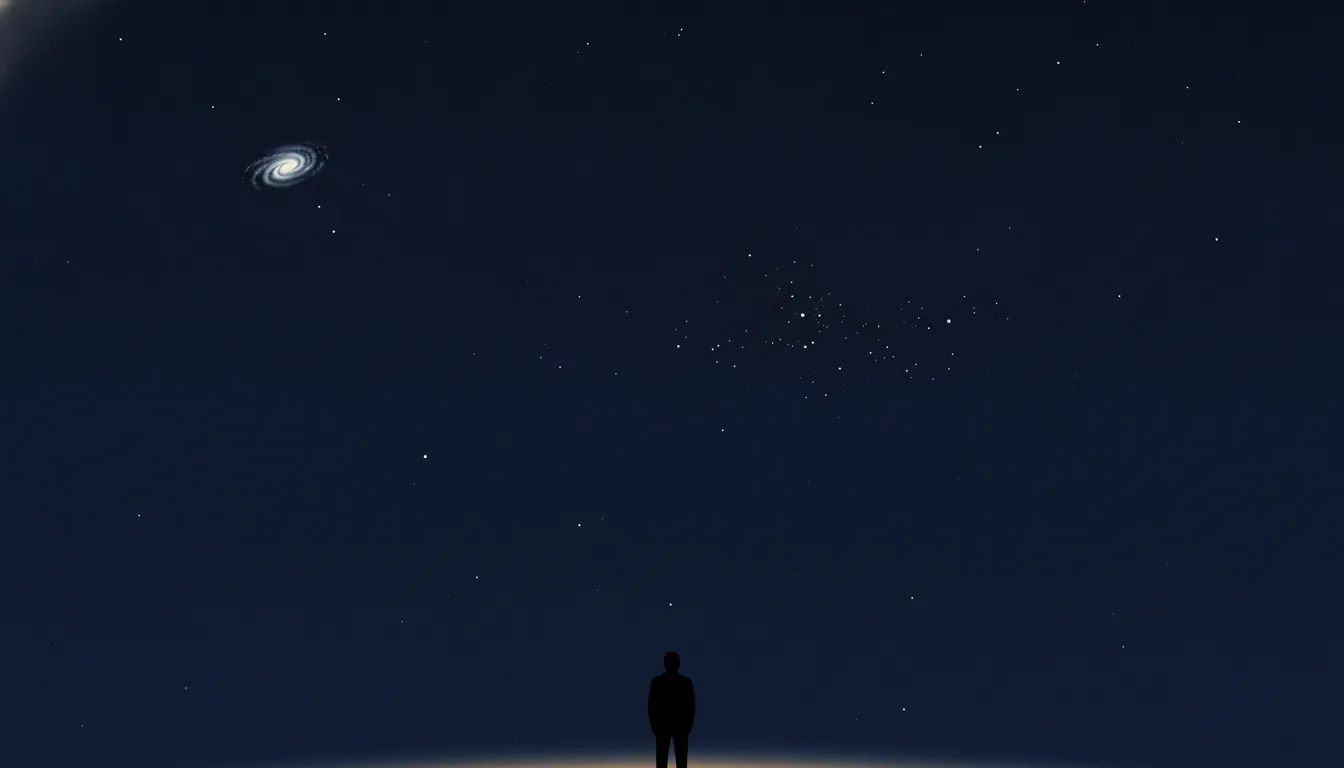
The sky should be crowded. Instead it's silent. No radio chatter, no megastructures dimming distant stars, no probes politely knocking. Just us, apparently, talking to ourselves.
The Great Filter is one of the sharpest, most unsettling attempts to explain that silence.
The idea, in one sentence
In 1998, the economist Robin Hanson framed it like this: somewhere along the road from dead matter to a civilization that spreads across the stars and endures, there is at least one step so improbable that almost nothing makes it through.
That's the filter. A wall on the path. Most of the universe's attempts at "life that colonizes galaxies" slam into it and stop.
The elegant, chilling part is that Hanson didn't say where the wall is. He just proved, more or less, that one must exist — because otherwise the galaxy would already be full, and it plainly isn't.
It's not one wall. It's a series of gates.
Think of the journey as a chain of bottlenecks. Each one has to be cleared for the next to matter:
- A star with the right kind of planet.
- The right chemistry — liquid water, stable conditions, the raw ingredients.
- Abiogenesis — non-living chemistry crossing over into self-replicating life. This may be the big one. It happened on Earth, but we have exactly one data point, which is statistically useless.
- Simple cells becoming complex cells (the jump from prokaryotes to eukaryotes). On Earth this took roughly two billion years and, as far as we can tell, happened once.
- Multicellularity.
- Intelligence of the tool-using, abstract-reasoning kind.
- Technology — fire, agriculture, industry, radios.
- And the final gate: surviving your own technology long enough to become a lasting, spacefaring species.
The Great Filter is whichever of these steps is the killer. Maybe it's just one. Maybe the improbability is smeared across several. Either way, the math has to work out so that the expected number of galaxy-spanning civilizations is somewhere near… one. Us. And we haven't even cleared the last gate yet.
The question that should keep you up at night
Here's where it stops being an abstract astronomy puzzle and becomes personal.
Is the filter behind us, or ahead of us?-
If it's behind us — if the hard, near-impossible step was something like abiogenesis, or the birth of complex cells — then we are the lottery winners. The cosmic fluke. We already did the hard part without knowing it, and the road ahead, while difficult, is survivable. This is the good news scenario. Lonely, but hopeful.
-
If it's ahead of us — if intelligent, technological life is actually fairly common but civilizations reliably destroy themselves before spreading — then the silence isn't luck. It's a warning. Nuclear war, engineered pandemics, ecological collapse, a technology that outpaces the wisdom to handle it. Every dead civilization out there hit the same wall, and we're walking toward it.
The universe's quiet isn't neutral. Depending on where the wall sits, it's either the most reassuring or the most terrifying fact in science.
The counterintuitive twist: finding alien life would be bad news
This is Hanson's most brilliant and disturbing move, and most people get it backwards.
We instinctively feel that discovering microbial life on Mars, or in the oceans of Europa, would be thrilling — proof we're not alone. And emotionally, sure. But logically it's a gut-punch.
If life springs up easily all over the place, if we keep finding it, then abiogenesis isn't the great filter. Simple life is cheap. Which means the improbable step, the wall, is more likely to be further along the chain. Closer to us. Possibly ahead of us.
So the more common life turns out to be, the more the empty sky demands an explanation, and the more that explanation points toward "civilizations don't survive." A dead galaxy full of the ruins of simple biology is roughly the worst news we could receive.
The best outcome, in this dark logic, is to keep searching and keep finding nothing. Sterile rocks all the way down. It would mean the wall is safely behind us.
A necessary deflation: maybe there's no paradox at all
Everything above assumes the silence genuinely demands a dramatic explanation. Honesty requires admitting that assumption is contested, and the sharpest challenge to it deserves its own space.
In 2018, Anders Sandberg, Eric Drexler, and Toby Ord published a paper with the wonderfully blunt title "Dissolving the Fermi Paradox." Their point is about how we do the arithmetic. The usual approach plugs a single best-guess number into each term of the Drake equation, multiplies them together, and gets a confident-looking estimate of many civilizations, which then clashes with the empty sky and feels like a paradox. But several of those terms, especially the probability of life arising, span many orders of magnitude of genuine uncertainty. When you stop using point estimates and instead propagate that full uncertainty honestly, a surprisingly large chunk of the probability lands on there being no other civilizations in our galaxy, or even the observable universe, right now.
If that's right, the silence isn't a paradox and doesn't need a Great Filter to explain it. It's just the unremarkable outcome of numbers we don't know precisely. I don't think this closes the question, and it doesn't make the Filter framing useless, but any honest treatment has to sit with the possibility that we've been feeling a chill down an empty hallway and calling it a ghost.
The main alternatives (because the Filter isn't the only answer)
The Great Filter is one solution to Fermi's paradox, not the only one. The honest position is that we don't know, and several ideas compete:
- Rare Earth. Complex life needs such a fragile stack of coincidences — a stabilizing large moon, plate tectonics, a Jupiter to vacuum up asteroids, the right galactic neighborhood — that it's just astronomically rare. This is basically "the filter is behind us, and it's tall."
- The Dark Forest. They're out there, but everyone's hiding. Announcing yourself to an unknown universe is suicidal, so the smart move is silence and the loud go extinct. (Chilling, popular in fiction, but requires every civilization to reason identically — a big assumption.)
- We're early. Hanson's later "grabby aliens" model suggests the universe is young and we may simply be among the first movers. The party hasn't started; we're the awkwardly punctual guests.
- The Zoo Hypothesis. They know we're here and are deliberately leaving us alone, like a nature preserve.
- We can't hear them. Our detection window is a blink, our methods primitive. Expecting to overhear an advanced civilization with our current tools might be like expecting to smell a Wi-Fi signal.
Sorted by why they'd leave the sky empty, the explanations fall into three camps:
The reading many people land on
Set aside any single verdict; here's where a lot of the popular thinking actually settles. Two of these are Great Filter theories proper; the third is really a different answer to Fermi's question — worth separating out rather than pretending it all fits under one banner.
One common lean is that the filter is mostly behind us, with a smaller-but-real gate still ahead.The reasoning: the roughly two-billion-year pause between simple cells and complex ones, and the fact that the eukaryotic leap seems to have happened only once in Earth's entire history, looks like a genuine wall. That long stall is the usual best candidate for the hard step.
It's worth flagging one tempting move this view carefully avoids, because it's a trap a lot of popular writing falls into. Life appears to have arisen fairly early in Earth's history, and it's easy to reason "early start, therefore abiogenesis is easy." Two problems. First, the timing of the earliest life is genuinely contested; the evidence sits somewhere in the 3.5-to-4.1-billion-year range depending on which biosignatures you trust, so "almost as soon as the planet cooled" overstates a real fight in the literature. Second, and more fundamentally, there's Brandon Carter's observation-selection point: intelligent observers can only ever find themselves on a planet where life happened to start early enough to leave billions of years for evolution to reach them. So we'd observe an early start whether abiogenesis is common or almost impossible. The inference "life started fast, so life is easy" is exactly the one we're not entitled to draw. The stronger version of the behind-us view leans on the eukaryotic bottleneck to get there, not on the early-start argument.
If that read is right, we're already through the worst of it, and we are, in a real sense, extraordinary.
That's no reason to relax, which points to a second popular position: the filter was probably never a single wall, and the last gate is one we build ourselves. The transition from "clever tool-using species" to "wise enough to survive planet-altering power" is genuinely non-trivial, and it's the one gate where the outcome isn't fixed by chemistry or luck — it's decided by choices. That makes it the most interesting filter of all, because it's the only one we have any vote in.
And a third, more speculative idea — though this one isn't a Great Filter theory at all. It's a rival explanation for the silence: no wall required, they're simply not doing the thing we're listening for. The suggestion is that advanced intelligence stops looking the way we expect. We're scanning for beings who colonize, expand, and shout across the void because that's what we'd do at our current stage. A civilization a few thousand years past us might turn inward, go quiet, become computationally dense and physically small, and simply have no interest in stamping itself across a hundred billion stars. Not filtered out, just not doing the loud thing we're listening for. The galaxy might not be a graveyard. It might be a library where everyone's finally learned to read silently.
Which of these is right? Nobody knows, and the Sandberg-Drexler-Ord result means we can't even be sure there's a question to answer. But notice that only one of the scenarios asks anything of us. A filter behind us is settled history. A universe that's simply empty is settled math. The one live variable is the last gate, the one made of our own choices, and that's the only place the story isn't already written.
Further reading, if the rabbit hole calls: Hanson's original 1998 essay and his more recent "grabby aliens" model are the two threads worth pulling first — both, and everything else cited above, are linked in the References below.
References
- "Fermi paradox" — Wikipedia (Fermi's 1950 "Where is everybody?" question).
- Robin Hanson (1998), "The Great Filter — Are We Almost Past It?" (author's hosted essay).
- Sandberg, Drexler & Ord (2018), "Dissolving the Fermi Paradox" (arXiv:1806.02404).
- Hanson, Martin, McCarter & Paulson (2021), "If Loud Aliens Explain Human Earliness, Quiet Aliens Are Also Rare" — the "grabby aliens" model (arXiv:2102.01522).
- "Drake equation" — Wikipedia.
- "Anthropic principle" — Wikipedia (Brandon Carter's observation-selection argument).
- "Rare Earth hypothesis" — Wikipedia (Ward & Brownlee, Rare Earth: Why Complex Life Is Uncommon in the Universe, 2000).
- "Dark forest hypothesis" — Wikipedia (from Liu Cixin's novel The Dark Forest).
- "Zoo hypothesis" — Wikipedia (John A. Ball, 1973).