
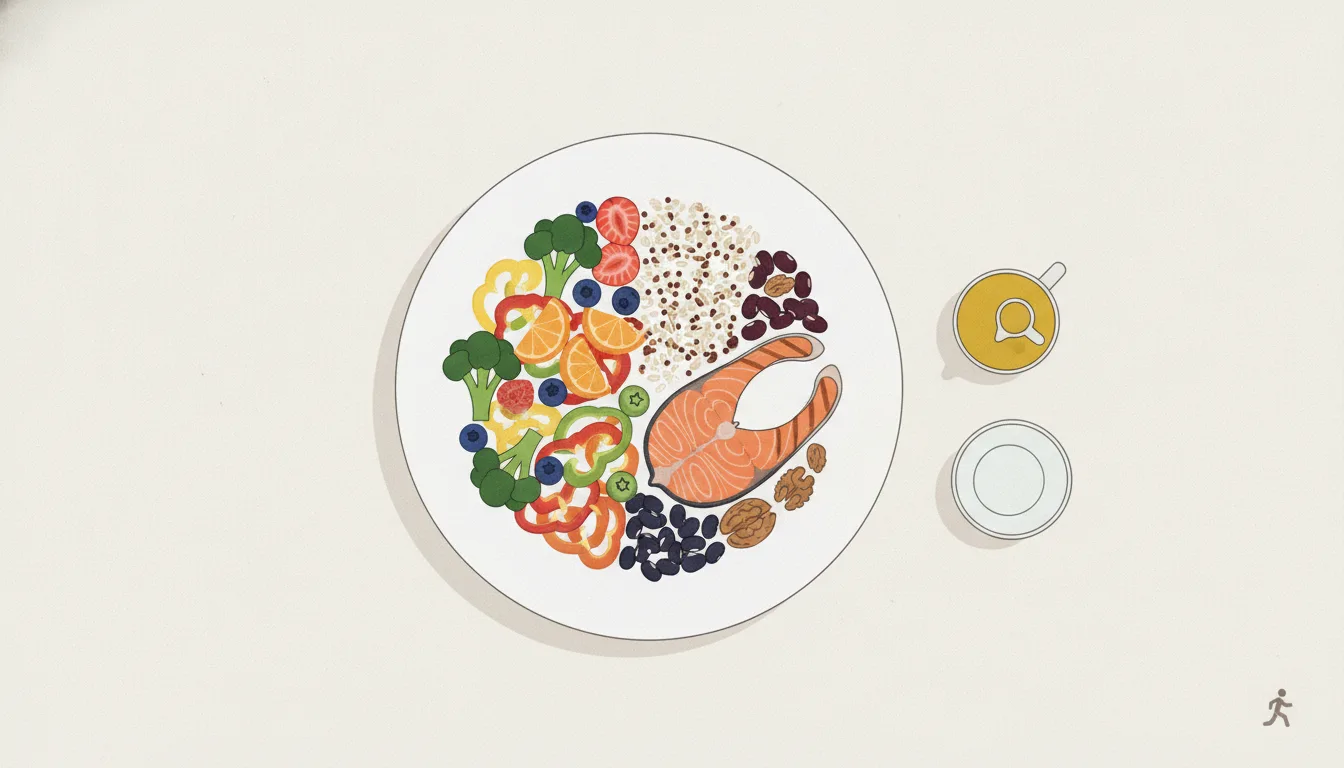
If you search for "how to eat a balanced diet," you'll eventually run into the Harvard Healthy Eating Plate. It was created in 2011 by nutrition scientists at the Harvard T.H. Chan School of Public Health as a science-first alternative to the USDA's MyPlate, and here's the short answer to the obvious question: yes, it's still relevant in 2026. Harvard still maintains it, health agencies in several countries have adopted versions of it, and it remains one of the most cited visual frameworks in nutrition education.
This is general nutrition information, not personalized dietary or medical advice. Individual needs vary — check with a doctor or registered dietitian before making significant changes, especially if you have a health condition.
But if your goal is specifically to age well — staying physically capable, mentally sharp, and free of chronic disease into your 70s and beyond — there's now stronger, more specific evidence worth knowing about. In 2025, a landmark 30-year study published in Nature Medicine compared eight healthy dietary patterns head-to-head and identified which one was most strongly associated with healthy aging. The winner, the Alternative Healthy Eating Index (AHEI), turns out to be a close cousin of the Harvard Plate — developed by the same institution, built on the same principles, just more precise.
So this post does both: it explains the plate as your everyday visual tool, then layers on what the newest aging research adds.
Part 1: The Harvard Plate, in two minutes
The plate is a proportion guide, not a calorie counter. Every meal, roughly:
Half the plate: vegetables and fruits. Mostly vegetables, with variety and color. One important caveat: potatoes don't count here, because of their effect on blood sugar.
A quarter of the plate: whole grains. Oats, brown rice, quinoa, barley, whole-wheat pasta and bread. The distinction matters: whole and intact grains have a much gentler effect on blood sugar and insulin than refined grains like white bread and white rice.
A quarter of the plate: healthy protein. Fish, poultry, beans, lentils, and nuts. Limit red meat; avoid processed meats like bacon and sausage.
On the side:
- Healthy plant oils (olive, canola, sunflower...) in moderation — the plate explicitly rejects the old "low-fat is healthy" dogma. Fat quality matters far more than fat quantity.
- Water, coffee, or tea as default drinks. Skip sugary drinks, and limit dairy to one or two servings a day.
- Stay active — the little running figure on the original graphic is part of the message.
The genius of the plate is that it's a mental model, not a set of rules. You don't need an app or a scale. You can apply it at a restaurant, at a family dinner, or while packing lunch. That's why it has aged so well.
Where the plate has limits
To be fair to the criticism: the plate tells you proportions, not amounts. A 2024 nutritional assessment found that when people freely composed meals following the plate graphic, many of the resulting dishes fell short on energy and several micronutrients (fiber, calcium, magnesium, iron for women of childbearing age, and some B vitamins). In other words, the plate is an excellent pattern guide but not a guarantee of nutritional adequacy on its own — total intake across the day, and especially food quality within each section, still matter. Which brings us to the newer evidence.
Part 2: The 2025 healthy-aging study — the strongest evidence we have
In March 2025, researchers from Harvard and the University of Montreal published "Optimal dietary patterns for healthy aging" in Nature Medicine (Tessier et al., doi: 10.1038/s41591-025-03570-5). It's arguably the most relevant single study on diet and aging to date:
- 105,000+ people (from the Nurses' Health Study and the Health Professionals Follow-Up Study), aged 39–69 at the start
- 30 years of follow-up, with repeated dietary questionnaires
- Instead of just measuring lifespan or single diseases, "healthy aging" was defined as reaching age 70 free of major chronic disease, with intact cognitive, physical, and mental health — i.e., quality of life, not just survival
- Eight dietary patterns compared head-to-head: AHEI, Mediterranean (aMED), DASH, MIND, healthful plant-based (hPDI), Planetary Health Diet, plus two inflammation/insulin-focused indices — along with ultra-processed food consumption
The results
1. Every one of the healthy patterns improved the odds of aging well. Adherence to any of them raised the likelihood of healthy aging by roughly 45–86%. There is genuinely no single mandatory diet — the researchers themselves stressed that healthy diets can be adapted to individual needs, cultures, and preferences.
2. The AHEI came out on top. People in the top fifth of AHEI adherence were 86% more likely to be aging healthily at 70, and about 2.2× more likely at 75, compared with the bottom fifth. The AHEI pattern: rich in fruits, vegetables, whole grains, nuts, legumes, and healthy unsaturated fats; low in red and processed meat, sugary drinks, sodium, and refined grains. If that sounds familiar — it's essentially the Harvard Plate with the quality knobs turned up.
3. Different patterns shone in different dimensions.
| Pattern | Strongest for | Notes |
|---|---|---|
| AHEI | Physical function & mental health | Overall winner; top fifth = 86% more likely to age well at 70 |
| Planetary Health Diet | Cognitive health & survival to 70 | Plant-forward with sustainability in mind |
| Healthful plant-based (hPDI) | Weakest of the healthy patterns | Being plant-based isn't enough without quality (whole vs. refined grains) |
Interestingly, plant-forward with moderate amounts of healthy animal foods (fish, poultry) did great — the lesson isn't "go fully plant-based," it's "prioritize quality."
4. Ultra-processed food was the clearest negative signal. Higher UPF intake — especially processed meats and sugary or diet beverages — was associated with about 32% lower odds of healthy aging. If you only make one subtraction to your diet, this is the one.
Findings from cohorts in France, Singapore, Australia, China, and Israel pointed in the same direction, which makes the overall picture unusually consistent for nutrition science.
Part 3: Putting it together — a balanced diet for aging well
Here's the practical synthesis. Use the plate as your visual default, and apply these AHEI-informed upgrades, which matter more the older you get:
1. Make plants the base, but chase quality within each section. Half the plate as vegetables only pays off if there's variety; a quarter of grains only pays off if they're whole grains. The quality distinction inside each plate section is exactly where AHEI beat the looser patterns.
2. Get serious about protein sources — and don't under-eat protein as you age. Muscle loss (sarcopenia) accelerates from your 50s onward, and preserving muscle is one of the strongest predictors of independence in old age. Legumes, fish, poultry, nuts, eggs, and some dairy spread across the day beats one protein-heavy dinner. Keep red meat occasional and processed meat off the regular menu.
3. Don't fear fat — choose it. Olive oil and other unsaturated plant oils, nuts, and fatty fish are consistently linked with better cardiovascular and cognitive outcomes. Replacing saturated fat with unsaturated fat is one of the highest-leverage swaps available.
4. Treat ultra-processed food as the main adversary. Not carbs, not fat, not any single macro. Processed meats and sugar-sweetened (and even diet) beverages were the most damaging UPF categories in the study.
5. Watch sodium, added sugar, and refined grains. These are the three "penalty" categories the AHEI scores against, and they're where most Western diets quietly lose points.
6. Water, coffee, or tea by default. Sugary drinks are the cheapest calories to cut, at any age.
7. Start now — midlife is when it counts. The study measured diets from ages 39–69 and outcomes at 70+. The diet you eat in your 40s and 50s is, quite literally, an investment whose returns arrive decades later. That said, every cohort that looked at later-life changes still found benefits — it's never too late to improve the pattern.
8. Stay active. It's on the original plate graphic for a reason. Diet and movement compound each other, especially for preserving muscle and bone.
The bottom line
The Harvard Plate has not been dethroned — if anything, the 2025 Nature Medicine study vindicated it, since the winning pattern (AHEI) was developed by the same Harvard nutrition group on the same principles. What the new research adds is precision: it's not just what categories fill your plate, but the quality within each category, the near-elimination of ultra-processed food, and the understanding that these choices in midlife are what determine whether you reach 70 and 75 healthy — not just alive.
Keep the plate on the fridge. Score yourself mentally against the AHEI. And remember the researchers' own conclusion: there is no one-size-fits-all diet — the best pattern is the evidence-based one you can actually sustain.
This post is for general information and isn't medical or dietary advice. If you have specific health conditions or needs, talk to a doctor or registered dietitian.
References
- Harvard T.H. Chan School of Public Health — The Healthy Eating Plate
- Tessier, A. et al. — "Optimal dietary patterns for healthy aging." Nature Medicine 31, 1644–1652 (2025). doi: 10.1038/s41591-025-03570-5
- Harvard Chan School — news release on the study
- Nutritional Assessment of the Healthy Eating Plate as Graphic Tool (PMC)
- Harvard Nutrition Source — Healthy Eating Plate vs. USDA MyPlate