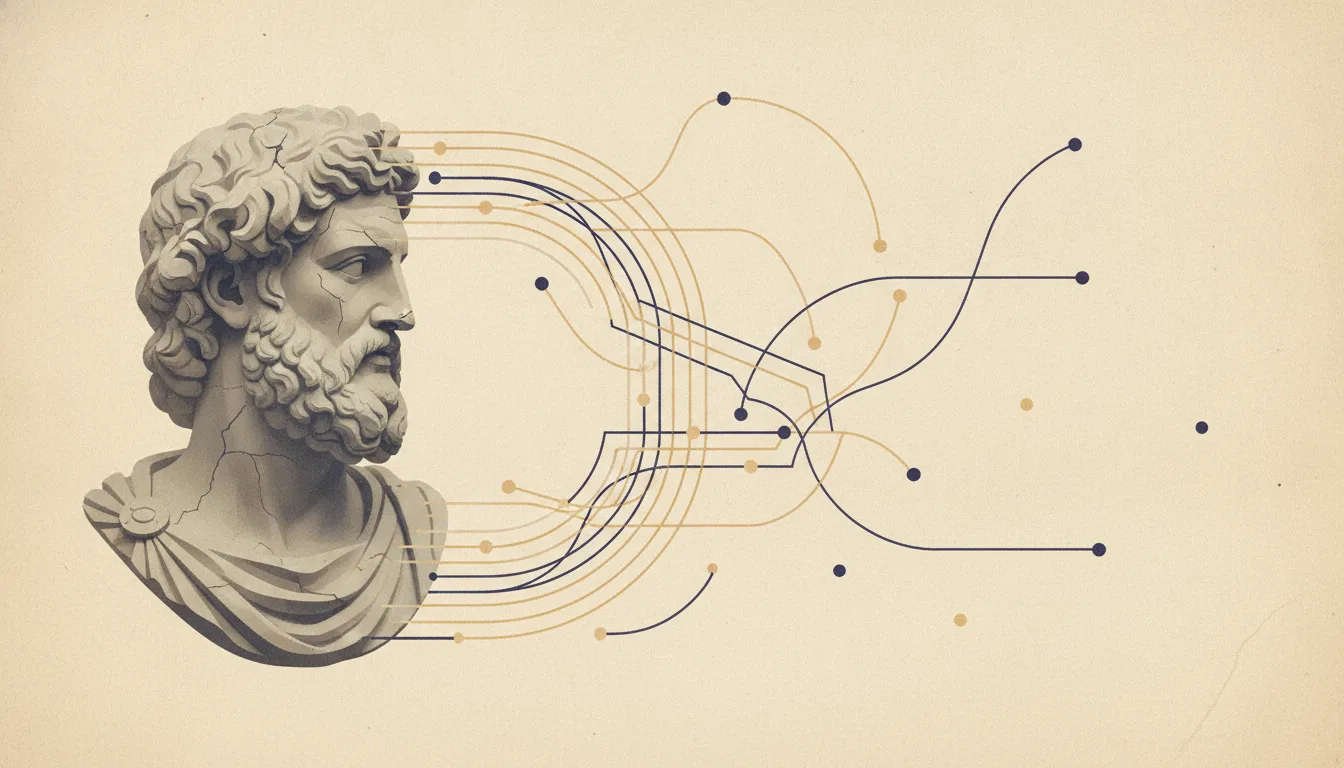
No lectures. No essays. Names, ideas, one key work each, and what each one is for. Look up whatever catches your eye — the goal is a map, not a syllabus.
If the companion essay argued that we're drowning in wisdom and dying of thirst, this is the reservoir laid out flat: a catalog you can walk. The point isn't to read all of it — it's to find the two or three ideas that change how you wake up tomorrow, and then actually let them. Skim the tables, follow one name that snags you, ignore the rest.
The philosophers
The thinkers below are grouped by era. The Western canon runs roughly left to right through time; the Eastern traditions developed in parallel, mostly out of contact until much later. Read the "reach for it when" column first — a philosopher is most useful as an answer to a problem you actually have.
Ancient Greece and Rome
| Thinker | Core idea | One key work | Reach for it when |
|---|---|---|---|
| Socrates (470–399 BC) | The examined life — question everything, especially yourself. Wrote nothing. | Apology (via Plato) | you're too sure of yourself |
| Plato (428–348 BC) | The allegory of the cave — most of what you see is shadows. | The Republic, Book VII | you suspect your worldview was handed to you |
| Aristotle (384–322 BC) | Happiness is an activity, not a feeling; virtue is a habit built by repetition. | Nicomachean Ethics | you want a practical framework for character |
| Epicurus (341–270 BC) | Pleasure rightly understood: friends, simple food, no fear of death. | Letter to Menoeceus (4 pages) | consumerism is winning |
| Diogenes (412–323 BC) | Radical simplicity; told Alexander the Great to step out of his sunlight. | the anecdotes in Diogenes Laertius | you care too much what people think |
| Seneca (4 BC–65 AD) | Life is long enough if you know how to use it. | On the Shortness of Life | you feel busy but empty |
| Epictetus (50–135 AD) | Born a slave, taught emperors: some things are up to you, most aren't. | Enchiridion (30 pages) | you're anxious about things you can't change |
| Marcus Aurelius (121–180 AD) | The most powerful man alive, writing private notes about staying decent. | Meditations (Gregory Hays translation) | you need a role model who struggled too |
Eastern traditions
| Thinker | Core idea | One key work | Reach for it when |
|---|---|---|---|
| Confucius (551–479 BC) | You become yourself through relationships and ritual, not despite them. | the Analects | individualism is making you lonely |
| Laozi (~6th century BC) | The soft overcomes the hard; stop forcing. | Tao Te Ching (Ursula K. Le Guin's version) | effort itself is the problem |
| Zhuangzi (369–286 BC) | Dreamed he was a butterfly, woke unsure which he was; perspective dissolves problems. | the Inner Chapters | you're taking everything too seriously |
| Siddhartha Gautama, the Buddha (~5th century BC) | Suffering comes from clinging; everything is impermanent. | the Dhammapada, or Stephen Batchelor's Buddhism Without Beliefs | you can't let go |
| Nagarjuna (~150–250 AD) | Nothing has a fixed essence; everything exists in relation. Advanced. | Jay Garfield's commentary | you're ready to go deeper than mindfulness apps |
Medieval and early modern
| Thinker | Core idea | One key work | Reach for it when |
|---|---|---|---|
| Augustine (354–430) | The divided will: "grant me chastity, but not yet." | Confessions, Books I–IX | you keep doing what you don't want to do |
| Montaigne (1533–1592) | Invented the essay by studying the only subject available: himself. | "Of Experience" | you want permission to be inconsistent and human |
| Descartes (1596–1650) | Doubt everything until something survives: "I think, therefore I am." | Meditations on First Philosophy | you want to see how far skepticism goes |
| Spinoza (1632–1677) | Freedom is understanding necessity; emotions lose power when you comprehend them. | the Ethics (hard), or Steven Nadler's biography (easier) | you're at war with reality |
| Pascal (1623–1662) | "All of humanity's problems stem from man's inability to sit quietly in a room alone." | the Pensées, fragments on diversion | you can't stop scrolling |
Enlightenment
| Thinker | Core idea | One key work | Reach for it when |
|---|---|---|---|
| David Hume (1711–1776) | Reason is the slave of the passions; habit runs your life more than logic. | Enquiry Concerning Human Understanding | you overestimate your rationality |
| Immanuel Kant (1724–1804) | Treat people as ends, never merely as means; act only on principles you'd universalize. | Groundwork of the Metaphysics of Morals | you need a hard ethical line |
| Jean-Jacques Rousseau (1712–1778) | Society teaches you to live in the eyes of others. | Discourse on Inequality | status anxiety is eating you |
| Adam Smith (1723–1790) | Before economics, he wrote about sympathy and the "impartial spectator" in your head. | The Theory of Moral Sentiments | you want ethics grounded in how people actually feel |
The 19th century
| Thinker | Core idea | One key work | Reach for it when |
|---|---|---|---|
| Arthur Schopenhauer (1788–1860) | Desire is a pendulum between pain and boredom; art and compassion are the exits. | Essays and Aphorisms (Penguin) | getting what you wanted didn't help |
| Søren Kierkegaard (1813–1855) | Anxiety is the dizziness of freedom; you must become an individual, not a crowd. | The Sickness Unto Death, or Fear and Trembling first | you're avoiding a decision only you can make |
| John Stuart Mill (1806–1873) | Liberty, higher pleasures, and the danger of social conformity. | On Liberty, chapter 3 | you're outsourcing your life choices to convention |
| Friedrich Nietzsche (1844–1900) | Become who you are; love your fate; create values instead of inheriting them. | Twilight of the Idols, then The Gay Science | you need courage, not comfort |
| Ralph Waldo Emerson (1803–1882) | "Envy is ignorance, imitation is suicide." | the essay "Self-Reliance" | you're living someone else's script |
| Henry David Thoreau (1817–1862) | Went to the woods to live deliberately; the cost of a thing is the life exchanged for it. | Walden, "Economy" and "Where I Lived" | you're auditing what your lifestyle actually costs you |
The 20th century and beyond
| Thinker | Core idea | One key work | Reach for it when |
|---|---|---|---|
| William James (1842–1910) | You are your habits; act as if, and belief follows. | "The Gospel of Relaxation" and "Habit" | you want psychology and philosophy in one |
| Bertrand Russell (1872–1970) | Happiness through outward interest, not inward obsession. | The Conquest of Happiness | self-focus is making things worse |
| Ludwig Wittgenstein (1889–1951) | Many "deep problems" are confusions of language. Advanced. | Ray Monk's biography | an argument feels unresolvable — check the words first |
| Martin Heidegger (1889–1976) | Being-toward-death: mortality is what makes your choices matter. | Hubert Dreyfus's commentary (rather than Being and Time raw) | you're drifting through an average life |
| Jean-Paul Sartre (1905–1980) | Condemned to be free; "bad faith" is pretending you have no choice. | Existentialism Is a Humanism (a short lecture) | you catch yourself saying "I had no choice" |
| Simone de Beauvoir (1908–1986) | Freedom is real only when it wills the freedom of others. | The Ethics of Ambiguity | existentialism feels too self-centered |
| Albert Camus (1913–1960) | The absurd — we demand meaning, the universe stays silent; rebel anyway. | The Myth of Sisyphus, final essay | nihilism knocks |
| Hannah Arendt (1906–1975) | Evil is often not monstrous but thoughtless; thinking itself is a moral act. | Eichmann in Jerusalem | you're tempted to just follow procedure |
| Viktor Frankl (1905–1997) | Survived Auschwitz; those with a why can bear almost any how. | Man's Search for Meaning | suffering seems pointless |
| Alan Watts (1915–1973) | The West's best translator of Eastern ideas; life is a dance, not a journey to a destination. | The Wisdom of Insecurity | you're always postponing living |
| Peter Singer (1946–) | The drowning-child argument: distance doesn't dilute moral duty. | "Famine, Affluence, and Morality" | you're deciding what you owe strangers |
| Martha Nussbaum (1947–) | Emotions are judgments of value; a good life is fragile, and that's the point. | The Fragility of Goodness | you think invulnerability is the goal |
| Byung-Chul Han (1959–) | We exploit ourselves voluntarily and call it achievement. | The Burnout Society (60 pages) | your oppressor is your own ambition |
The concepts
If the philosophers are the people, these are the tools they left behind. You don't need to know who said what — a good idea works whether or not you can cite it. The map below groups them by the problem they solve.
About living well
- Eudaimonia — flourishing as a whole life well-lived, not a mood. The question shifts from "am I happy?" to "am I living well?"
- Ataraxia — tranquility; the Epicurean and Stoic end goal. Not excitement — undisturbedness.
- Arete — excellence at being human, the way a knife is excellent at cutting.
- The golden mean — courage sits between cowardice and recklessness; generosity between stinginess and waste. Virtue is calibration.
- Memento mori — remember you will die. Not morbid: a prioritization tool. By tradition, whispered to victorious Roman generals mid-triumph.
- Amor fati — love your fate. Nietzsche's test: would you live this exact life again, on repeat, and say yes?
- Wu wei — effortless action; the skill of not forcing. Water beats stone.
- Hedonic adaptation — you return to baseline after every win. The raise, the car, the launch — three months, then normal. Plan accordingly.
- Ikigai — the overlap of what you love, what you're good at, what the world needs, and what pays. Popularized, simplified, still useful.
About control and acceptance
- The dichotomy of control — your judgments, choices, and responses are yours; outcomes, reputations, and other people are not. The single most practical idea here.
- Negative visualization (premeditatio malorum) — briefly imagine losing what you have. Result: gratitude now, resilience later.
- Impermanence (anicca) — everything you love is temporary; that's not a flaw in the world, it's a property of it. Grip lightly.
- The second arrow — a Buddhist image: pain is the first arrow; your resistance and story about the pain is the second one, and you shoot it yourself.
- The view from above — mentally zoom out: your street, your city, the planet, deep time. Your problem shrinks at scale.
- The trichotomy of control — a modern refinement: some things you fully control, some you influence, some neither. Internalize goals ("play my best") over outcomes ("win").
About meaning
- The absurd — the mismatch between our hunger for meaning and the universe's indifference. Camus: don't escape it through faith or suicide — revolt, live anyway.
- Existential freedom — existence precedes essence: you weren't made for a purpose, you choose one. Terrifying, then liberating.
- Bad faith — telling yourself "I can't" when the truth is "I won't." The waiter who is only a waiter. The employee who "has no choice."
- Authenticity — living a life that is recognizably yours, not the default settings of your class, family, or feed.
- The leap of faith — Kierkegaard: some commitments (love, vocation, belief) can't be justified in advance. You jump, then you know.
- Nihilism — "nothing matters." Worth understanding precisely so you can answer it: nothing matters by default — meaning is made, not found.
- Logotherapy — Frankl's therapy of meaning: you can find it in work, in love, or in the stance you take toward unavoidable suffering.
About thinking clearly
- The Socratic method — don't assert; ask. Most positions collapse under three honest "why"s, including yours.
- First principles — strip a problem to what you actually know is true, then rebuild from there. (You already do this when debugging.)
- Falsifiability — Karl Popper: if no evidence could ever prove your belief wrong, it's not knowledge, it's identity.
- Occam's razor — among competing explanations, prefer the one with fewer assumptions. Not always right; usually right.
- The Ship of Theseus — replace every plank, is it the same ship? Replace every cell and belief, are you the same person? (Yes — but why?)
- Epistemic humility — Socrates was called the wisest man in Athens because he alone knew how much he didn't know.
- Steelmanning — argue against the best version of the opposing view, not the weakest. The inverse of the strawman, and rarer.
- Motivated reasoning — you don't reason toward conclusions; you reason from them and call it thinking. Hume saw this two and a half centuries before the studies confirmed it.
About others
- The categorical imperative — before acting, ask: what if everyone did this? If the answer breaks the world, don't.
- People as ends, never merely means — the one-line test for whether you're using someone.
- The veil of ignorance — John Rawls: design society without knowing if you'll be born rich, poor, healthy, or sick. Whatever you'd build, that's justice.
- Ubuntu — a southern African philosophy: "I am because we are." Personhood is granted through community, not achieved alone.
- The banality of evil — Arendt on Eichmann: the worst harms are often committed by people who simply stopped thinking. Bureaucracy is not an alibi.
- Moral luck — two identical drunk drivers; one hits a child, one gets home. Same act, different guilt? How much of your virtue is just circumstance?
- The expanding circle — Singer: ethics is the history of widening who counts — family, tribe, nation, species, and now further.
About modern life
- The hedonic treadmill — the structural reason "more" never arrives. See: every salary bump you've ever had.
- The attention economy — your focus is being mined; philosophy of mind meets business model. Who owns your inner life?
- The burnout society — Han: discipline societies said "you must"; achievement societies say "you can" — and we whip ourselves harder than any master would.
- Digital minimalism — Cal Newport's screen-age version of Thoreau's cost accounting: what amount of life is this app exchanged for?
- Fear of missing out (FOMO) as a philosophical error — every choice excludes; that's not a bug of your life, it's the definition of having one. Kierkegaard called anxiety the price of possibility.
- Voluntary simplicity — reducing wants beats increasing means. The oldest trick in the book, still undefeated.
Five reading paths (pick one lane)
Don't read broadly — read one line all the way down. A single tradition read to the end beats a dozen sampled and abandoned. Each path is ordered: start at the left, finish at the right.
- The Stoic path — Epictetus's Enchiridion → Seneca's On the Shortness of Life → Marcus Aurelius's Meditations → William Irvine's A Guide to the Good Life.
- The Existentialist path — Sartre's Existentialism Is a Humanism → Camus's The Myth of Sisyphus → Frankl's Man's Search for Meaning → de Beauvoir's The Ethics of Ambiguity.
- The Eastern path — the Tao Te Ching → the Dhammapada → Zhuangzi's Inner Chapters → Watts's The Wisdom of Insecurity.
- The clear-thinking path — Plato's Apology → Hume's Enquiry → Russell's The Problems of Philosophy → anything by Popper on falsifiability.
- The modern-life path — Pascal's fragments on diversion → Thoreau's Walden (first two chapters) → Han's The Burnout Society → Newport's Digital Minimalism.
If you only absorb five ideas
Everything above collapses, in a pinch, to these five. Master these and the rest of the map is optional.
- The dichotomy of control — the anxiety killer.
- Memento mori — the priority filter.
- Bad faith — the excuse detector.
- Hedonic adaptation — the ambition debugger.
- The examined life — the operating system all the others run on.
The point isn't to know all of this. It's to find the two or three ideas that change how you wake up tomorrow — and then actually let them.
References
Books and works are listed under the thinker who wrote them; every philosopher's name links to a fuller biography inline above.
- Meditations — Marcus Aurelius (Gregory Hays translation recommended)
- Enchiridion — Epictetus
- On the Shortness of Life (De Brevitate Vitae) — Seneca
- The Republic — Plato
- Nicomachean Ethics — Aristotle
- Tao Te Ching — Laozi
- Dhammapada — attributed to the Buddha
- Confessions — Augustine
- Meditations on First Philosophy — Descartes
- The Theory of Moral Sentiments — Adam Smith
- On Liberty — John Stuart Mill
- Existentialism Is a Humanism — Jean-Paul Sartre
- The Myth of Sisyphus — Albert Camus
- The Ethics of Ambiguity — Simone de Beauvoir
- Eichmann in Jerusalem — Hannah Arendt
- Man's Search for Meaning — Viktor Frankl
- The Wisdom of Insecurity — Alan Watts
- "Famine, Affluence, and Morality" — Peter Singer
- The Conquest of Happiness — Bertrand Russell
- The Burnout Society — Byung-Chul Han
- Walden — Henry David Thoreau
- A Guide to the Good Life: The Ancient Art of Stoic Joy — William B. Irvine
- Digital Minimalism — Cal Newport