
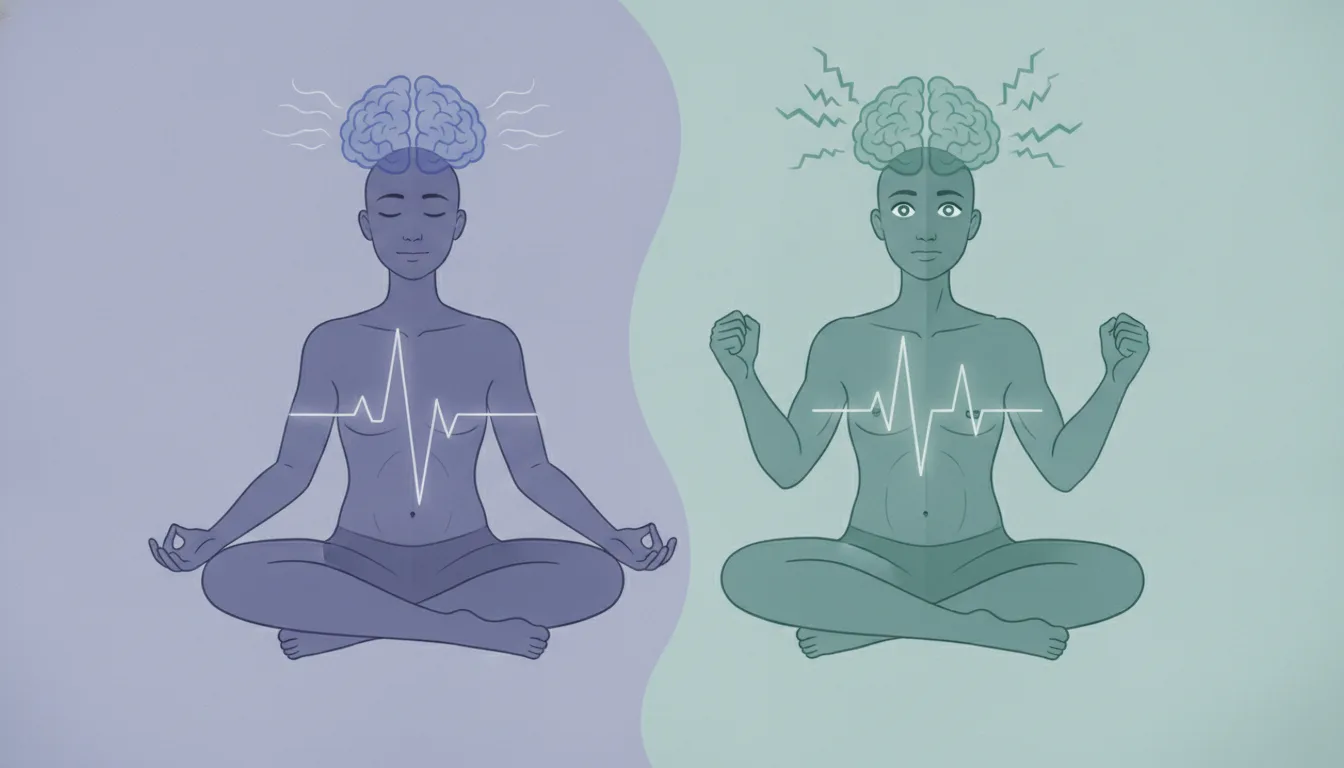
There are situations where, from the outside, everything seems fine. No one is treating you badly. There's no real threat. No tragedy is unfolding. And yet, your body activates: tension, discomfort, irritability, sadness, the urge to leave, a feeling of being trapped.
This can happen at family gatherings, social obligations, mandatory visits, or places where you don't feel entirely comfortable.
This is a general explainer about how the nervous system works — not medical or psychological advice. If stress or anxiety is persistent, severe, or getting in the way of your life, please talk to a doctor or mental-health professional.
And the first thing worth understanding is this:
The absence of objective danger doesn't mean your body isn't experiencing stress.
Sometimes stress doesn't come from an external attack, but from a combination of factors: heat, noise, lack of control, social exposure, fatigue, physical insecurity, expectations, comparison, or the feeling of "I have to be okay because I have no reason to feel bad."
That last thought usually makes everything worse.
You Don't Start With Gratitude
When you're activated, trying to force yourself to feel gratitude can turn into guilt.
You tell yourself:
"I have everything. I shouldn't feel this way."
But that sentence doesn't calm you down. It usually adds another layer of tension: now, on top of feeling bad, you're judging yourself for feeling bad.
Gratitude shouldn't be used as punishment. It should be used as guidance.
Before trying to feel grateful, you need to regulate your body.First: Lower the Activation
When you notice yourself spiraling, the goal isn't to be happy all at once. The goal is simpler:
return to a manageable state.
You can start with something physical:
- Inhale for 4 seconds.
- Exhale for 6 seconds.
- Repeat for 2 or 3 minutes.
It also helps to take a short break, drink water, look for shade, walk a little, or simply go to the bathroom to reclaim some privacy.
It's not running away. It's regulating yourself.Then: Change the Internal Dialogue
Once the body calms down a bit, you can work with your thoughts.
You don't need to jump from:
"I don't want to be here."
to:
"I'm happy and grateful."
That usually feels too fake.
A more useful sentence would be:
"This isn't my ideal situation, but I can get through it calmly."
Or also:
"This is discomfort, not danger."The goal isn't to deny what you feel. It's to not let the discomfort control the entire experience.
Techniques That Actually Break a Negative Thought
Reframing helps, but sometimes a thought is too sticky to simply soften. When you're stuck in a loop, these are the techniques that hold up best in research — mostly from cognitive behavioral therapy (CBT), acceptance and commitment therapy (ACT), and mindfulness. You don't need all of them. Pick one and use it.
| Technique | What you do | Rooted in |
|---|---|---|
| Name the thought | Relabel "I can't handle this" as "I'm having the thought that I can't" | ACT (defusion) |
| Question it | Interrogate the thought like a claim — check the actual evidence | CBT (restructuring) |
| Talk to yourself by name | Switch to "you"/your own name to create distance | Distanced self-talk |
| Postpone it | Schedule the worry for later instead of suppressing it | CBT (stimulus control) |
| Ground in your senses | 5-4-3-2-1: see, hear, touch, smell, taste | Mindfulness |
| Change your state | Interrupt the loop through the body and environment | Behavioral activation |
Name the thought. There's a real difference between "I can't handle this" and "I'm having the thought that I can't handle this." The first one you experience as reality; the second one you experience as a mental event — something your mind is producing under stress, not a verdict about you. This move comes from acceptance and commitment therapy, and its power is that you don't have to argue with the thought or prove it wrong. You just downgrade it from fact to weather: something passing through, not something you have to obey. Say the longer version a few times until the thought stops feeling like the truth and starts feeling like a sentence your brain wrote.
Question it. Anxious thoughts feel true precisely because you never inspect them — they arrive already dressed as conclusions. So slow down and interrogate the thought like a claim: What's the actual evidence for this? Has the thing I'm predicting actually happened the last ten times I feared it? What would I say to a friend who told me this about themselves? That last question does a lot of work, because we're almost always more fair and more generous with other people than with ourselves. The aim isn't to force a happy thought on top of a scary one — it's accuracy, swapping a catastrophic story for a more balanced and honest one.
Talk to yourself by name. When you narrate your own distress in the first person — "I'm overwhelmed, I can't do this" — you stay trapped inside it. Studies of "distanced self-talk" found that switching to your own name or "you" — "You're okay, Pere. You've dealt with worse than this" — creates a small but real psychological gap between you and the feeling. From that gap you can coach yourself the way you'd coach someone you love, instead of drowning alongside them. It feels slightly ridiculous the first time. It also works, and it turns a spiral into something closer to a conversation.
Postpone it. Trying to stop a thought usually backfires — suppression makes it louder and brings it back more often. So don't suppress it; schedule it. Tell the worry, "I'll deal with you at 7pm," and mean it. You're not pretending the concern doesn't matter; you're refusing to loop on it right now. Most of the time, by the time the appointment arrives the worry has lost its charge or already sorted itself out. And on the occasions it hasn't, you get to face it deliberately, with a calmer head — on your terms, not the spiral's.
Ground in your senses. Rumination lives in your head, in the past or the future; your senses only ever live in the present, and you can't fully occupy both at once. That's why the 5-4-3-2-1 exercise works: name five things you can see, four you can hear, three you can touch, two you can smell, one you can taste. It feels mechanical — that's exactly the point. You're deliberately reclaiming the attention the spiral was running on and pointing it somewhere neutral. Do it slowly and actually notice each thing; racing through the list to "get it over with" just hands the attention back.
Change your state. A ruminating brain feeds on stillness and repetition, so interrupt the pattern through the body instead of the mind: stand up, walk into another room, splash cold water on your face, or start a task absorbing enough to crowd the thought out. This isn't avoidance — you're not deciding the problem doesn't exist. You're changing the physical and environmental context the loop was running in, and that shift is often enough to loosen its grip so the other techniques can actually land.
The point isn't to win an argument with your mind. It's to stop feeding the loop long enough for it to lose momentum.
Concrete Gratitude, Not Abstract
Gratitude works better when it's specific.
Not:
"I should be grateful for everything."
Yes:
- Today I'm grateful that I have a place to be.
- Today I'm grateful that I can take care of my body.
- Today I'm grateful that I've been able to get through an uncomfortable situation without breaking down.
Quick Technique: Stop Before Falling Into the Spiral
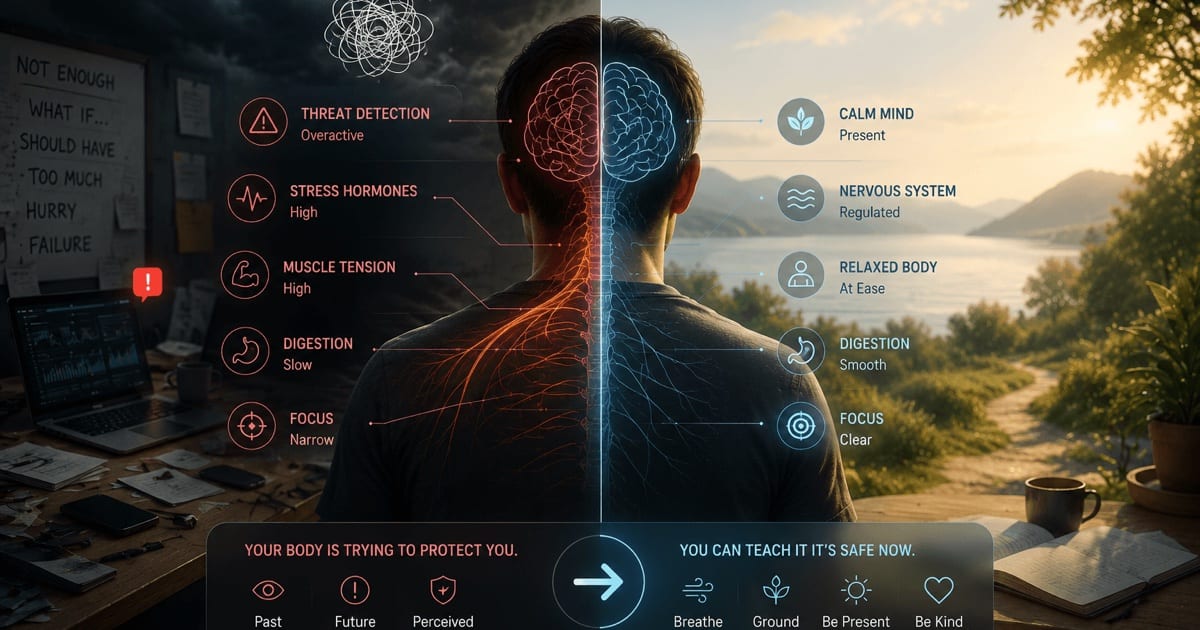
Everything so far — the body, the thoughts, the gratitude — condenses into one short sequence you can run the moment you feel it starting:
- I stop.
- I breathe.
- I name what's happening: "my body is activated."
- I remind myself: "I'm not in danger."
- I take a small action: water, shade, a break, breathing, listening.
The whole in-the-moment sequence, in one picture:
A Healthier Approach
Maybe the goal isn't to "always enjoy yourself."Maybe the goal is:
- To be present.
- To take care of myself.
- To not feed the spiral.
- To act according to my values.
- To go home without having mistreated myself mentally.
That's already progress.
Then, the Longer Work: Raise Your Baseline
Everything above helps you survive a hard moment. But there's a second layer, and it's the one that actually changes things: you can make those moments happen less often, hit less hard, and pass faster.
Think of it as a window. Inside it, you can feel discomfort and still function. Outside it, you spiral. That window isn't fixed — you can widen it. But you don't widen it in the moment. You widen it with what you do on ordinary days:
- Sleep. A tired nervous system has a narrow window — this is the foundation, not a luxury.
- Move your body. Regular cardio and strength train your system to handle activation and recover from it.
- Breathe when you're calm, not only in crisis — so the skill is automatic when you actually need it.
- Small, voluntary discomfort: cold water, a hard workout, hunger, boredom. Stress you choose teaches your body that discomfort is survivable and always passes.
- Don't avoid what activates you — approach it gradually. Avoidance shrinks the window; gradual exposure expands it.
- Lower your baseline load: less caffeine, less doomscrolling, fewer low-grade stressors stacking up. You have a limited stress budget.
- Recover on purpose: real rest, nature, connection, downtime. Capacity is built during recovery, not only during effort.
The goal isn't a life without discomfort. It's a body that treats discomfort as normal, not as an emergency.
Conclusion
We can't always choose the situations we're in. But we can train how we enter them, how we talk to ourselves while they happen, and how we leave afterward.
It's not about faking happiness.
It's about practicing regulation, acceptance, and realistic gratitude.A good sentence to remember would be:
"I don't need to be perfectly okay. I just need to not fight against myself."
And that, repeated many times, can change the experience.
References
- Physiology, Autonomic Nervous System — StatPearls (NCBI Bookshelf, NIH) — how the sympathetic ("fight or flight") and parasympathetic ("rest and digest") systems drive the bodily activation described here.