
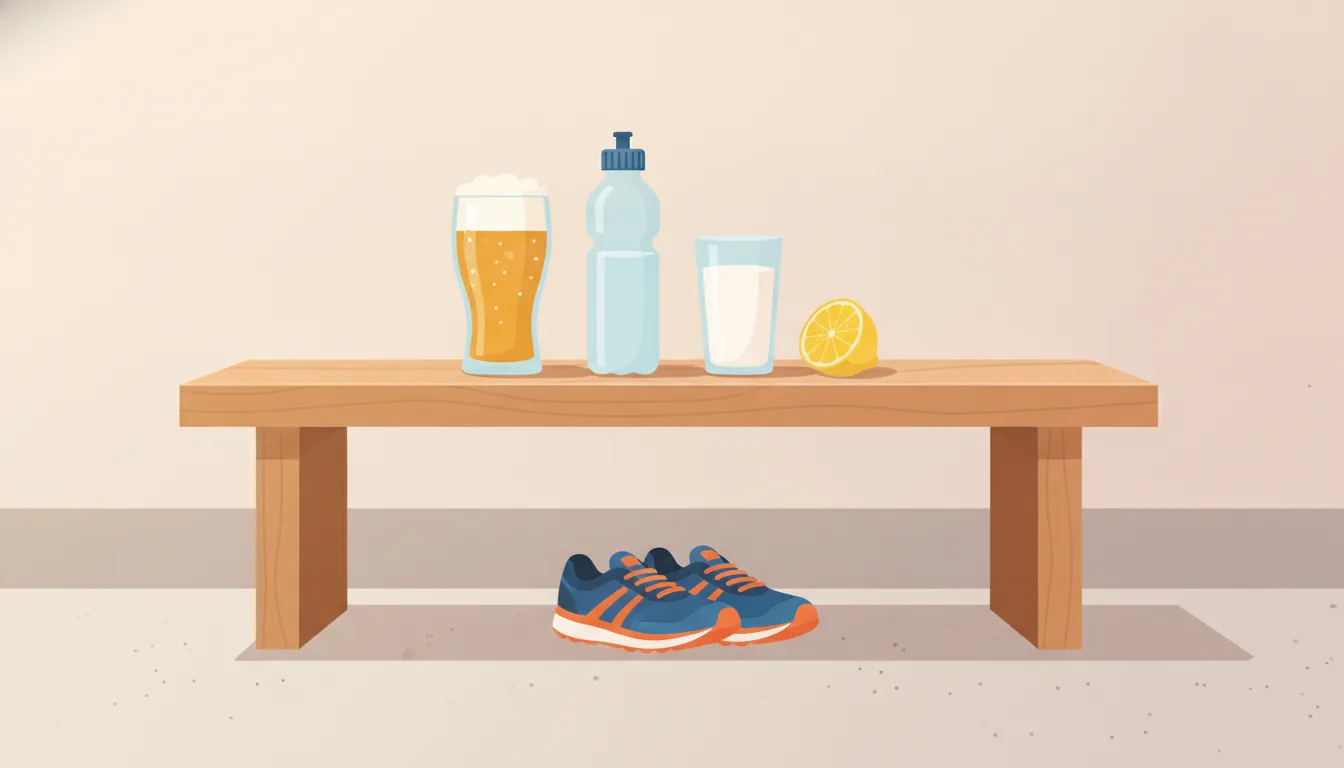
After a hard session, what should you actually drink? A tour of the recovery drinks that genuinely work — and an honest look at whether 0.0 beer has earned its place among them.
This is general nutrition information, not personalized dietary or medical advice. If you have a health condition, train competitively, or are managing your weight under supervision, talk to a professional.
You finish a long ride or a sweaty run, and everyone has an opinion about what belongs in your hand next: an electric-blue sports drink, coconut water, a glass of milk — or, increasingly, an alcohol-free beer whose label all but promises it was brewed for athletes. Most of those opinions are marketing. The way to cut through them is to stop asking "is this drink healthy?" and start asking "what job does it do?"
What a recovery drink actually has to do
A recovery drink is only ever doing four jobs, and every drink — from tap water to isotonic beer — can be judged by how many of them it covers. Exercise takes four things out of you, and recovery is simply putting them back:
- Fluid. You sweat out water; it has to come back.
- Electrolytes. Sweat carries salts with it — above all sodium, the one that actually limits rehydration, plus smaller amounts of potassium and magnesium.
- Carbohydrate. Long or intense sessions burn through glycogen, the carbohydrate your muscles store as fuel.
- Protein. Hard training leaves micro-damage in muscle fibres, and repairing it needs amino acids.
One more thing before judging any drink: how much you need depends on the session. An easy 40-minute jog costs you some water and little else. A two-hour summer ride costs you all four. That distinction does most of the work in what follows.
Water covers more than you think
For everyday exercise under about an hour, plain water plus your next normal meal covers all four jobs, and nothing you can buy improves on it. The meal brings the salt, the carbohydrate and the protein; the water brings the fluid. Sports drinks, recovery shakes and functional beers are solutions to a problem most gym sessions don't create.
The calculus changes when sessions get long, hot or very sweaty, or when you have to perform again soon — a tournament day, a multi-day trek, two-a-day training. That's when the other three jobs become urgent enough to be worth drinking, rather than eating.
The natural drinks that actually work
When you do need more than water, the best options are ordinary drinks, not engineered ones.
Milk — and chocolate milk — is the quiet champion. It's mostly water, it naturally contains sodium and potassium, and it delivers both carbohydrate and high-quality protein in one glass. A systematic review and meta-analysis of controlled trials found chocolate milk performs as well as, and on some markers better than, commercial sports and recovery drinks[1] — at a fraction of the price. It's the only drink on this list that covers all four jobs at once.
A homemade isotonic drink is the cheapest electrolyte fix. "Isotonic" just means the drink has roughly the same concentration of dissolved particles as your blood, so it empties from the stomach and absorbs quickly. You can make one in a minute:
- Start with 1 litre of water.
- Add a good pinch of salt, about 1.5 g (this is the sodium, the part that matters).
- Add the juice of a lemon for flavour and a little potassium.
- Optionally add a spoonful of sugar or honey if the session was long enough to need refuelling.
Coconut water is fine, but it solves the wrong half of the problem. It's rich in potassium but poor in sodium — the opposite of what sweat loses. A controlled comparison in exercise-trained men found it rehydrates about as well as a sports drink, with no performance advantage and a bit more bloating[9]. Pleasant, natural, not magic.
Tomato juice is the dark horse. It carries meaningful sodium and potassium, and its antioxidant lycopene appears to blunt exercise-induced oxidative stress: in a study of athletes, two months of tomato-juice supplementation raised the body's own antioxidant defences and improved a running-performance test[10].
| Drink | Rehydrates | Replaces salts | Refills carbs | Repairs muscle |
|---|---|---|---|---|
| Water | ||||
| Homemade isotonic | ||||
| Coconut water | ||||
| Tomato juice | ||||
| Milk / chocolate milk |
If you can't drink milk
Crowning milk is awkward for a large share of readers, because most adults worldwide gradually lose the lactase enzyme that digests milk sugar after childhood. Happily, the champion has a direct substitute.
Lactose-free milk isn't a compromise — it's ordinary milk with the lactose already split, so everything that put milk at the top of the table survives. The dairy adds lactase to the carton, which breaks the lactose into glucose and galactose before you drink it; the protein, the sodium and potassium, and the carbohydrate are untouched. The evidence backs the swap directly. In a randomised crossover trial, ten lactose-intolerant men did a glycogen-depleting session, recovered for two hours on one of three drinks, then cycled to exhaustion: they lasted 69.6 minutes on lactose-free milk, against 52.1 on a commercial sports drink and 36.0 on water[2]. A separate trial found skimmed lactose-free milk retained about 69% of the fluid drunk, against 40% for water and 56% for a sports drink[3].
Before rearranging your fridge, though, check the dose — intolerance is a threshold, not a switch. A systematic review of 36 randomised trials concluded that 12–15 g of lactose, roughly one 250 ml glass of milk, is tolerated by most affected adults with no or minor symptoms, and that cutting below that buys little[4]. Milk carries about 4.5–5 g of lactose per 100 ml, so a normal glass sits right at the limit while a half-litre recovery bottle is double it. The amount may be the culprit rather than the milk. And if you've never actually been tested, it's worth doing: the symptoms overlap with irritable bowel syndrome and other gut conditions, and a hydrogen breath test settles the question.
Two other routes work. Fermented dairy — kefir or a drinking yogurt — arrives with bacteria that carry their own lactose-splitting enzyme and do part of the digestion for you: in a trial feeding 20 g lactose doses to adults with lactose maldigestion, kefir and yogurt cut the flatulence that milk caused by 54–71%[5]. Soy milk is the one plant milk that qualifies, at roughly 3.3 g of protein per 100 ml with a complete amino-acid profile; almond, oat, rice and coconut drinks average under 1.1 g per 100 ml[6] and are, for recovery purposes, flavoured water. Soy does trail dairy on the repair job specifically — skim milk beat a protein- and calorie-matched soy drink for muscle protein accretion after resistance exercise[7], and over twelve weeks milk drinkers gained more lean mass than soy drinkers[8] — but it covers the other three jobs well.
| Option | Covers the four jobs | Lactose |
|---|---|---|
| Lactose-free milk | ||
| Kefir / drinking yogurt | ||
| Milk, one 250 ml glass | ||
| Soy milk | ||
| Oat / almond / rice milk |
So the natural options are settled, dairy or not. Now for the drink that prompted this post — the one with a marketing department.
Where 0.0 beer enters the picture
Alcohol-free beer earns its first point by subtraction. Alcohol packs 7 kilocalories per gram — nearly as energy-dense as fat — so removing it cuts a beer's calories roughly in half: a regular 5% lager runs around 130–150 kilocalories (kcal) per 33 cl can, while most 0.0 versions land between 50 and 80.
The second point is bigger than the calories. Alcohol doesn't just fail to help recovery — it actively sabotages it, so swapping a post-match beer for a 0.0 removes a genuine harm. Alcohol taken after training suppresses muscle protein synthesis — the repair process itself — by roughly a quarter even when you drink it alongside protein[11]. It's also a diuretic: a study that rehydrated mildly dehydrated exercisers with beers of varying strength found that low-alcohol beer retained fluid about as well as water, while full-strength beer measurably increased urine output and worked against rehydration[12].
But notice what kind of argument this is. Removing a harm is not the same as adding a benefit. A 0.0 beer after sport is less bad than a regular one — it is not thereby good for recovery. Whether it contributes anything positive comes down to what's actually in the can, and for that you have to read a label.
Case study: reading the Free Damm label
Free Damm is a useful specimen because Damm publishes its full nutritional data, and the label tells a more interesting story than the advertising. Per 100 ml, the official figures are 20 kcal, 4.7 g of carbohydrate (of which 1.7 g sugars) and 0 g of salt; the ingredients are water, barley malt, maize, glucose-fructose syrup, rice and hops[13].
Two things jump out:
- The salt line kills the "sports drink" idea. With essentially zero sodium, Free Damm cannot replace what sweat takes out. If you were drinking it as a natural isotonic, you were getting the water and nothing else — job 1 of 4.
- The syrup is doing the alcohol's old job. Alcohol gives beer body and perceived sweetness; take it out and something must fill the gap. Here it's added glucose-fructose syrup — exactly the ingredient nutritionists tell you to watch for on any label. The sugar load is modest (about 5.6 g per can, a quarter of a can of cola), but it's added sugar all the same.
To be fair, 0.0 beers do retain small amounts of B vitamins and polyphenols — antioxidant compounds from the barley and hops. The quantities are real but modest; nobody should drink beer for its micronutrients. As a refreshment, 66 kcal per can is a perfectly reasonable deal. As a recovery tool, the label says no.
The toasted-beer trap
A tempting upgrade suggests itself: darker, toastier 0.0 beers taste richer and are marketed on the extra antioxidants of roasted malt — surely the "healthier" choice? The label logic runs the other way: toasted 0.0 beers carry more sugar and more calories than pale ones, and the extra antioxidants are too small to compensate.
Roasting malt frees and concentrates sugars, and the numbers show it. Estrella Galicia 0,0 Tostada — a well-regarded example — declares 24 kcal and 2.1 g of sugars per 100 ml[14], against Free Damm's 20 kcal and 1.7 g:
| Per 100 ml | Regular lager (~5%) | Free Damm (0.0 pale) | Estrella Galicia 0,0 Tostada |
|---|---|---|---|
| Energy | ~43 kcal | 20 kcal | 24 kcal |
| Sugars | ~0–1 g | 1.7 g | 2.1 g |
| Salt | ~0 g | 0 g | 0 g |
Pick a toasted 0.0 because you prefer the flavour — that's a fine reason. Just don't pick it as the healthy option; on the numbers, the pale one is the lighter choice.
Isotonic beers: the marketing and the science
If a plain 0.0 isn't a recovery drink, could a beer engineered to be one work? The industry has certainly tried. In 2016 San Miguel launched San Miguel 0,0 Isotónica with Pau Gasol and Mireia Belmonte as ambassadors, formulated to match the solute concentration of blood[15] — and today you'd struggle to find it in an ordinary supermarket, which says something about how the experiment went. The idea lives on mainly in Germany: Erdinger Alkoholfrei is openly marketed as an isotonic regeneration drink, advertising folic acid and vitamin B12 alongside its 25 kcal per 100 ml[16]. (Note it's alkoholfrei, not 0.0 — German law lets beers up to 0.5% alcohol by volume (ABV) carry the label.)
Surprisingly, there is real science here — just not about hydration. The Be-MaGIC study had 277 runners drink 1–1.5 litres of alcohol-free wheat beer or a polyphenol-free placebo daily for three weeks before and two weeks after the Munich Marathon. The beer group showed significantly less post-race inflammation and a 3.25-fold lower incidence of upper respiratory tract infections — the colds that classically follow marathons[17]. The finding was solid enough that alcohol-free beer became a fixture at German Olympic training tables[18].
Read the fine print, though. The effect is attributed to polyphenols, not to anything uniquely beery — fruits, vegetables, tea and coffee are far denser sources. The dose was up to 1.5 litres a day under a study protocol, and the subjects were marathoners in the most immunologically stressful fortnight of their year. The honest summary of the isotonic-beer science is that alcohol-free beer is a legitimately decent carrier of fluid and polyphenols — and still an inferior recovery drink to milk or a pinch of salt in your water.
The verdict
Put the beers through the same four-job test as everything else, and the picture settles:
| Option | Rehydrates | Replaces salts | Recovery value | Harms recovery |
|---|---|---|---|---|
| Regular beer (5%) | ||||
| 0.0 pale (e.g. Free Damm) | ||||
| 0.0 toasted | ||||
| Isotonic 0.x (Erdinger) | ||||
| Milk (or lactose-free) / homemade isotonic |
And when you're standing at the fridge after training, the decision is short:
The bottom line: water and food do the recovery, milk (lactose-free if you need it) is the best drink you can buy, and 0.0 beer's honest role is social, not sportive — a beer that no longer works against you, not a drink that works for you. That's a genuinely good thing to be. It just isn't a sports drink, whatever the label whispers.
References
- Amiri et al., Chocolate milk for recovery from exercise: a systematic review and meta-analysis of controlled clinical trials — European Journal of Clinical Nutrition
- Sudsa-ard et al., Lactose-free milk prolonged endurance capacity in lactose intolerant Asian males — Journal of the International Society of Sports Nutrition
- Aragón-Vargas et al., Skimmed, Lactose-Free Milk Ingestion Postexercise: Rehydration Effectiveness and Gastrointestinal Disturbances Versus Water and a Sports Drink — International Journal of Sport Nutrition and Exercise Metabolism
- Shaukat et al., Systematic review: effective management strategies for lactose intolerance — Annals of Internal Medicine
- Hertzler & Clancy, Kefir improves lactose digestion and tolerance in adults with lactose maldigestion — Journal of the American Dietetic Association
- Craig & Fresán, Nutritional assessment of plant-based beverages in comparison to bovine milk — Frontiers in Nutrition
- Wilkinson et al., Consumption of fluid skim milk promotes greater muscle protein accretion after resistance exercise than does consumption of an isonitrogenous and isoenergetic soy-protein beverage — American Journal of Clinical Nutrition
- Hartman et al., Consumption of fat-free fluid milk after resistance exercise promotes greater lean mass accretion than does consumption of soy or carbohydrate in young, novice, male weightlifters — American Journal of Clinical Nutrition
- Kalman et al., Comparison of coconut water and a carbohydrate-electrolyte sport drink on measures of hydration and physical performance in exercise-trained men — Journal of the International Society of Sports Nutrition
- Ramaswamy & Indirani, Effect of supplementation of tomato juice on the oxidative stress of selected athletes — Journal of the International Society of Sports Nutrition
- Parr et al., Alcohol Ingestion Impairs Maximal Post-Exercise Rates of Myofibrillar Protein Synthesis following a Single Bout of Concurrent Training — PLoS ONE
- Wijnen et al., Post-Exercise Rehydration: Effect of Consumption of Beer with Varying Alcohol Content on Fluid Balance after Mild Dehydration — Frontiers in Nutrition
- Free Damm — Nutritional information, Damm official site
- Estrella Galicia 0,0 Tostada — official product page with nutritional values
- Cervezas San Miguel lanza una cerveza 0,0 isotónica — Mahou San Miguel press release, September 2016
- Erdinger Alkoholfrei — official product page (isotonic and vitamin claims)
- Scherr et al., Nonalcoholic beer reduces inflammation and incidence of respiratory tract illness — Medicine & Science in Sports & Exercise (the Be-MaGIC study)
- Olympians Are Using Nonalcoholic Beer As Recovery Drinks. Here's The Science — NPR, February 2018