
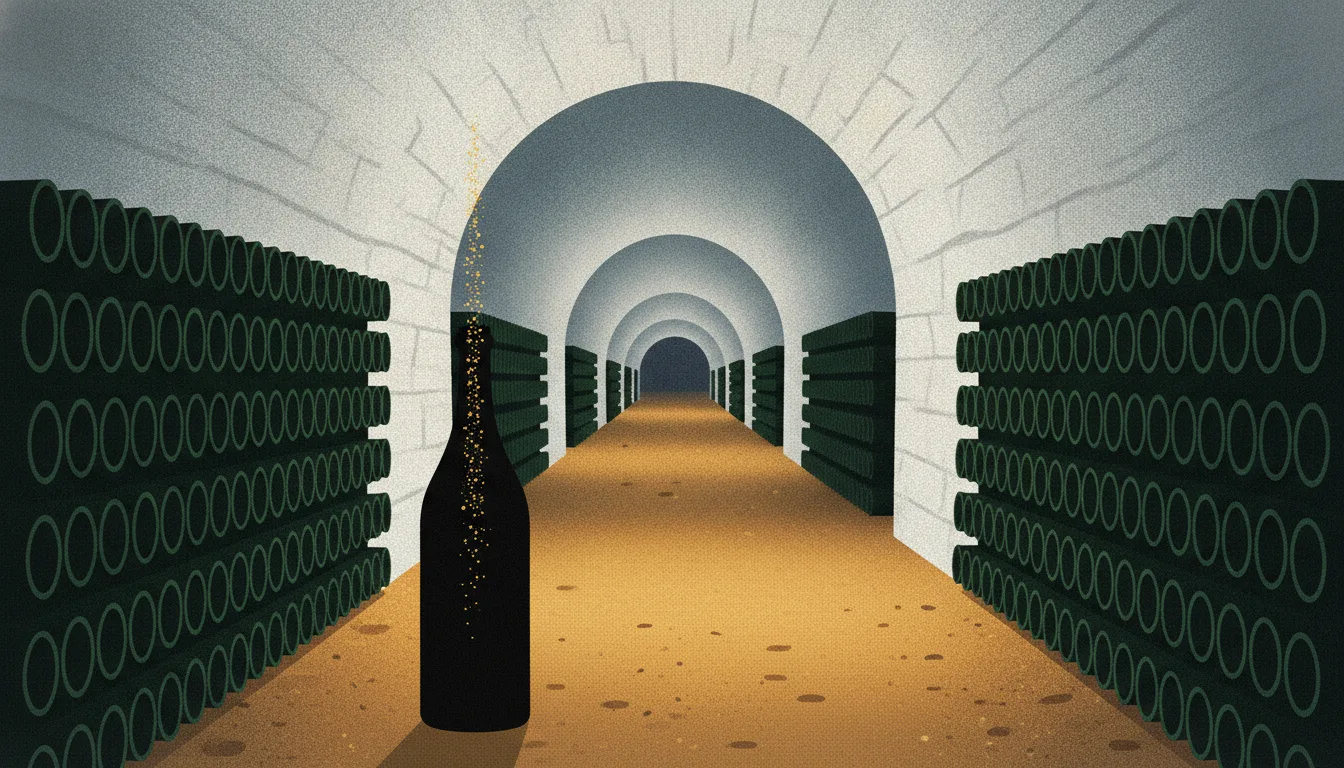
Champagne is not a style of wine or a way of making it. It is a cold, chalky, legally fenced piece of northern France, and almost everything people find confusing about sparkling wine dissolves once that one fact is in place.
Appellation rules, yields, prices and producer counts move. Everything here reflects where things stood in 2026 — check the current figures before quoting them.
The mental model: two fermentations and a long wait
Every sparkling wine in this guide starts as an ordinary still wine that is deliberately made to ferment a second time inside a sealed container, so the carbon dioxide (CO₂) that would normally escape into the air stays dissolved in the liquid. That is the whole trick. What separates one sparkling wine from another comes down to three questions.
- Where did the grapes grow? A cold place gives thin, sharp base wine; a warm place gives ripe, soft base wine. This decides what the wine can eventually taste like.
- Where did the second fermentation happen? In the individual bottle you buy, or in a big pressurised steel tank that gets bottled afterwards.
- How long did the wine then sit on the dead yeast cells? Weeks, or a decade.
Champagne, Corpinnat and Cava all answer question two the same way: in the bottle. They differ on question one — France, Catalonia — and on how hard their rulebooks push on question three. Prosecco answers question two differently, and does so on purpose. Hold those three levers in mind and the rest of this guide is detail.
Champagne is a place, not a method
To be sold as champagne, a wine has to satisfy three conditions at once, and no two out of three will do.
- Origin. The grapes must be grown inside the zone drawn by a French law of 1927, spread across five departments — Marne, Aube, Aisne, Haute-Marne and Seine-et-Marne. The Comité Champagne, the trade body that governs the region, puts it at roughly 34,300 hectares across 319 villages, tended by more than 16,000 growers on nearly 280,000 separate plots. The average plot is about 0.12 hectares — the size of a tennis court.
- Method. The second fermentation must happen in the very bottle the wine is sold in.
- Rulebook. Hand harvesting is compulsory, press yields are capped, minimum ageing periods are fixed, and the whole thing is audited.
A wine made by exactly the same method twenty kilometres outside the line is a fine wine that is not champagne. It may call itself méthode traditionnelle or método tradicional or metodo classico, but since 1994 European Union (EU) rules have forbidden any wine outside the appellation from printing méthode champenoise on its label.
The legal shape of this is an Appellation d'Origine Contrôlée (AOC), France's controlled designation of origin, which since 1936 has also been recognised across Europe as a Protected Designation of Origin (PDO). What an AOC protects is a name attached to a place and a set of practices — never a technique.
For scale: the region shipped 266 million bottles in 2025, a fraction of a percent of the world's vineyard producing a wildly disproportionate share of the world's sparkling-wine revenue.
Chalk, five zones and the cru ladder
Under most of Champagne sits chalk — soft, porous calcium carbonate laid down when the Cretaceous sea covered northern Europe. It does two things no other soil in the region does as well. It holds several hundred litres of water per cubic metre deep down and releases it slowly, so vines carry through a dry summer without the abrupt stress that shuts down ripening; and it drains heavy rain away while damping swings in soil temperature.
Chalk also gave the region its cellars. The crayères beneath Reims are quarry galleries the Romans cut for building stone, later reused for wine: naturally 10–12 °C, humid, dark and utterly still. You cannot buy conditions like that for long ageing.
On top of the chalk sits a thin skin of silt, clay and sand that supplies the local variation, and in the far south the geology changes entirely.
| Zone | Dominant grape | Character |
|---|---|---|
| Montagne de Reims | Pinot noir | Structure, power, wines built to keep. Ambonnay, Bouzy, Verzenay, Aÿ |
| Vallée de la Marne | Meunier | Fruit, roundness, drinkable early. More clay and marl in the soil |
| Côte des Blancs | Chardonnay | Tension, salinity, the reference for blanc de blancs. Cramant, Avize, Oger, Le Mesnil-sur-Oger |
| Côte de Sézanne | Chardonnay | A sunnier, fruitier version of the Côte des Blancs |
| Côte des Bar | Pinot noir | Kimmeridgian marl, the same as Chablis. Home to many restless growers |
Grand Cru and Premier Cru mean less than you think
Champagne inherited the échelle des crus, a percentage scale built in 1919 to price grapes village by village. Villages rated 100% were Grand Cru — there are 17 — and those between 90% and 99% were Premier Cru, of which there are 42.
Two things make the mention weaker than it sounds. The rating applies to an entire village, not to a plot, so it tells you nothing about the specific parcel, the yield or the winemaking. And the scale was scrapped in 2004 because tying grape prices to it fell foul of EU competition law. The words survive on labels; the mechanism behind them does not.
The cold is the whole point
If you keep one idea from this guide, keep this one: champagne exists because of its climate, not in spite of it.
The region sits near the 49th parallel, at the northern edge of where vines ripen at all in continental Europe. That marginality has four direct consequences, and every characteristic of the wine descends from them.
- High acidity, low sugar. Grapes arrive at the winery with only enough sugar for 9–11% alcohol and a lot of tartaric and malic acid. As a still wine that would be lean and harsh. As a base for sparkling wine it is close to ideal: the acidity supports the bubble, survives years of ageing, and balances the sugar added at the end.
- Muted primary aroma. Barely-ripe grapes do not give explosive fruit. Champagne's smell comes mostly from ageing and blending, not from the grape variety.
- Violent vintage variation. One year in three is difficult. The region's answer became its signature invention: blend across vintages, using wine held back from previous years, and sell a consistent house style with no vintage on the label.
- Permanent agronomic risk. Spring frost — 2016, 2017 and 2021 were brutal — plus hail, rain during flowering, and constant fungal pressure from downy and powdery mildew in a damp climate.
Champagne gets weather from two directions: an oceanic influence brings mild winters and rain spread through the year, while a continental one brings hard frosts and a dangerous spring. The forests on the Montagne de Reims moderate temperature, and the vineyards face mostly east and south-east to claw back sunlight.
A warming region is the region's biggest story
Average growing-season temperature has risen by more than 1 °C in four decades, and the effects are not subtle.
- Harvest has moved forward by two to three weeks compared with the 1980s.
- Potential alcohol is up and acidity is down. Grapes now ripen more reliably than at any point in the region's history. That is mostly excellent news — less chaptalisation, more good vintages — and one long-term threat: acidity is the region's identity, and it is the thing being eroded.
- Dosage has collapsed. A standard brut carried 10–12 grams of sugar per litre (g/l) in the 1980s; many houses now sit at 6–8 g/l, and the extra brut and brut nature categories have gone from curiosity to commonplace. The fruit simply needs less help.
- Volatility is rising. Earlier budbreak makes late frosts more damaging, and heat spikes and out-of-season rain have both become normal. For the 2026 harvest the Comité Champagne set the marketable yield at 8,800 kilograms per hectare — the lowest of the modern era apart from the pandemic year of 2020, and equivalent to roughly 250 million bottles.
- Resistant grape varieties are being trialled. Champagne has approved Voltis, a hybrid that is largely Vitis vinifera but highly resistant to downy mildew and resistant to powdery mildew, with the aim of cutting spray treatments. It is capped at 5% of a grower's planted area and 10% of any blend, and its permanent status is not due for review until 2032.
- A lost grape came back. Chardonnay rosé, a pink mutation of chardonnay documented in the region for over a century, was written back into the appellation rules on 31 July 2025.
The most eloquent side-effect is a hundred kilometres north-west. Southern England now has roughly the heat summation Champagne had forty years ago, on chalk from the same geological formation, and several champagne houses have bought vineyards there.
How a fault became an icon
For centuries Champagne made thin, pale still wines that lost to Burgundy. The bubbles were an accident of the cold: fermentation stalled when the cellars chilled in autumn, the wine was bottled with live yeast and leftover sugar, and in spring it restarted inside the bottle. Growers called the result vin du diable, the devil's wine, because the bottles exploded. It was a defect.
Two English contributions turned the defect into a product, and both are routinely left out of the story. In 1615 England banned wood in glass furnaces to reserve timber for the navy, forcing glassmakers onto coal, which burns hotter and yields far stronger bottles — glass that could hold pressure. And on 17 December 1662, Christopher Merret presented a paper to the Royal Society describing how wine coopers added sugar to make wine "drink brisk and sparkling". That is the first written description of the principle, decades before Dom Pérignon's work.
Dom Pierre Pérignon (1638–1715), cellarer at the abbey of Hautvillers, did not invent champagne and spent much of his career trying to prevent the bubbles. His real contribution is enormous and lies elsewhere: he perfected blending across plots to make a wine better than any of its parts, developed fast gentle pressing of black grapes to yield white juice, imposed low yields and cold early picking, and helped replace waxed hemp plugs with cork.
The nineteenth century solved the industrial problems. Around 1816 the widow Clicquot and her cellar master Antoine Müller built the pupitre, the slotted rack that lets a bottle be tilted and turned so the sediment slides into the neck — before which champagne was cloudy. Disgorging that sediment out of the neck followed. And in 1836 the pharmacist Jean-Baptiste François published how to calculate exactly how much sugar a bottle could take; breakage rates that had run from 20% to 50% of a cellar dropped sharply. Pasteur's work on yeast from 1857 explained why any of it worked.
Taste was set in the same century. Nineteenth-century champagne was intensely sweet — up to 150–200 g/l for the Russian market — and the dry style was invented to satisfy British buyers, with the word brut appearing around 1874.
Then came the collapse. Phylloxera reached the region around 1890 and destroyed the vineyard; houses covered the shortfall by buying cheap grapes from outside. In 1910 and 1911 growers rioted in the Marne and the Aube, cellars were sacked and cavalry was sent in. The modern framework is what came out of it: the 1927 boundary law, AOC status in 1936, and in 1941 the Comité Interprofessionnel du Vin de Champagne (CIVC), the joint growers-and-houses body that still sets yields and strategy.
For most of the twentieth century champagne was a brand business: the house bought grapes from thousands of growers and guaranteed a house style year after year. Since the late 1990s a different model has grown up alongside it — growers who bottle their own fruit and talk about plots, soils and vintages the way Burgundy does. Names like Jacques Selosse, Egly-Ouriet, Larmandier-Bernier, Agrapart, Pierre Péters, Vilmart, Chartogne-Taillet, Bérêche and Ulysse Collin changed the conversation: champagne stopped being only a luxury brand and became, again, a wine from somewhere.
The grapes
Eight varieties are permitted, and three of them account for about 99% of what is planted.
| Variety | Share of plantings | What it brings |
|---|---|---|
| Pinot noir | ~38% | Structure, body, red fruit, ageing potential. Rules the Montagne de Reims and the Côte des Bar |
| Meunier | ~31% | Fruit, roundness, immediate aroma; buds late, which shelters it from frost. King of the Vallée de la Marne |
| Chardonnay | ~31% | Finesse, tension, acidity, longevity. The soul of the Côte des Blancs |
Meunier is no longer officially called pinot meunier — the region dropped the prefix, since it is a distinct mutation rather than a pinot clone.
The remaining four together occupy well under 1% and are being rediscovered precisely because the climate is changing: arbane (very late, aromatic, difficult), petit meslier (searing acidity, herbal and citric), pinot blanc and pinot gris, the latter known locally as fromenteau and prized for weight and texture. A handful of producers — Drappier, Laherte Frères, Aubry, Tarlant — bottle cuvées from all seven historic varieties. Voltis, the disease-resistant newcomer, makes nine names on the list, though it is still an experiment rather than a grape you will meet in a glass.
How champagne is actually made
Each step leaves a specific mark in the glass, which is why the process is worth following once, in order.
Harvest and pressing
Picking is by hand, by law. Bunches have to reach the press intact, because broken skins on black grapes would bleed colour into juice that is supposed to come out white. Presses sit in the villages, close to the vines, so the trip is short.
The pressing rules are surgical. A press load — a marc — is 4,000 kilograms of grapes, and the maximum legal extraction from it is 2,550 litres, split into two named fractions.
The cuvée is the heart: clean, acidic, fine, richest in aromatic precursors, and the base of the serious wines. The taille carries more colour, more phenolic compounds and more potassium, with less acidity — it gives volume and early fruit but ages worse. Whatever comes out after those 2,550 litres is called rebêche and may not become champagne at all; it goes to the still. Whether a house uses taille is one of the biggest stylistic decisions it makes, and most prestige cuvées are pure cuvée.
First fermentation and the malolactic question
The juice is settled cold and fermented dry into a vin clair: a still, austere, sharply acidic wine of 10–11% alcohol. Stainless steel gives precision and fruit; barrels and large casks give texture, a controlled dose of oxygen and complexity, which is the Krug and Bollinger signature.
Then comes a decision that shapes the whole house style. Malolactic fermentation converts hard, green malic acid — the acid of an unripe apple — into softer lactic acid. Allow it and you get roundness, brioche and butter, and a wine that drinks well sooner; that is most of the big houses. Block it and you keep tension, citrus, precision and a longer life, which is the path taken by Lanson, Gosset, Alfred Gratien, partly Bollinger, and a great many Côte des Blancs growers.
Blending, the central art
Between January and March the cellar master tastes dozens or hundreds of vins clairs, separated by plot, variety and vessel, and assembles the wine. A non-vintage brut may contain thirty, fifty or more base wines from several years.
The reserve wines are the house's memory: wine from earlier vintages held in tank, barrel or magnum. Some houses run a perpetual reserve, a solera-style blend where a portion is drawn off each year and topped up with the new vintage; Charles Heidsieck and Jacquesson are famous for how they manage this.
One linguistic trap is worth defusing now. A "reserve wine" in Champagne is not a "Reserva" in Spain. Champagne has no legal category called Reserva at all — Brut Réserve on a French label is a product name with no defined ageing behind it. In Cava, as we will see, Reserva is a legal term with a verifiable minimum.
Tirage and the long wait on the lees
The blended wine is bottled with the liqueur de tirage: roughly 24 g/l of sugar, selected yeast and clarifying agents. The bottle is closed with a crown cap — the same closure as a beer bottle — and goes down to the cellar. A useful rule of thumb: 4 grams of sugar per litre generates about one atmosphere of pressure, so 24 g/l lands at the 5–6 bar typical of champagne, while adding around 1.2–1.3% alcohol.
The fermentation itself takes a few weeks. What matters is what happens afterwards. Autolysis is the slow breakdown of the dead yeast cells, and it does three things at once: it generates aromas of toast, brioche, pastry, nuts and beeswax; it releases mannoproteins, large molecules that make the bubble finer and the texture creamier; and it protects the wine from oxidation, which is why a good bottle can be kept for decades.
The legal minimums are modest. A non-vintage champagne must spend 12 months on the lees and 15 months in total from bottling to sale. A millésime, a single-vintage wine, needs 36 months. Those are floors, not targets, and the gap between a competent champagne and a memorable one usually opens right here: serious houses give a non-vintage brut 30 to 40 months, and their prestige cuvées seven to ten years or more.
Riddling, disgorgement and dosage
Riddling works the sediment into the neck by turning and progressively tilting each bottle. A skilled hand-riddler on wooden racks handles tens of thousands of bottles a day over three to eight weeks; a gyropalette, a robotic cage holding several hundred bottles, does the same job in three to eight days with results that are effectively identical. Hand riddling survives mostly for magnums and special cuvées.
Disgorgement removes the sediment. The neck is dipped in brine at about −25 °C, the crown cap is lifted, and the pressure fires out a plug of ice with the lees frozen inside it. The older method, à la volée, opens the bottle unfrozen and is now mostly a demonstration.
What is lost is replaced by the liqueur d'expédition, or dosage: wine — sometimes reserve wine, sometimes barrel-aged — with sugar dissolved in it, and in some houses a touch of sulphur dioxide (SO₂). How much sugar goes in decides the sweetness category on the label.
Then the cork, the wire cage (muselet, always five and a half twists), a shake to homogenise, and a rest after disgorgement of at least three to six months. A freshly disgorged bottle tastes closed and disjointed; the dosage needs time to knit into the wine.
The styles you will meet on a shelf
By vintage, there are three tiers. A brut sans année, non-vintage (NV) in English, blends several years and is the house's identity wine — around 80–85% of everything produced. A millésimé comes from one declared year and is only made in good ones. A cuvée de prestige is the summit: Dom Pérignon, Cristal, La Grande Dame, Comtes de Champagne, Sir Winston Churchill, La Grande Année, built from selected plots and very long ageing.
By composition, three more. A blanc de blancs is made only from white grapes, almost always chardonnay: fine, citric, mineral, very long-lived. A blanc de noirs is made only from black grapes pressed to white juice, giving more body, stone and orchard fruit, and more texture. And rosé — Champagne is the one European region allowed to make pink wine by blending, adding 5–20% of local red wine, with the reds of Bouzy and Les Riceys the classic sources. The alternative, rosé de saignée, gets its colour from a short skin maceration and is deeper and more vinous.
A few other mentions are worth recognising. Récemment dégorgé (R.D.), a Bollinger coinage, means a bottle held for many extra years on its lees and disgorged just before release. Non dosé, brut zéro and sans soufre mean, respectively, no dosage and no added sulphites. Parcellaire means a single vineyard and monocru a single village. Coteaux Champenois is the region's still wine, getting steadily more interesting as the climate warms, and Rosé des Riceys is a rare still pinot noir rosé from the Aube with its own appellation. Ratafia de Champagne is the local fortified grape must.
Bottle sizes, and why the magnum matters
| Format | Capacity | Equivalent |
|---|---|---|
| Quart / Piccolo | 200 ml | ¼ bottle |
| Demi | 375 ml | ½ |
| Bouteille | 750 ml | 1 |
| Magnum | 1.5 l | 2 |
| Jéroboam | 3 l | 4 |
| Réhoboam | 4.5 l | 6 |
| Mathusalem | 6 l | 8 |
| Salmanazar | 9 l | 12 |
| Balthazar | 12 l | 16 |
| Nabuchodonosor | 15 l | 20 |
| Salomon | 18 l | 24 |
| Melchisédech | 30 l | 40 |
The magnum is not showing off. The ratio of wine to the small pocket of air under the cork is more favourable, the larger mass of liquid holds a steadier temperature, and the wine evolves more slowly and more gracefully. Above jéroboam the argument disappears: those bottles are usually filled by transfer from standard bottles after the second fermentation, so the ageing advantage is not there.
Sugar: brut, extra brut, and the "Gran Brut" trap
The sweetness scale is set by EU Regulation 2019/33 and is identical for champagne, cava, corpinnat, prosecco and every other sparkling wine in the Union.
| Term | Sugar (g/l) | Notes |
|---|---|---|
| Brut Nature / Pas Dosé / Dosage Zéro | 0–3 | No sugar added; whatever is there is residual |
| Extra Brut | 0–6 | |
| Brut | 0–12 | The best-selling category in the world |
| Extra Dry / Extra Sec / Extra Seco | 12–17 | Counter-intuitively sweeter than brut. The classic prosecco style |
| Dry / Sec / Seco | 17–32 | |
| Demi-Sec / Semiseco | 32–50 | Dessert territory |
| Doux / Dulce | Over 50 | Very rare |
Outside brut nature, an analytical tolerance of ±3 g/l is allowed against what the label says.
"Gran Brut" is not a category
No wine authority anywhere recognises "Gran Brut". It is a commercial name — Freixenet among others has used it. On a bottle labelled Gran Brut, the only legally meaningful word is brut, meaning under 12 g/l of sugar. The "Gran" is decoration. The same is true of Gran Cuvée, Grande Réserve, Selección Especial and Premium: product names, not categories.
What is legally defined: Grand Cru and Premier Cru and millésimé in Champagne; Cava de Guarda and Cava de Guarda Superior in Spain; in Italy the two tiers Denominazione di Origine Controllata (DOC) and Denominazione di Origine Controllata e Garantita (DOCG), along with Superiore, Rive, Cartizze and Sui Lieviti; and the sugar scale above, everywhere.
Less sugar is not automatically better
Dosage is a balancing tool, not a badge of virtue.- Brut nature over a thin or underripe base wine is hard, angular and short. Zero dosage demands excellent fruit and long ageing to work.
- Six to eight grams, well integrated, can turn a taut wine into a complete and long one.
- A generous dosage can be used honestly or dishonestly — to balance a wine, or to mask a mediocre or bitter base. That second use is the one to detect: if you taste the sugar sitting on top of the wine rather than dissolved into it, that is the tell.
How to read a champagne label
Past the name and the sweetness term, two pieces of small print separate an informed buyer from everyone else.
The producer code
Somewhere on the label, in tiny type beside a registration number, sit two letters that tell you what kind of business made the wine.
| Code | Stands for | What it means |
|---|---|---|
| NM | Négociant-manipulant | Buys grapes or wine. Every big house |
| RM | Récoltant-manipulant | A grower making wine from their own fruit — the "grower champagne" |
| CM | Coopérative de manipulation | A cooperative |
| RC | Récoltant-coopérateur | A co-op member selling co-op wine under their own label |
| SR | Société de récoltants | A growers' company, usually a family |
| ND | Négociant-distributeur | Buys finished bottles and applies its own label |
| MA | Marque d'acheteur | Buyer's brand — supermarket own-label |
RM is not automatically better and NM is not automatically worse; there are superb houses and forgettable growers. But the code tells you what you are actually buying.
The disgorgement date
More and more producers print it on the back label or laser it onto the glass, and it is the single most useful number on a bottle. It tells you how long the wine has been in contact with the small amount of air the cork admits. For most non-vintage bruts the good window runs from about six months to three or four years after disgorgement. Very recent means closed and unresolved; very old, especially from a warm, brightly lit shop shelf, usually means tired.
Also worth looking for: the base vintage, the exact dosage in g/l — printing it is a signal of confidence — and any named plot.
What actually makes a champagne good
In the vineyard
- Yield, above all. Champagne permits generous yields by French standards, and the great wines come consistently from vines cropped well below the maximum.
- Vine age. Old vines crop less per plant, root deeper and ripen more evenly year to year.
- Consistency of sourcing. A wine assembled from 500 different growers each year can be excellent and reliable; it will rarely have a voice.
- Fruit health and picking date. Grey rot is fatal to sparkling wine — the laccase enzyme produced by Botrytis destroys the foam, and the wine picks up a mushroom note.
In the cellar
- Cuvée only, or cuvée plus taille, and how much.
- The depth and quality of the reserve wines — the thing that gives a non-vintage brut its dimension.
- Real time on the lees, well past the legal floor.
- Coherent oxygen handling: barrel or steel, malolactic or not, chosen to serve one style rather than hedged.
- Dosage set by the wine, not by the export market.
- Enough rest after disgorgement.
In the glass
| Signal | What people assume | How reliable it is |
|---|---|---|
| Very fine bubbles | Marks a great wine | |
| Grand Cru on the label | Guarantees quality | |
| Price | Tracks quality | |
| Low dosage | Means a better wine | |
| A printed disgorgement date | Signals a careful producer | |
| Months spent on the lees | Predicts depth and texture | |
| Length of the finish | Predicts quality |
Bubble size deserves its low rating: how fine and persistent the mousse looks depends heavily on how clean the glass is, how cold the wine is and how long ago it was disgorged. What genuinely signals quality is the creamy texture autolysis leaves behind — something you feel rather than see.
Beyond that, work through the glass in order. Colour: pale yellow with green tints means young, often chardonnay; gold means ageing, pinot or oak; amber or copper in a young wine means something has gone wrong. Nose: there should be two layers, fruit and ageing. Fruit alone means the wine was rushed; ageing alone means the fruit ran out underneath it. Palate: attack, middle and finish — and a good champagne is still there ten, fifteen, twenty seconds after you swallow, with flavour rather than just acid. Balance: acidity has to be carried by material. If the wine makes your jaw clench, it is either too young or too thin. And the saline, chalky tension in the finish is one of the region's most sought-after signatures.
The faults to recognise
- Premature oxidation (often shortened to premox): bruised apple, rancid walnut, and too much gold in a young wine.
- Light-strike, goût de lumière in French: boiled cabbage or rubber. Light reacts with riboflavin in the wine, which in turn oxidises the amino acid methionine into foul sulphur compounds — a mechanism studied specifically in champagne. This is why bottles are dark and cellars are not.
- Cork taint, from 2,4,6-trichloroanisole (TCA): wet cardboard, damp cellar.
- Bitter finish: too many phenolics, usually from hard pressing or heavy use of taille.
- Mushroom or wet earth: rot in the fruit.
- Aggressive, short-lived fizz: rushed ageing and badly integrated CO₂.
One practical buying rule
Within a single house and at a similar price, the bottle with more months on the lees and less dosage usually wins. And below roughly €25–30, a good Cava de Guarda Superior, a Corpinnat or a long-aged Spanish traditional-method sparkler will almost always give more wine for the money than an entry-level champagne — because in cheap champagne what you are paying for is the appellation, the marketing and the extraordinary cost of a hectare of vines, not the ageing.
Corpinnat: the rulebook that pays the farmer
Corpinnat is not a designation of origin. It is a collective trademark registered in the European Union, which is a genuinely different legal animal: instead of a public authority defining a region, a group of producers defines a standard and polices it themselves. The name fuses cor, heart, with Pinnat, the Latin root of Penedès — "in the heart of the Penedès".
Its rulebook is arguably the most demanding in the sparkling wine world, and not because of the method, which is the ordinary traditional method. It is demanding about origin, farming and economics in ways no designation of origin requires.
A group of long-ageing Penedès houses — Recaredo, Gramona, Llopart, Torelló, Nadal, Sabaté i Coca, Huguet de Can Feixes, Mas Candí, Júlia Bernet among them — had spent years asking the Cava designation for real zoning and a more ambitious quality tier. Their underlying complaint was that cava can be made across several Spanish regions in geographically scattered places, which makes any story about origin impossible to tell. The Corpinnat brand launched on 10 April 2018, initially intended to coexist with the Cava designation; when the designation changed its rules to prevent that, the group announced its departure on 30 January 2019.
It has grown steadily since, and passed twenty member wineries in 2026 — the heaviest arrival being Juvé & Camps, which left the Cava designation in April 2026 and immediately became the group's largest producer. There is precedent on both sides: in 2012 Raventós i Blanc left cava to create its own private appellation, Conca del Riu Anoia, and in 2014 fourteen wineries led by Josep Maria Albet i Noya left to form Clàssic Penedès inside the Penedès designation, with organic farming compulsory.
| Requirement | Detail |
|---|---|
| Origin | A delimited territory in the heart of the Penedès, around 46 municipalities |
| Viticulture | 100% certified organic |
| Harvest | By hand, compulsory |
| Varieties | At least 90% historic Penedès varieties: xarel·lo, macabeu, parellada, malvasia, sumoll, xarel·lo vermell, garnatxa, monastrell |
| Winemaking | Entirely on the estate, from grape to bottle |
| Ageing | 18 months minimum, with the culture of the group pushing towards 30 and 60 |
| Economics | At least 75% of grapes owned or on long leases, multi-year contracts, and a guaranteed minimum grape price well above the cava average |
| Traceability | Audited and public |
That last row is the ideologically interesting one. Corpinnat does not only regulate the wine; it regulates what the farmer gets paid, an explicit answer to decades of grape-price deflation in the Penedès.
Stylistically the axis is xarel·lo, an unusually good sparkling variety: firm acidity, a high natural content of antioxidant compounds, real structure and a genuine capacity to age. Its signature runs to fennel, Mediterranean herbs, citrus, ripe white fruit and a saline undertow that, given years, starts to resemble the best of Champagne without imitating it. Macabeu adds florals and finesse, parellada — planted high — adds lightness and perfume, and sumoll, xarel·lo vermell, garnatxa and monastrell go into the rosés and blends. The archetypal bottle — Recaredo Turó d'en Mota, Gramona Enoteca, Llopart Ex-Vite, Torelló Kripta, Nadal Salvatge — is brut nature, long-aged, textured, herbal and very dry.
Cava: the biggest, the cheapest, and the most misunderstood
In 1872 Josep Raventós i Fatjó of Codorníu bottled the first traditional-method sparkling wines at Sant Sadurní d'Anoia after travelling through Champagne. Fifteen years later phylloxera destroyed the Penedès — and, perversely, made the region's fortune: replanting swapped red vineyards for macabeu, xarel·lo and parellada, the three whites that turn out to suit sparkling wine. The twentieth century did the rest, with Codorníu and Freixenet turning Spain into a volume giant.
The wine was called xampany locally until French legal pressure forced a change. In 1972 Spain created a regulatory council for sparkling wines and adopted the name cava, after the underground cellars the wine ages in, and with Spain's entry into the European Community in 1986 cava became a formal Denominación de Origen (DO), a designation of origin. Since roughly 2015 the designation has been in an identity crisis, because a single name covering both nine-month industrial cava and six-year single-plot wine satisfies nobody — which is what produced the departures described above and, eventually, a serious reform.
Cava is the only major sparkling designation that is not geographically contiguous: it is produced in more than 150 municipalities across Catalonia, where the overwhelming majority sits, plus Aragon, La Rioja, Navarre, the Basque Country, Castile and León, Valencia and Extremadura. The 2022 reform finally introduced zones — Comtats de Barcelona (the Penedès core, subdivided into Valls d'Anoia-Foix, Serra de Mar, Conca del Gaià, Serra de Prades and Pla de Ponent), Valle del Ebro, Viñedos de Almendralejo and Zona de Levante.
The same reform replaced the old classification with two blocks that are worth learning, because unlike most wine labelling they mean something checkable.
| Category | Minimum ageing | Requirements |
|---|---|---|
| Cava de Guarda | 9 months | The designation's general rules |
| Cava de Guarda Superior — Reserva | 18 months | Organic grapes, identified vineyard, vintage on the label, full traceability |
| Cava de Guarda Superior — Gran Reserva | 30 months | As above |
| Cava de Guarda Superior — Paraje Calificado | 36 months | Single named site, vines over 10 years old, maximum 8,000 kg per hectare, hand harvest, vinification on the estate, extraction capped at 48 hectolitres per hectare, brut nature to brut only, always vintage-dated, and an independent tasting panel |
Alongside that: every Cava de Guarda Superior released from 2025 onwards must be 100% organic, Reserva moved from 15 to 18 months, vines must be at least 10 years old, yields are capped at 10,000 kg per hectare, and the vintage year is compulsory. The Paraje Calificado tier remains tiny — around fifteen wines in total.
Which sets up the mirror image of the trap from earlier: Reserva and Gran Reserva are legal, verifiable ageing categories in cava, and do not exist in champagne at all. Most people believe exactly the reverse.
The permitted grapes are macabeu (viura), xarel·lo, parellada, chardonnay and subirat parent (malvasia) in white, and garnatxa, monastrell, trepat — rosé only — and pinot noir in red, with rosé cava requiring at least 25% red varieties. The classic trio divides the labour neatly: macabeu brings fruit and finesse and buds late, xarel·lo brings structure, acidity and staying power, and parellada, planted at altitude, brings perfume and lightness.
Commercially, cava sold just over 190 million bottles in 2025 with about 60% going abroad, after drought cut supply hard. It is the sparkling wine that has suffered most from being mentally filed under "cheap", even though its top tier competes without embarrassment against champagnes at three times the price.
Prosecco: a different method for a different goal
The glera grape has grown in north-eastern Italy for centuries, and the name prosecco comes from a village near Trieste. Antonio Carpenè founded his house in 1868, and the Conegliano oenological school — Italy's first — opened in 1876 and professionalised the whole area. The technical breakthrough came in 1895, when Federico Martinotti patented a second fermentation in a sealed tank; in 1907 the Frenchman Eugène Charmat industrialised it, which is why the method carries two names, Martinotti in Italy and Charmat everywhere else.
Then came the decisive legal move. Because "prosecco" was also the name of the grape, anyone anywhere could plant it and sell the result as prosecco. In 2009 Italy renamed the grape glera, turned Prosecco into a protected geographical name, and simultaneously extended the zone to nine provinces of the Veneto and Friuli Venezia Giulia. It was a brilliant piece of lawyering and, to many, a dilution. Ten years later the steep hills at the historic core were inscribed as a UNESCO World Heritage site — the United Nations Educational, Scientific and Cultural Organization's cultural-landscape list — and in 2020 Prosecco DOC Rosé was authorised.
| Tier | What it is |
|---|---|
| Prosecco DOC | The base tier, across nine provinces. Enormous volume — 667 million bottles in 2025 |
| Prosecco DOC Rosé | Glera with 10–15% pinot nero vinified red. Always vintage-dated, with a minimum 60 days of second fermentation in tank |
| Asolo Prosecco DOCG | The hills around Asolo |
| Conegliano Valdobbiadene Prosecco Superiore DOCG | The historic and qualitative heart. Steep slopes, harvested by hand out of necessity |
| Rive | Within the DOCG, 43 recognised mentions naming one hillside, commune or hamlet. Hand harvest and vintage compulsory |
| Superiore di Cartizze | The grand cru: about 107 hectares in Valdobbiadene, the most expensive farmland in Italy |
| Sui Lieviti / Col Fondo | Bottle-fermented, never disgorged, cloudy. The old farmhouse style, revived |
Glera must be at least 85% of the blend, with the balance drawn from verdiso, bianchetta trevigiana, perera and glera lunga, or from chardonnay, pinot bianco, pinot grigio and pinot nero.
Why the tank is a choice, not a shortcut
In the Charmat method the second fermentation happens in a pressurised stainless steel autoclave, and the wine is then filtered and bottled isobarically — that is, without ever letting the pressure drop.
The consequences follow directly. Glera's charm is delicate primary aroma — green apple, pear, acacia and wisteria blossom, citrus — and three years on lees would obliterate it, so the tank protects exactly what the grape is good at. There is no meaningful autolysis, so there is no toast and no brioche, because prosecco is not trying for them. It is far faster and cheaper, weeks instead of years. And the bubble is a little coarser and less persistent, at lower pressure: a frizzante runs about 1–2.5 bar against 3 or more for spumante and 5–6 for champagne.
This is not an inferior method, it is a different one aimed at a different result. Putting Champagne chardonnay through a Charmat tank would waste it; putting glera through five years on lees would waste that too.
One last thing that explains a widespread impression. Prosecco's historically dominant style is Extra Dry, which at 12–17 g/l is sweeter than brut — hence "prosecco tastes sweet". Brut is now common and Extra Brut and Brut Nature are growing, particularly in the DOCG. Traditional Cartizze, meanwhile, is Dry at 17–32 g/l, which surprises people who expect the zone's most expensive wine to be its driest.
The four side by side
| Champagne | Corpinnat | Cava | Prosecco | |
|---|---|---|---|---|
| Legal nature | French AOC / PDO | EU collective trademark | Spanish DO / PDO | Italian DOC and DOCG |
| Origin | One delimited zone, ~34,300 ha in north-east France | Heart of the Penedès, ~46 municipalities | Multi-regional: Catalonia plus seven other regions, zoned since 2022 | Nine provinces of the Veneto and Friuli; DOCG in the hills |
| Method | Traditional | Traditional | Traditional | Charmat / Martinotti; sui lieviti in bottle |
| Key grapes | Chardonnay, pinot noir, meunier | Xarel·lo, macabeu, parellada | Macabeu, xarel·lo, parellada, chardonnay, pinot noir, trepat | Glera, minimum 85% |
| Minimum ageing | 15 months, of which 12 on lees; 36 for vintage | 18 months | 9 months (Guarda); 18 / 30 / 36 (Guarda Superior) | Weeks in tank; 60 days for rosé |
| Aroma profile | Autolytic: brioche, hazelnut, citrus, chalk | Autolytic plus Mediterranean: fennel, herbs, citrus, salt | Very variable, from neutral and fruity to deeply autolytic | Primary: pear, green apple, acacia blossom |
| Annual volume | 266 M bottles shipped in 2025 | Small, high-end niche | ~190 M bottles sold in 2025 | 667 M bottles of DOC in 2025 |
| Typical price | €30–80; prestige cuvées €150 and up | €20–60 | €6–15 (Guarda); €20–80 (Guarda Superior) | €8–20; Cartizze €25–40 |
The rulebooks differ more sharply than the wines do, and it is worth seeing that separately — with the caveat that this table rates strictness, not quality. A permissive rulebook covering 667 million bottles is doing a different job from one covering three million.
| Champagne | Corpinnat | Cava | Prosecco | |
|---|---|---|---|---|
| Certified organic vineyards | ||||
| Hand harvesting | ||||
| Minimum time on lees | ||||
| Minimum grape price in the rules | ||||
| Geographic tightness |
The climate comparison underneath all of this is the most revealing of the lot.
| Champagne | Penedès | Veneto | |
|---|---|---|---|
| Latitude | ~49° N | ~41° N | ~46° N |
| Climate | Cold, oceanic and continental | Mediterranean, moderated by altitude | Temperate, pre-Alpine with Adriatic influence |
| Main challenge | Ripening the grapes | Keeping the acidity | Balancing fruit and freshness |
| Emblematic soil | Chalk | Limestone and clay | Moraine and conglomerate on the hills |
| Consequence in the cellar | Acidic base wine, so long ageing works | Staggered ripening and altitude do the work | Primary fruit is protected |
In Champagne the fight is for ripeness; in the Penedès it is for freshness. Xarel·lo, with its firm acidity and unusual resistance to oxidation, is the Catalan answer to the problem that chalk and cold solve in France.
Serving, keeping and pairing
Temperature is where most bottles are ruined at home. A young non-vintage brut or a prosecco wants 7–9 °C. A millésime, an aged blanc de blancs, a Gran Reserva cava or a long-aged Corpinnat wants 10–12 °C — serving those ice-cold anaesthetises the aroma and sharpens the acidity into a point. Never use the freezer; use an ice bucket with water and ice together, because ice alone barely cools, for twenty to thirty minutes.
The glass matters almost as much. A narrow flute preserves the bubble and prevents you smelling anything, which is a poor trade for a serious wine. The wide coupe is worse still, losing both gas and cold. What works is a tulip-shaped white wine glass or a broad flute, filled to about a third, and scrupulously clean — detergent residue and cloth fibres kill the mousse.
Opening should be quiet. Hold the cork still, tilt the bottle to about 45°, and turn the bottle. A sigh is correct; a bang is CO₂ and aroma leaving without you.
Keeping a bottle asks for very little: darkness above all, since light causes the light-strike fault described earlier, plus 10–14 °C, around 70% humidity and no vibration. Orientation is irrelevant for a bottle you will drink within a year and worth getting right — lying down or tilted — for long storage. An opened bottle with a proper sparkling-wine stopper keeps perfectly well for two or three days in the fridge; the teaspoon in the neck is folklore with no demonstrated effect.
| Style | Works with |
|---|---|
| Blanc de blancs, extra brut | Oysters, sashimi, raw shellfish, caviar, ceviche |
| Brut sans année | Aperitif, fried food, cured ham, fresh cheeses |
| Blanc de noirs and vinous styles | Roast poultry, pork, mushrooms, aged cheeses |
| Mature millésime | Fish in sauce, truffle, rice dishes, foie gras |
| Rosé | Tuna, salmon, light lamb, red fruit, charcuterie |
| Demi-sec | Fruit desserts, pastry, foie gras |
| Gran Reserva cava and Corpinnat | Rice dishes, fideuà, Catalan cooking, cheese, Japanese food |
| Prosecco | Aperitif, Venetian fried snacks, prosciutto, light Asian food, Spritz |
The best of these is the simplest: anything fried, with a sharp sparkling wine. The gas and the acid strip the fat off your palate between one bite and the next.
Ten myths worth retiring
- "Dom Pérignon invented champagne." He worked to stop the bubbles. His real legacy is blending.
- "The finer the bubble, the better the wine." It depends more on the glass, the temperature and the time since disgorgement than on quality.
- "Gran Brut is a superior category." It does not exist in law. Only the word brut carries information.
- "Brut nature is always better." Only if the base wine can carry it. Without material, zero dosage is skeletal.
- "Reserva and Gran Reserva are champagne categories." They are cava categories. In Champagne, Réserve is a marketing word.
- "Cava is cheap champagne." Different climate, different grapes, different structure. A Paraje Calificado or a sixty-month Corpinnat is not a cheap champagne; it is another wine.
- "Prosecco is lower quality." It is a different method for a different aim. A Cartizze or a DOCG Rive is a serious wine, and comparing it to champagne is like comparing Riesling to Burgundy.
- "A teaspoon in the neck keeps the fizz." It does not. Use an airtight stopper.
- "Champagne does not age." Good bottles evolve beautifully over ten, twenty or forty years. In magnum, longer.
- "Grand Cru guarantees quality." It guarantees the village. Not the yield, not the ageing, not the talent of whoever made it.
Glossary
- Autolysis. The breakdown of dead yeast cells during ageing; the source of the bread and pastry aromas and the creamy texture.
- Assemblage. Blending base wines from different plots, varieties and vintages.
- Cuvée. The first 2,050 litres of a press load — and, loosely, "a particular wine from a particular house".
- Dégorgement. Disgorgement: expelling the sediment from the neck.
- Dosage. The final addition of wine and sugar that sets the sweetness level.
- Échelle des crus. The historic percentage scale that ranked Champagne's villages.
- Liqueur de tirage. The sugar and yeast added to trigger the second fermentation.
- Marc. A press load of 4,000 kilograms of grapes.
- Perlage. The bubble — its fineness and persistence.
- Pupitre. The hinged wooden riddling rack.
- Remuage. Riddling: working the lees down into the neck.
- Rima. In cava, the horizontal position bottles rest in while ageing; "crianza en rima" means ageing on the lees.
- Taille. The 500 litres pressed after the cuvée.
- Vin clair. The still base wine, before tirage.
- Reserve wines. Wine from earlier vintages held back for blending.
The four questions that replace "is it champagne?"
Standing in front of a bottle, the appellation on the label is the least interesting thing about it. Four questions do more work.
- Where did the grapes come from, and who farmed them? The producer code, a named plot, a named zone.
- How long did it spend on its lees? The real figure, not the legal minimum.
- How much sugar does it carry, and when was it disgorged? Producers who print both are telling you something.
- Is the sugar covering something up? Taste for whether it sits on top of the wine or inside it.
A producer who answers all four with precise numbers on the back label is, almost always, making good wine. That logic works identically in Reims, in Sant Sadurní d'Anoia and in Valdobbiadene.
References
- The Champagne region — Comité Champagne
- Champagne: 2025 shipment review and outlook — Comité Champagne
- Pressing — Comité Champagne
- Le Chardonnay rosé, un cépage oublié qui retrouve sa place — Comité Champagne press release, 2025
- Champagne to limit production to 250m bottles for 2026 — The Drinks Business
- Champagne experiments with a new grape — Wine Spectator
- Grand cru and premier cru on champagne, and why the system was abandoned — BKWine
- Christopher Merrett and the beginnings of champagne — Royal College of Physicians Museum
- Commission Delegated Regulation (EU) 2019/33, Annex III — EUR-Lex
- On the origin of "goût de lumière" in champagne — Analytica Chimica Acta
- Corpinnat, an emerging category of Spanish sparkling wine — SevenFifty Daily
- Juvé & Camps joins Corpinnat — The Drinks Business
- Cava de Guarda Superior: what's the deal with the new cava rules? — Club Oenologique
- DO Cava to offer 100% organic Cava de Guarda Superior going forward — Drinks International
- Cava sales hit again by drought in 2025 — Just Drinks
- Production regulation — Consorzio Tutela Prosecco DOC
- Le Colline del Prosecco di Conegliano e Valdobbiadene — UNESCO World Heritage Centre
- Prosecco DOC: 667 million bottles in 2025 — Consorzio Tutela Prosecco DOC