
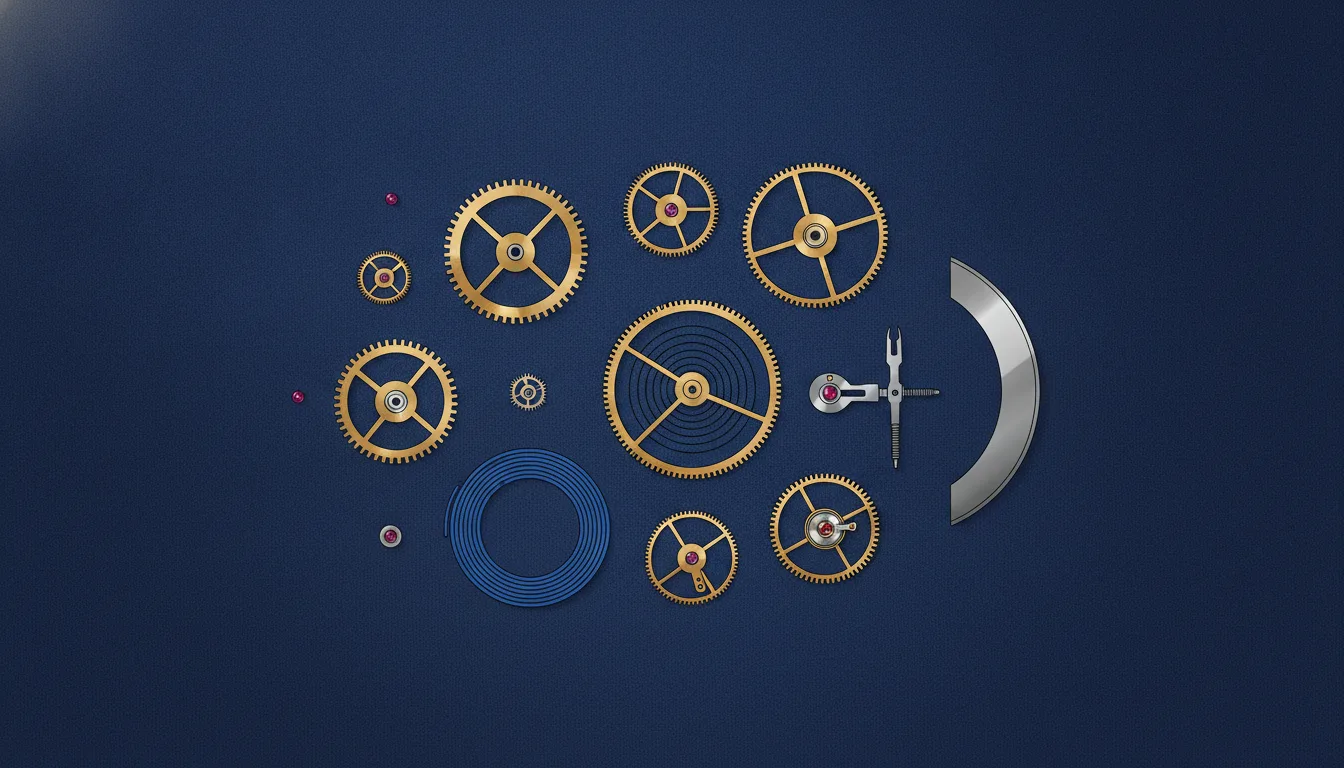
Watch marketing sells cases, dials and stories. The calibre inside is the one part of the spec sheet you can check, compare and price — and once you know a dozen of them by name, most of the market stops being mysterious.
Prices, model line-ups and service quotes below are a late-2026 snapshot and vary enormously by market and by watchmaker. Treat every figure as an order of magnitude, not a quotation.
A movement is an engine
A mechanical movement — a calibre, in the trade — does four things, in order. It stores energy in a coiled spring, transmits that energy through gears, releases it in tiny equal steps, and counts those steps. Everything else is decoration.
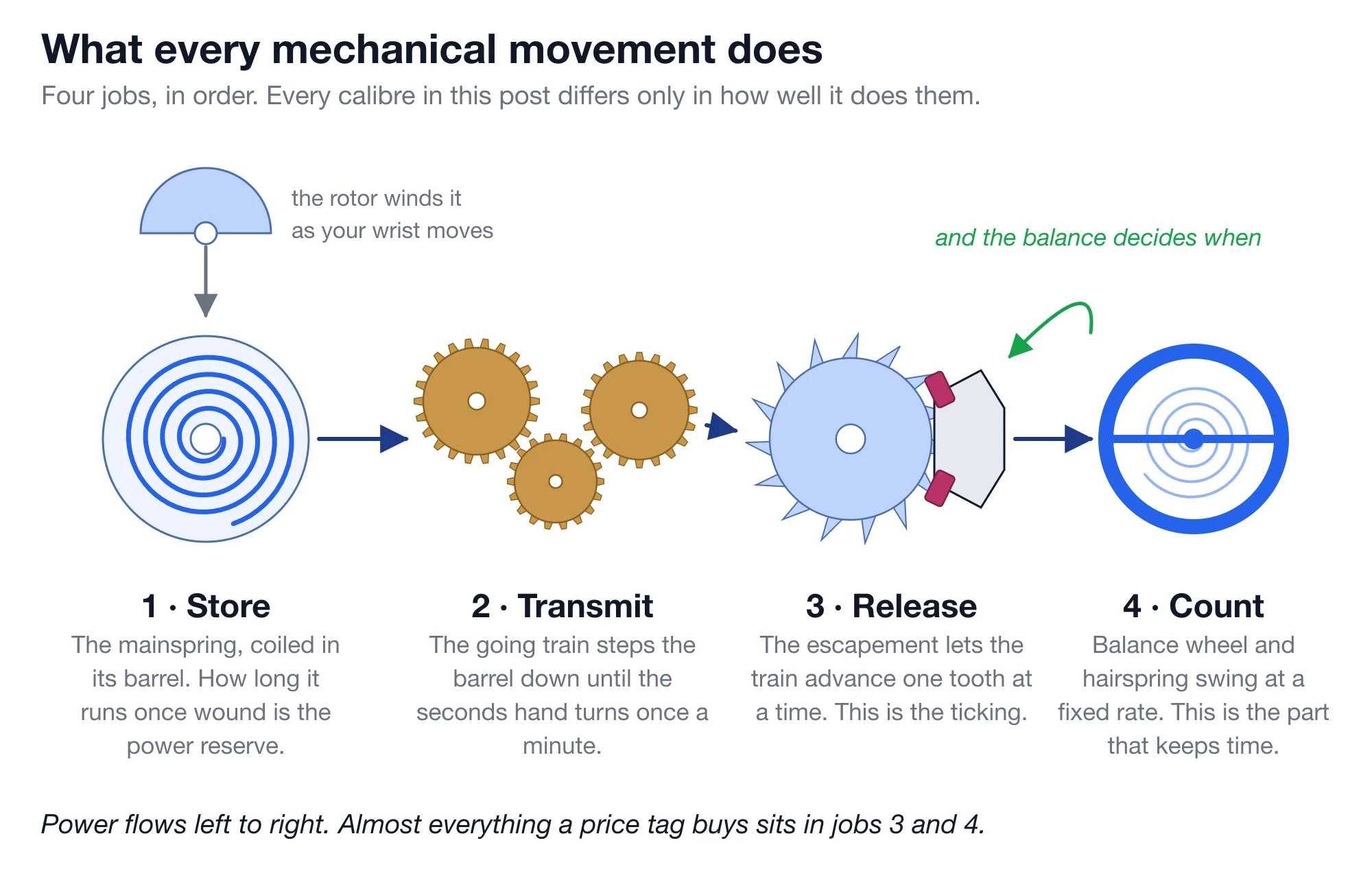
The fourth job is the one that matters. A balance wheel swinging on a hairspring is a pendulum that doesn't care which way is up, and its rate is set by how heavy the wheel is and how stiff the spring is. Change the temperature, hold the watch in a different position, put it near a magnet, let the oil age — and that rate moves. Every meaningful difference between a €300 watch and a €12,000 one is an attempt to stop it moving.
That framing explains something that otherwise looks absurd: a Seiko for €200 and a Rolex for €10,000 both keep time to within a few seconds a day. They are doing the same physics. The expensive one is doing it more consistently, for longer, under more abuse — and it is doing it while somebody polished the inside edges of parts nobody will ever see.
The three numbers that mean something
Three specifications on a calibre actually predict how the watch behaves. A fourth, the one brands print largest, predicts almost nothing.
Beat rate is how many times a second the balance swings, quoted in the old unit of vibrations per hour (vph) or in hertz (Hz), where one hertz is two vibrations. 28,800 vph is 4 Hz, and it's the modern standard. A faster balance is less disturbed by a knock or by gravity, so it tends to keep better time and it can time shorter intervals — but it eats the mainspring faster and wears more.
Power reserve is how long the watch runs from fully wound. Forty hours means taking it off on Friday evening and finding it dead on Sunday. Eighty hours means it survives the weekend. This is a genuine quality-of-life difference and it is the axis the industry has competed hardest on since about 2010.
Accuracy tolerance is the range the maker will stand behind, in seconds gained or lost per day. Note that it is a range, not a number: a movement rated ±7 to ±20 seconds a day is one where a good example does one thing and a bad example does another, and both leave the factory.
Jewel count, printed on rotors since the 1950s, is the one to ignore. Jewels are synthetic ruby bearings that reduce friction at the pivots; a watch needs about 17 to have them where they matter, and the rest are marketing or a consequence of complications. Twenty-five jewels is not better than twenty-one in any way you will notice.
Those numbers place a calibre somewhere on a ladder that the rest of this post walks up.
An ébauche is the trade word for a movement blank sold to other brands to finish, case and sell under their own name. It is the hinge of the whole story.
How the industry got here
Almost every calibre in this post is a survivor of one catastrophe, and several of them survived it by being physically hidden.
Before wristwatches, pocket watches
The oldest design still in daily production is the Unitas 6497, a hand-wound pocket watch movement from around 1950 that is 36.6 mm across — enormous, because pockets are bigger than wrists[1]. It runs at a leisurely 18,000 vph with 17 jewels and about 46 hours of reserve. Its sibling the 6498 is the same movement with the seconds subdial moved, for a different pocket-watch case layout.
It should have died. Instead, when Panerai revived its oversized diver's watches in the 1990s it needed a movement big enough to fill a 44 mm case, and the 6497 was sitting there. Panerai's early calibres are 6497s. The entire fashion for very large hand-wound watches is downstream of a movement designed for a waistcoat.
1969, and three companies claiming the same first
The automatic chronograph — a self-winding watch that also times intervals — arrived in 1969 from three unconnected teams within months of each other, and which one was "first" depends entirely on which criterion you pick.
| Claimant | Movement | The claim |
|---|---|---|
| Zenith | El Primero 3019 PHC | Announced first, in January 1969 — and the only integrated design rather than a module bolted onto a base |
| Heuer, Breitling, Hamilton and Dubois Dépraz | Calibre 11 "Chronomatic" | First public demonstration, unveiled simultaneously in four cities that March |
| Seiko | 6139 | First actually on sale, in Japan in May 1969[2] |
Zenith's entry was the technically extreme one: an integrated column-wheel chronograph running at 36,000 vph, or 5 Hz, fast enough to time a tenth of a second[3]. Nothing else came close, and nothing has really needed to since.
Seiko's 6139 went on to become the first automatic chronograph in space, on Colonel William Pogue's wrist aboard Skylab 4 in 1973 — unofficially, since NASA had qualified the hand-wound Omega[4]. That Omega's engine was the Lemania 2310, a column-wheel chronograph designed by Albert Piguet and launched in 1942, which Omega sold as the calibre 321[5].
The quartz crisis, and what people hid
Then a quartz oscillator turned out to keep better time than any of it, for a fraction of the money. Between 1970 and the mid-1980s the number of Swiss watch companies fell from over 1,600 to under 600, and employment in the industry went from roughly 90,000 people to about 33,000[6]. Two conglomerates holding most of the famous names went insolvent and were merged, under Nicolas Hayek, into what became the Swatch Group.
Two of this post's calibres exist today only because employees disobeyed orders.
At Valjoux, Edmond Capt had designed the 7750 in 1974 — reportedly the first watch movement developed with computer-aided design — and was told within a year to destroy the tooling and documentation. He preserved them instead[7]. At Zenith, the American parent ordered mechanical production stopped and the El Primero tooling scrapped; the watchmaker Charles Vermot archived the plans and walled roughly 150 punching presses into the attic of a building next to the Le Locle factory, and led management back to them years later when the market turned[8]. Recreating that tooling from scratch was later estimated at six to seven million francs.
Without Vermot there is no El Primero revival — and no Rolex Daytona calibre 4030, which was a modified El Primero from 1988 to 2000.
ETA's monopoly, and the competitor it created
By the 1990s the consolidated survivor of the Swiss movement industry was ETA, inside the Swatch Group, and it supplied half the trade. In 2002 it announced it would stop selling ébauches to outside customers — which would have quietly killed a large part of the independent industry[9].
The Swiss Competition Commission, COMCO, spent the next seventeen years slowing that down: forced deliveries to the end of 2010, a 2013 settlement with a staged reduction to 2019, extensions after that. Meanwhile the patents on the ETA 2824 lapsed in 2002, and Sellita — a firm that had spent decades assembling ETA movements under contract, and therefore knew them intimately — started building its own. By 2019 it was shipping around a million movements a year, roughly double ETA's third-party volume[10].
This is why every brand suddenly announced an in-house calibre in the 2010s, and it is why the movement in your Swiss watch is now as likely to say Sellita as ETA.The Swiss workhorses
Four movements cover most Swiss watches under about €3,000.
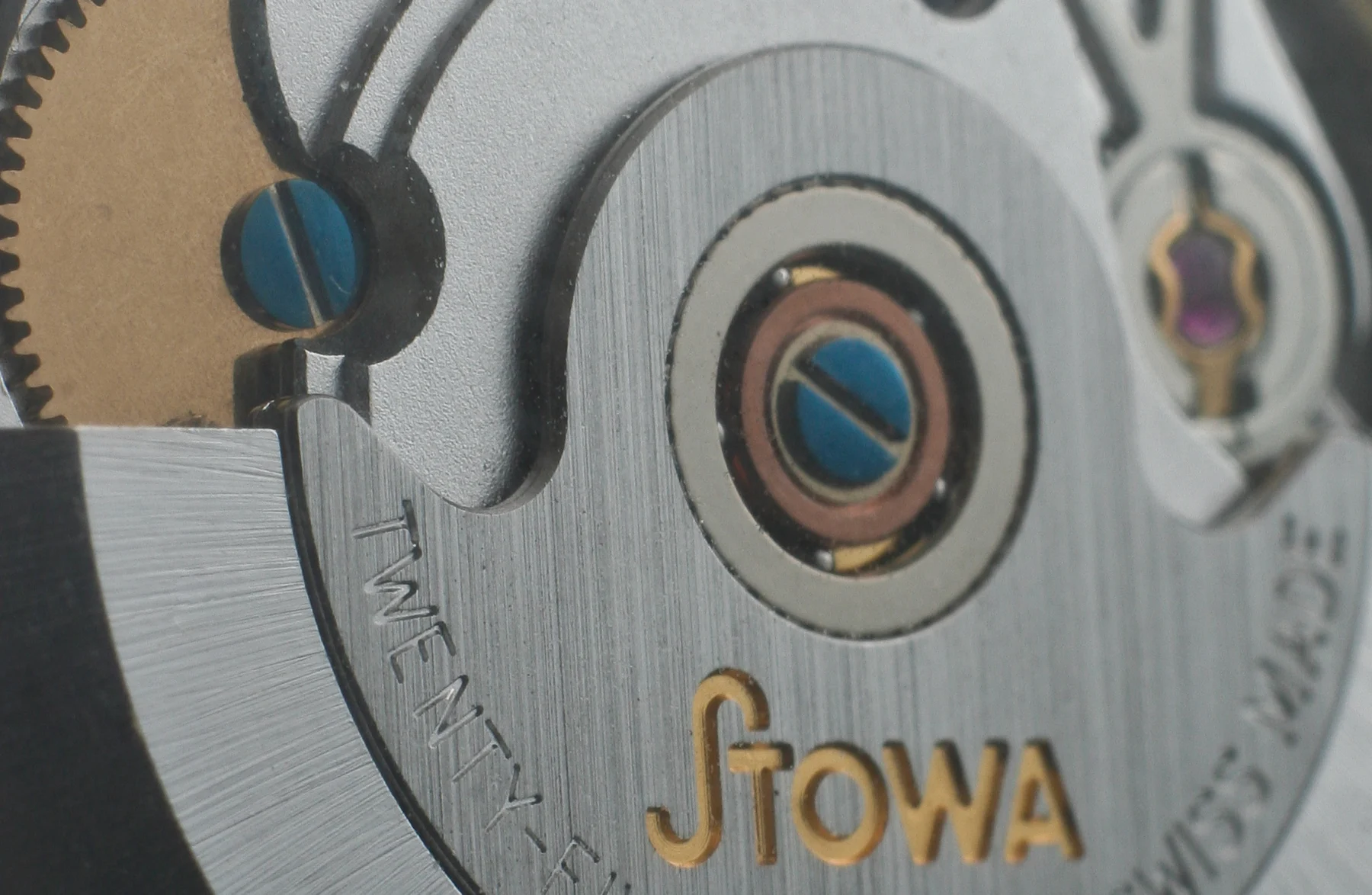
An ETA 2824 seen through the back of a Stowa Antea. The engraved rotor is the giveaway — brands decorate the one part of the movement you can see. Photo by Guy Sie, cropped, CC BY-SA 2.0.
ETA 2824-2 and Sellita SW200-1 — the default
The 2824 arrived in 1971 and the 2824-2 in 1982[11]. It is 25.6 mm across and 4.6 mm thick, runs at 28,800 vph, holds around 38 to 42 hours, has 25 jewels, and does everything a three-hand automatic should: winds by hand, stops the seconds hand when you pull the crown, quick-sets the date[12].
What makes it the default is not any of that. It is that ETA sells it in four grades, and that Sellita's clone uses the same architecture, the same dimensions and largely the same parts[13].
| Grade | Positions adjusted | Accuracy, seconds per day |
|---|---|---|
| Standard | 2 | ±12 to ±30 |
| Elaboré (Sellita: Special) | 3 | ±7 to ±20 |
| Top (Sellita: Premium) | 5 | ±4 to ±15 |
| Chronomètre | COSC certified | −4 to +6 |
Two watches with "ETA 2824-2" on the spec sheet can therefore be four times different in accuracy, and brands are frequently vague about which grade they bought. It is the single most useful question to ask before buying.
ETA 2892-A2 — the thin one everything is built on
The 2892 came out of the quartz crisis in 1975 as a rationalisation exercise and grew into ETA's elite base: same 25.6 mm width but only 3.6 mm thick, 21 jewels, 28,800 vph, around 42 hours[14]. Thinness is the point — it leaves room to stack a chronograph, a calendar or a power-reserve indicator on top without the watch becoming a hockey puck.
An enormous amount of apparently in-house luxury watchmaking is a 2892 underneath: Breitling, Hublot, IWC, TAG Heuer, Cartier, Panerai and Omega have all shipped calibres built on it. Sellita's SW300-1 equivalent now carries a barrel giving 56 hours, which makes the clone objectively better than the original on the spec most people care about.
Valjoux 7750 — the chronograph that scaled
Capt's 7750 is 30 mm across and 7.9 mm thick, runs at 28,800 vph, holds about 45 hours, and puts its subdials at 6, 9 and 12 o'clock — a layout so common it reads as "chronograph" to most people[7].
Its defining choice is a cam rather than a column wheel to control the start-stop-reset sequence. A column wheel is a little rotating castle that routes the levers; a cam is a stamped lobe that shoves them. The column wheel gives the silky pusher feel that enthusiasts write about; the cam is cheaper, faster to make and easier to service, and it is why the 7750 became by volume the most-produced mechanical chronograph in history. Breitling, IWC, Omega, TAG Heuer, Panerai, Sinn, Tudor and Hamilton have all used it or a derivative.
Powermatic 80 — eighty hours, and an argument
The Powermatic 80 is what happens when a company decides the power reserve is the spec that sells. Introduced by ETA in 2013 on 2824 architecture, it drops the beat rate to 21,600 vph — 3 Hz instead of 4 — and spends the energy saved on an 80-hour reserve[15]. Take the watch off on Friday and it is still running on Monday. Nothing else at €400 does that.
Two variants exist and the difference is worth knowing: the C07.111 has 23 jewels and a synthetic polymer escape wheel and pallet fork, while the C07.611 has 25 jewels and a conventional metal escapement with ruby pallets. The rotor engraving tells you which one you have. Many but not all are now fitted with Nivachron, a titanium-based hairspring alloy developed by the Swatch Group with Audemars Piguet, claimed to cut magnetic sensitivity by a factor of ten to twenty — brands are inconsistent about which references get it, so check the specific model rather than the calibre code.
Then there is the regulation argument, which is the most misreported thing in this segment. The facts are not in dispute: the movement has no index regulator — no little lever you nudge to speed it up or slow it down — and is instead free-sprung, adjusted by inertia screws on the balance rim, set at the factory by an automated laser process.
What that means is disputed. Critics argue that since an independent watchmaker cannot laser-regulate, the movement effectively has to go back to a Swatch service centre, and that combined with polymer escapement parts and a low replacement cost it is a disposable movement dressed as a Swiss one[16]. The rebuttal is that the laser is used at the factory to poise the balance by removing tiny amounts of metal, and that any competent watchmaker can still adjust the rate using the two inertia screws[17]. Both are true. It is adjustable — just not in the way a 2824 is, and not by the mental model most watchmakers were trained on.
The honest summary: the Powermatic 80 trades the traditional repair model for eighty hours and a low price. Whether that is a bargain depends entirely on whether you expect to still own the watch in 2050.
The prestige tier
Above about €4,000, brands make their own movements — or say they do.
Rolex 3135 and 3235
The 3135 powered Submariners and Datejusts from 1988 for nearly three decades and is the movement watchmakers name when asked what a robust automatic looks like: 28.5 mm, 31 jewels, 28,800 vph, about 48 hours, a free-sprung balance regulated by Microstella nuts rather than an index.
The 3235 replaced it in 2015 with over 90% of its parts new or redesigned[18]. The headline change is the Chronergy escapement — a reshaped, nickel-phosphorus (so non-magnetic) version of the Swiss lever, about 15% more efficient — which together with a thinner, higher-capacity barrel takes the reserve from 48 to about 70 hours.
Rolex then tests the finished, cased watch to its own Superlative Chronometer standard of −2 to +2 seconds a day, after the movement has already passed COSC[19]. That "after casing" detail matters more than the number, and the next section explains why.
Omega and the co-axial escapement
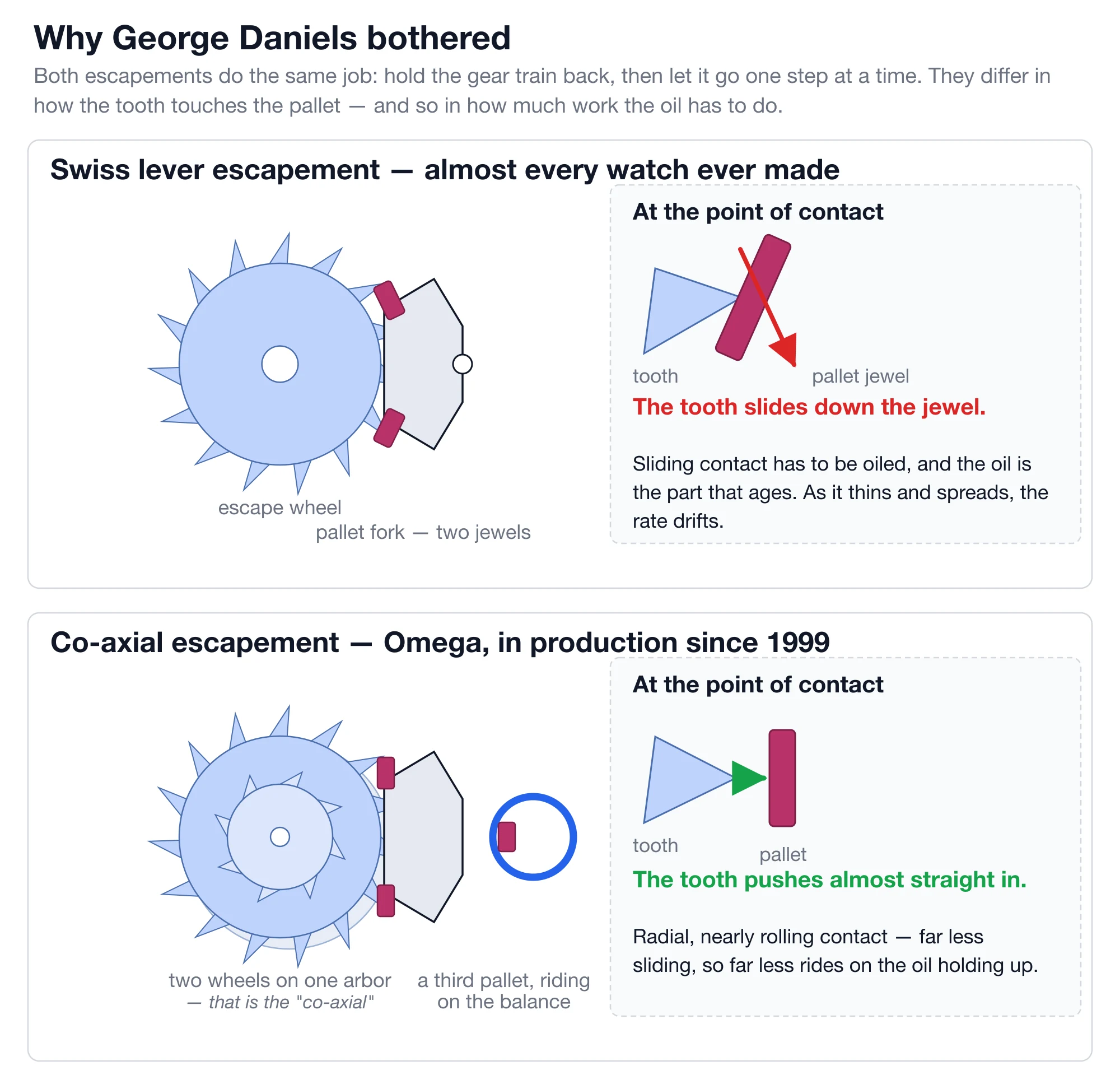
Every escapement so far in this post is a Swiss lever, and every Swiss lever has the same weakness: the escape wheel tooth slides along the face of the pallet jewel as it delivers its push. Sliding contact needs oil, oil ages, and an ageing escapement is most of why a watch drifts and most of what a service puts right.
George Daniels designed a way around it in 1974 — some accounts say 1976 — and patented it in 1980[20]. His co-axial escapement uses two escape wheels on a shared arbor and three pallets instead of two, arranged so the impulse is delivered as a nearly radial push rather than a slide. Less sliding means far less riding on the lubricant.
He spent two decades being turned down by the entire Swiss industry. Omega bought the patent in 1993, Hayek pushed it through, and the first production watches appeared in 1999 with the calibre 2500 — which was, tellingly, an ETA 2892 with the new escapement fitted.
| Calibre | Year | Beat | Power reserve | Certification |
|---|---|---|---|---|
| 2500 | 1999 | 28,800, later 25,200 vph | ~48 h | COSC |
| 8500 | 2007 | 25,200 vph | 60 h | COSC — Omega's first fully in-house automatic |
| 8800 | 2016 | 25,200 vph | 55 h | METAS Master Chronometer |
| 8900 | 2016 | 25,200 vph | 60 h | METAS Master Chronometer |
The 8800 and 8900 pair the co-axial with a silicon balance spring, which is what lets Omega promise resistance to 15,000 gauss — enough that the magnets in a laptop or a handbag clasp stop being a concern[21].
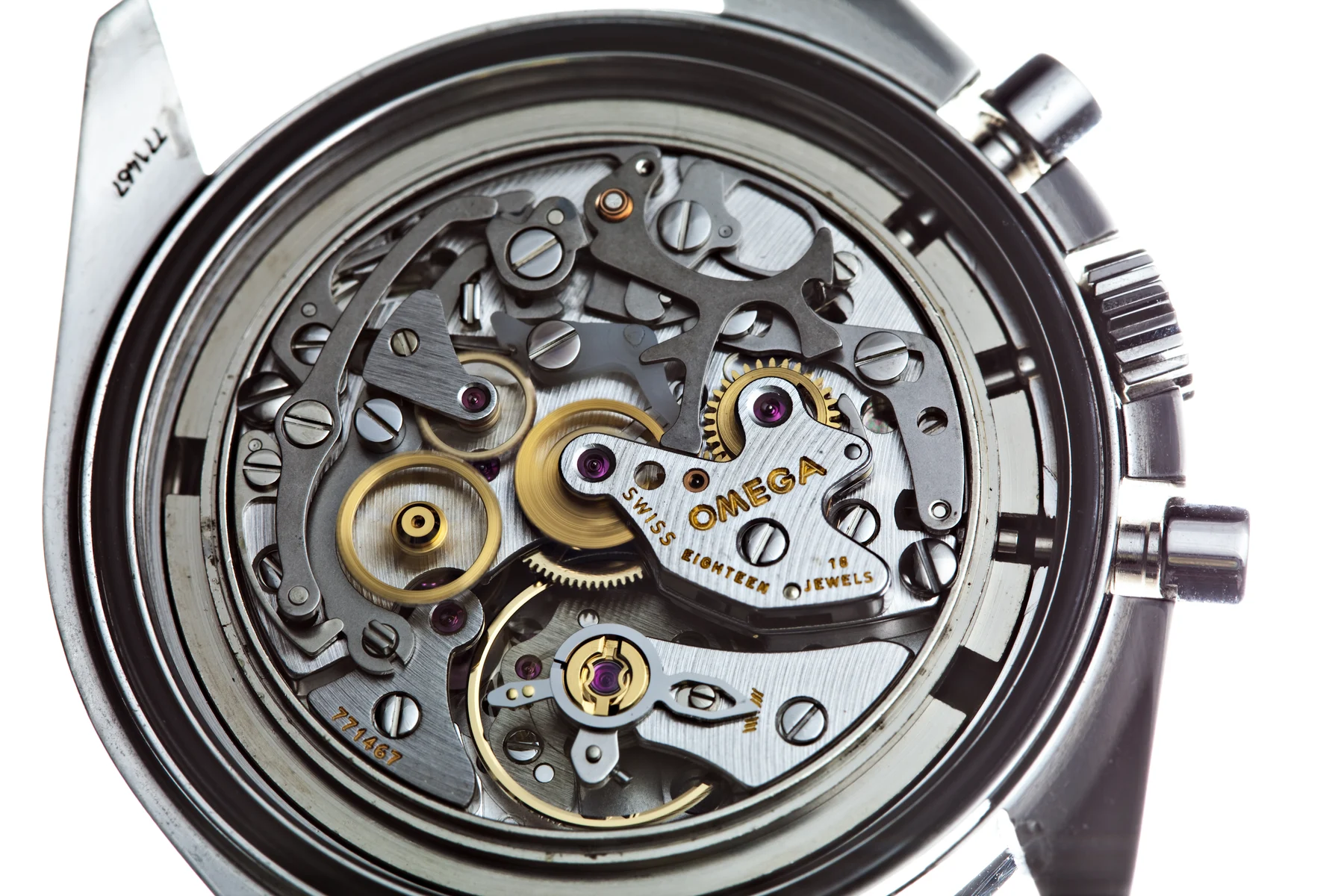
The Speedmaster's calibre 1861 — a descendant of the 1942 Lemania 2310, with a cam in place of the original column wheel. In 2021 the Moonwatch moved to the 3861, which adds a co-axial escapement, a silicon hairspring and METAS certification to the same basic hand-wound architecture. Photo by Shane Lin, CC BY-SA 2.0.
Zenith El Primero
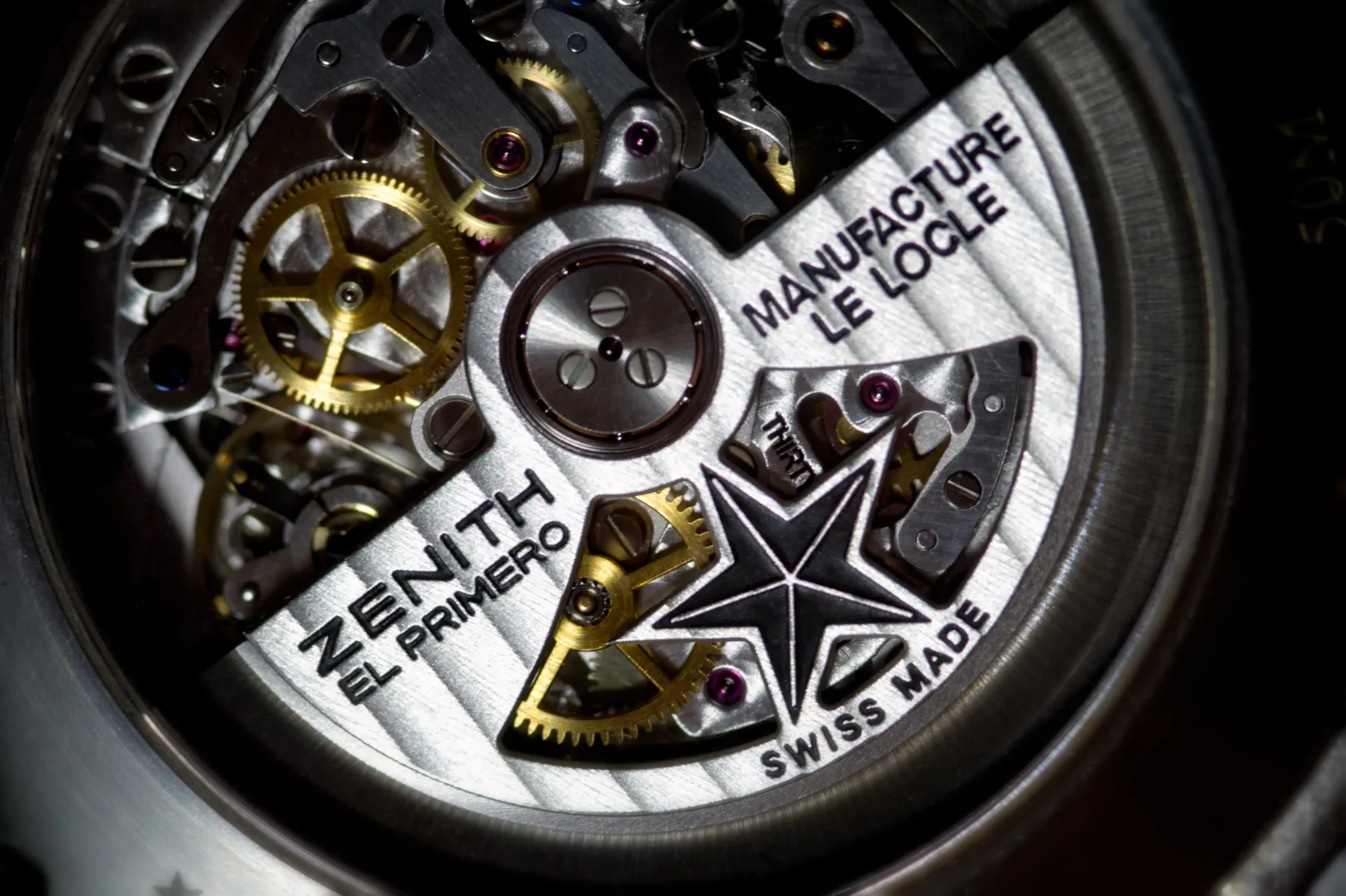
Zenith El Primero. The star is the Zenith logo; the movement beneath it is the one Charles Vermot walled into an attic. Photo by Eric Kilby, cropped, CC BY-SA 2.0.
Still 36,000 vph, still an integrated column-wheel chronograph, still around 50 hours and 31 jewels, still built from 278 parts. Nothing else in production runs that fast, and the high beat is audible: an El Primero's seconds hand moves in ten steps a second rather than the usual eight, which reads to the eye as a smoother sweep.
The movement that four companies used and its maker didn't
In 1967 Jaeger-LeCoultre built the calibre 920, at 2.45 mm still the thinnest full-rotor automatic ever made — thin enough that the rotor rides on a peripheral rail with ruby rollers instead of a central bearing. JLC never put it in a Jaeger-LeCoultre watch. It sold it as an ébauche.
Audemars Piguet used it as the 2120/2121, in the 1972 Royal Oak. Patek Philippe used it as the 28-255, in the 1976 Nautilus. Vacheron Constantin used it as the 1120, in the 1977 222[22].
The three watches routinely described as the founding luxury sports watches all run the same movement, made by a fourth company that never used it itself. Keep that in mind whenever a brochure says in-house.
The Japanese answer
Japan spent the quartz crisis on the winning side, and its mechanical movements were designed by people who had no romantic attachment to the Swiss way of doing things.
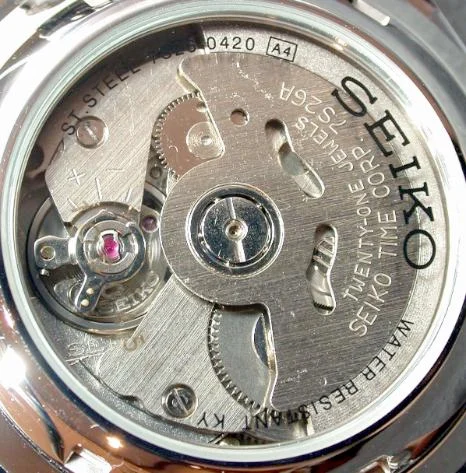
The Seiko 7S26, direct ancestor of today's NH35 and the engine of the SKX diver. Note the complete absence of decoration: no stripes, no polishing, nothing you would show off. Photo by "Poor Man watch", public domain.
NH35 — the hobbyist default
The NH35 and the Seiko-branded 4R35 are the same movement: 27.4 mm, 24 jewels, 21,600 vph, about 41 hours, with hand-winding and a hacking seconds hand[23]. Accuracy is usually quoted at −20 to +40 seconds a day, a figure that circulates far more widely than any published datasheet supports.
Its ancestor is the 7S26 from 1996, the movement in the SKX divers, which had neither hand-winding nor hacking — you shook the watch to start it and could not set it to the second. Adding both is the whole reason the NH35 replaced it in enthusiasts' affections.
Two pieces of Seiko engineering explain its reputation. Diashock is Seiko's shock-absorbing mount for the delicate balance pivots. And the Magic Lever is the winding system, patented in the 1950s and unchanged since.
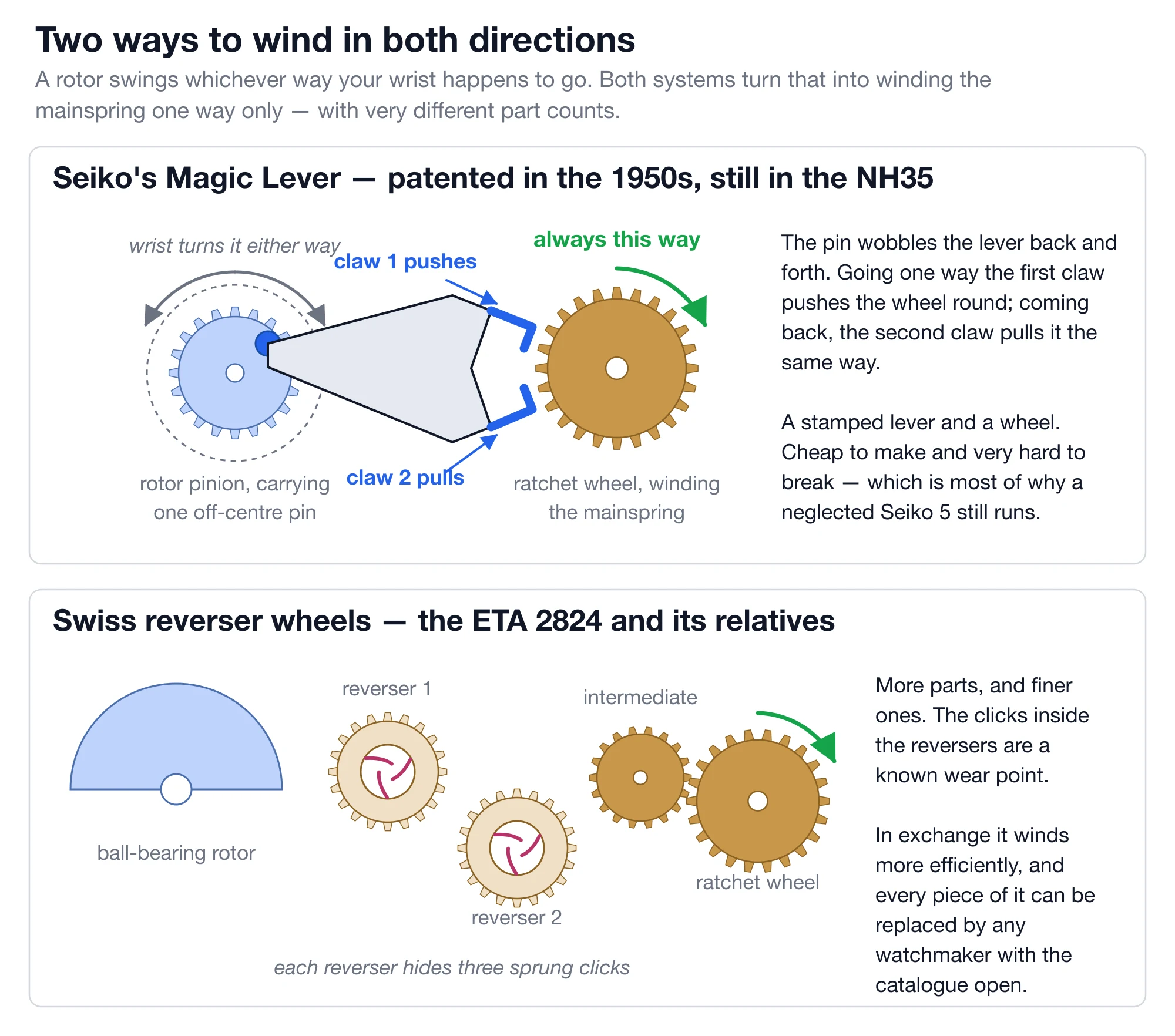
A Swiss automatic converts both directions of rotor swing into one direction of winding using reverser wheels with sprung clicks inside them — efficient, and a known wear point. Seiko does it with one stamped lever carrying two claws: swing one way and the first claw pushes the ratchet round, swing back and the second claw pulls it the same way. Fewer parts, almost nothing to wear out, and cheap enough that when it does fail the answer is a new movement rather than a repair.
That last point is the NH35's real argument. It has the largest ecosystem of any movement on earth — cases, dials, hands and stems from dozens of suppliers are built to its dimensions — and it costs so little that replacement beats repair. It is not accurate and it is not refined. It is unkillable and infinitely available, which for most people is worth more.
6R35, Grand Seiko, and Spring Drive
Seiko's step up, the 6R35, keeps 21,600 vph but stretches the reserve to about 70 hours using its proprietary Spron mainspring alloy. Its accuracy spec, though, stays at −15 to +25 seconds a day, and real-world results are notoriously variable between examples[24]. At the €700–1,600 the watches around it cost, that is a fair thing to hold against Seiko: a Sellita in Premium grade would do better.
Grand Seiko is a different company in all but name. The 9S65 runs 28,800 vph with 35 jewels, about 72 hours, and a rated −3 to +5 seconds a day, tested for 17 days in 6 positions[25]. Its escape wheel and pallet fork are fabricated using MEMS — micro electro mechanical systems, the etching technology used to make silicon chips — which produces lighter, more precise parts than stamping can.
Spring Drive is the genuinely strange one. It has a mainspring and a gear train like any mechanical watch, but no escapement and no balance. The train ends in a glide wheel that spins continuously, generating a trickle of current that runs a quartz oscillator; a circuit compares the wheel's actual speed to the quartz reference and brakes it electromagnetically, without contact[26]. The result is ±1 second a day, 72 hours of reserve, and a seconds hand that genuinely glides rather than ticks, because nothing is being released in steps.
Miyota 8215 and 9015
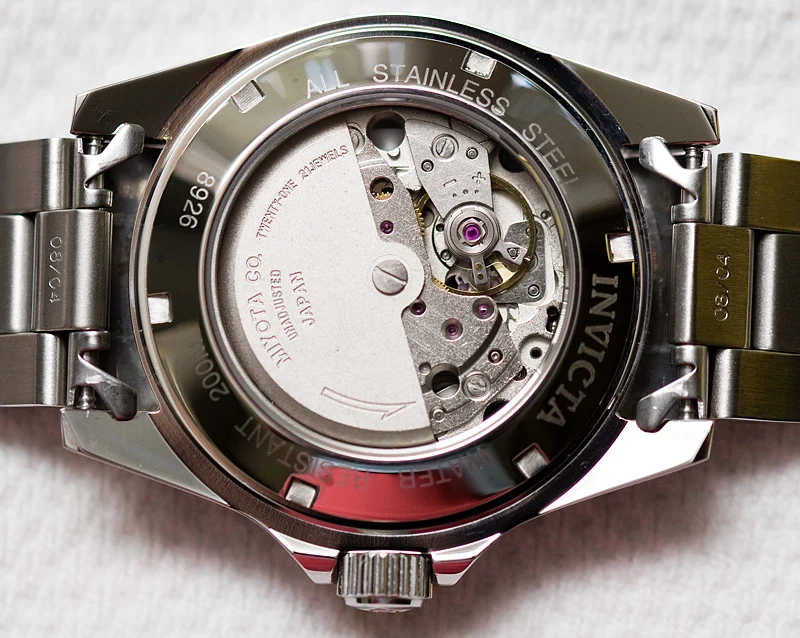
A Miyota 8215 in an Invicta. "Unadjusted" is printed right on the plate — a statement of intent about which end of the market this is. Photo by Rosstomson, CC BY 3.0.
Citizen's movement arm makes the NH35's main rival and the movement that beats it on paper.
| Miyota 8215 | Miyota 9015 | |
|---|---|---|
| Beat | 21,600 vph | 28,800 vph |
| Thickness | 5.67 mm | 3.9 mm |
| Jewels | 21 | 24 |
| Power reserve | ~42 h | ~42 h |
| Hacking seconds | No | Yes |
| Accuracy, s/day | −20 to +40 | −10 to +30 |
The 8215 is the cheap one, and its non-hacking seconds and audible rotor stutter are its well-known tells. The 9015 is the one microbrands reach for: Swiss beat rate, genuinely thin, hacking, and a tighter tolerance, at a fraction of Swiss cost[27]. Its weaknesses are rotor noise and a service ecosystem far smaller than Seiko's or ETA's.
The Chinese tier
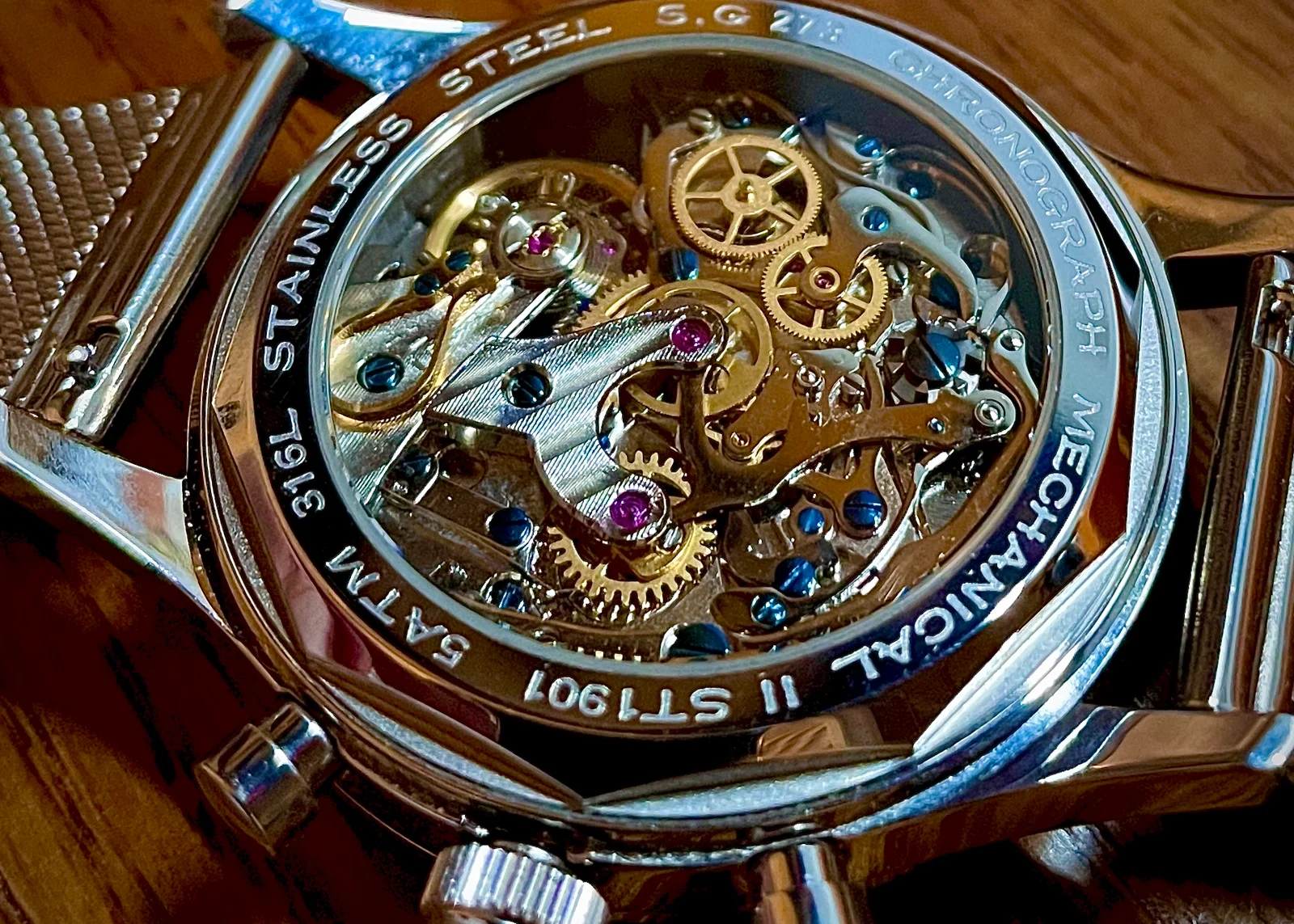
A Seagull ST1901, engraved on the caseback. The small toothed cylinder near the centre is the column wheel — the part the Valjoux 7750 deliberately replaced with a cam. Photo by Czarcaustic, cropped, CC BY-SA 4.0.
The Seagull ST19 family has the best origin story of any movement here. It descends directly from the Venus 175, a Swiss hand-wound column-wheel chronograph whose tooling and drawings Venus sold to the Tianjin Watch Factory in 1961, under a state programme to build a chronograph for the Chinese air force[28]. Tianjin has been making it ever since: 31.3 mm, 21,600 vph, up to 22 jewels, roughly 42 to 51 hours.
The consequence is that the only genuinely affordable column-wheel chronograph in the world is Chinese. A Swiss column-wheel chronograph starts in the thousands; an ST19 watch costs a few hundred.
Seagull's other significant movement is the ST2130, a 2824 clone at 25.6 mm, 28,800 vph, 26 jewels. Independent bench testing found it capable of meeting ETA's own minimum specifications, with good rate stability[29]. It has a darker side too: the ST2130 is the base most commonly used for counterfeit ETA 2824-2 movements, complete with convincing laser-engraved logos — a real risk if you buy a loose "genuine ETA" movement on the grey market.
Everything, side by side
| Calibre | Beat | Power reserve | Accuracy as sold, s/day | Serviceability | Typical watch price |
|---|---|---|---|---|---|
| Seiko NH35 / 4R35 | 21,600 vph | ~41 h | −20/+40 (commonly quoted) | €80–600 | |
| Miyota 8215 | 21,600 vph | ~42 h | −20/+40 | €100–400 | |
| Miyota 9015 | 28,800 vph | ~42 h | −10/+30 | €300–1,200 | |
| Seagull ST19 | 21,600 vph | ~42–51 h | not specified | €200–500 | |
| ETA 2824-2 | 28,800 vph | ~38–42 h | ±7 to ±20 (Elaboré) | €300–1,500 | |
| Sellita SW200-1 | 28,800 vph | ~38–41 h | ±7 to ±20 (Special) | €300–1,200 | |
| ETA 2892-A2 | 28,800 vph | ~42 h | ±4 to ±15 (Top) | €1,000–8,000 | |
| Sellita SW300-1 | 28,800 vph | ~56 h | ±4 to ±15 (Premium) | €800–4,000 | |
| Valjoux 7750 | 28,800 vph | ~45 h | ±7 to ±20 | €1,000–8,000 | |
| Powermatic 80 | 21,600 vph | 80 h | −2/+8 | €350–900 | |
| Seiko 6R35 | 21,600 vph | ~70 h | −15/+25 | €700–1,600 | |
| ETA / Unitas 6497 | 18,000 vph | ~46 h | grade dependent | €200–8,000 | |
| Zenith El Primero 400 | 36,000 vph | ~50 h | chronometer grade | €7,000+ | |
| Omega 8800 / 8900 | 25,200 vph | 55–60 h | 0/+5 | €5,000–10,000 | |
| Rolex 3235 | 28,800 vph | ~70 h | −2/+2 | €8,000+ | |
| Grand Seiko 9S65 | 28,800 vph | ~72 h | −3/+5 | €4,500–7,000 | |
| Grand Seiko 9R65 Spring Drive | no escapement | ~72 h | ±1 | €5,000+ |
What the certifications actually certify
Four standards get quoted, and the number is the least interesting part of each.
| Standard | Tolerance, s/day | Tested on | Test |
|---|---|---|---|
| COSC chronometer | −4 to +6 | Uncased movement | 15 days, 5 positions, 3 temperatures |
| Grand Seiko standard | −3 to +5 | Movement | 17 days, 6 positions, 3 temperatures |
| METAS Master Chronometer | 0 to +5 | Cased watch | 8 tests over 10 days, including 15,000 gauss |
| Rolex Superlative Chronometer | −2 to +2 | Cased watch | 7 positions plus a rotating rack, after COSC |
COSC — the Contrôle Officiel Suisse des Chronomètres, the Swiss body that has certified chronometers since 1973 — tests a bare movement, judged on seven criteria of which the daily rate is only one[30]. METAS, the Swiss Federal Institute of Metrology, tests the finished watch with its dial, hands and case fitted[31].
That distinction is the whole point. A movement can pass COSC on the bench and then lose time once it is cased, because fitting the hands changes the load on the train and the case changes how the movement sits. Certifying the object the customer actually receives is a harder promise than certifying the part inside it, and it is the substantive thing Omega and Rolex did in the mid-2010s while everyone else was announcing power reserves.
The sweet spot
Here is the uncomfortable conclusion of all of the above: the accuracy curve flattens fast. A €400 Tissot rated −2 to +8 seconds a day and a €9,000 Rolex rated −2 to +2 are, in daily use, both watches you set once a month. The money past that point is buying three other things — how long it runs, how long it lasts, and how it looks under a loupe.
Which means the value question is really about serviceability, and there the answer is unambiguous.
The ETA 2824-2 and Sellita SW200-1 share an architecture, dimensions and most of their parts. There are millions of them, in every country, and any competent independent watchmaker can open one and order what they need from a catalogue. That is not true of a Powermatic 80, or of a Grand Seiko, or of anything in-house. A 30-year-old watch running a 2824 is a repairable object; most of the alternatives, in 30 years, will be a question mark.
| Best at | Real cost | Value verdict | |
|---|---|---|---|
| Seiko NH35 | Being replaceable and unkillable | ~€150 for a new movement | |
| Sellita SW200-1, Premium grade | Swiss accuracy at Swiss-clone prices | €200–300 a service, every ~5 years | |
| Miyota 9015 | Spec per euro — 4 Hz, thin, hacking | Replace, ~€200 | |
| ETA 2892-A2 / Sellita SW300-1 | Thinness and headroom for complications | €250–350 a service | |
| Powermatic 80 | 80 hours nothing else touches at the price | Realistically a factory exchange | |
| Rolex 3235 | Being serviceable in 40 years, at a price | €800+ a service, every ~10 years | |
| Seiko 6R35 | 70 hours in a nicely made watch | Replace |
Turning that into a decision:
What is actually worth paying for
Three things, in order.
Serviceability, because it decides whether you own a watch or a countdown. A movement with a catalogue behind it and a parts supply outside one company is worth a real premium over a better-specified one without.
Power reserve, because it is the only spec you notice every week. Eighty hours versus forty is the difference between a watch that is running when you pick it up and one that isn't.
A movement with a story, because that is honestly what most of the money above €3,000 buys and there is no point pretending otherwise. An El Primero is not a better timekeeper than a Grand Seiko 9S65 and costs more; what it is, is the movement a watchmaker hid in an attic to save it. That is worth something, and it is a more honest reason to buy than a spec sheet nobody can tell apart on the wrist.
Accuracy is not on the list. Past the entry level, they are all accurate enough, and the ones that aren't — the 6R35, the base-grade 2824 — are usually the ones being sold on something else anyway.
References
- The History of the ETA/Unitas 6497 and 6498 — Monochrome
- Seiko's 6139 Speedtimer in the Race to Create the World's First Automatic Chronograph — The Hour Markers
- The History of the Zenith El Primero — Time and Watches
- TBT: The Seiko 6139 "Pogue" Chronograph — Fratello
- The Complete History of the Lemania Chronograph Calibre 2310 — Revolution
- Quartz crisis — Wikipedia
- Valjoux 7750: History, Technical Explanation, Evolution and Clones — Monochrome
- How Charles Vermot Saved the Zenith El Primero, in His Own Words — Grail Watch
- Explaining the End of ETA Movement Sales and the COMCO Ruling — Watches by SJX
- The History of Sellita — Time+Tide
- The History of the ETA 2824, the Mundane Calibre That Shaped the Industry — Monochrome
- ETA Caliber 2824-2 — Caliber Corner
- Sellita Caliber SW200-1 — Caliber Corner
- In-Depth: History of the ETA 2892-A2 — Monochrome
- Tissot Caliber Powermatic 80 — Caliber Corner
- Tissot Powermatic 80 Is Practically Unserviceable — Miragecraft
- Could This Be the Future of the Powermatic 80? — Time+Tide
- Rolex Caliber 3235 — Professional Watches
- What Is the Rolex Superlative Chronometer Standard? — Time+Tide
- Coaxial escapement — Wikipedia
- Omega Caliber 8800 — Caliber Corner
- Calibres 2120 & 2121 — AP Chronicles, Audemars Piguet
- Seiko Caliber NH35A — Caliber Corner
- The Seiko 6R35 and Soprod: A Workhorse Movement in Flux — Fratello
- Caliber 9S65 — Grand Seiko
- Spring Drive — Grand Seiko
- Miyota Caliber 9015 — Caliber Corner
- Tianjin Seagull — Chinese Watch Wiki
- Comparison: Sea-Gull ST2130, ETA 2824-2 and Peacock SL3000 — Watchguy
- COSC FAQ — Contrôle Officiel Suisse des Chronomètres
- Master Chronometer Explained: New Standards by Omega — Fratello