
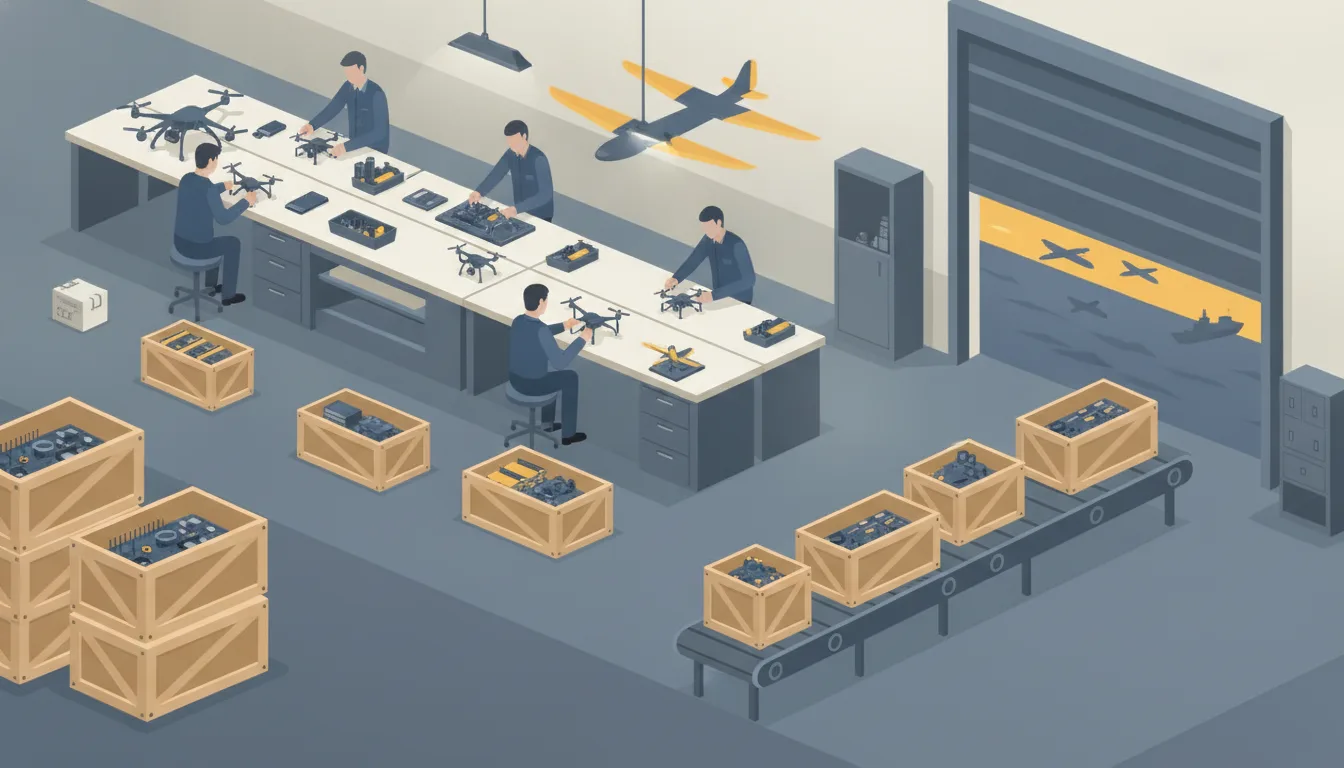
Ukraine now makes almost all the drones it uses in the war, and its factories can make more than the country can pay for. This post explains who builds them, who helps pay for them, and which countries have started to buy them.
This post reflects the situation in October 2026. The war changes fast, and many numbers here are official Ukrainian statements, not checked by anyone outside the government. Check the latest news before you rely on a figure.
The picture in four answers
Four questions explain most of the story, and each one has a short answer.
- Does Ukraine make its own drones? Yes. In 2022 it had about ten drone makers. Today it has hundreds, and almost all the drones its army uses are made in Ukraine. The weak point is that many small parts still come from China.
- Does it get help? Yes, mostly money. Other countries and the European Union (EU) pay Ukrainian factories to make drones for the Ukrainian army. Some countries also build Ukrainian drones in their own factories.
- Does it have more than it needs? Not in finished drones. There is no large stock waiting to be sold. What Ukraine has is unused factory capacity: its companies could make far more drones than the state has money to buy.
- Who are the clients? Since July 2026 Ukraine allows controlled sales abroad. The first real buyer is the United States (US). About ten other countries have signed general agreements that allow future sales. Many of these agreements are about building drones together, not only buying them.
The diagram shows how the money and the drones move.
The rest of the post takes each answer in turn, starting with the drones themselves.
The kinds of drones Ukraine uses
A drone is an aircraft, boat or vehicle with no person inside. Someone controls it from far away, or it follows a programme on its own. "The front" in this post means the front line, the area where the two armies fight. Ukraine uses five main kinds.
- FPV drones. FPV means "first-person view": the pilot wears goggles and sees what the drone's camera sees. These are small, cheap drones, often built from the same parts as toy and hobby drones. They carry an explosive and fly into a target a few kilometres away. They are the most common drones at the front.
- Interceptor drones. These are fast drones that fly into enemy drones and destroy them in the air. Ukraine uses them mainly against the Shahed, a long-range attack drone designed in Iran that Russia builds and launches at Ukrainian cities.
- Long-range strike drones. These are bigger drones that fly hundreds or even more than a thousand kilometres to hit targets inside Russia, such as oil refineries and airfields.
- Naval drones. These are small fast boats with no crew, filled with explosives or carrying weapons. The best known are Magura and Sea Baby.
- Ground robots. These are small vehicles on wheels or tracks. They carry supplies to the front, take wounded soldiers away, or lay mines, so that fewer soldiers have to go into danger. The military name is UGV, "unmanned ground vehicle".
The prices are very different too. An FPV drone is cheap enough to lose every day. A long-range FP-1 drone costs about $55,000[1], and a Magura naval drone a few hundred thousand dollars[2]. With the kinds in mind, the next question is where all these drones come from.
Are the drones made in Ukraine?
Yes. Ukraine went from a few small workshops in 2022 to one of the biggest drone industries in the world.
The yearly numbers grew very fast. According to Ukrainian officials, Ukraine made at least 800,000 drones in 2023, 2.2 million in 2024 and at least 4 million in 2025. The plan for 2026 was 7 million[3].
In July 2026, President Volodymyr Zelensky went further and said Ukraine was producing 10 million drones a year, with a goal of 20 million together with partners[4]. Treat the biggest numbers as what the factories could make, not what they actually delivered. Independent estimates for 2025 were around 4 million. For comparison, the same report says the US makes about 100,000 military drones a year[4].
The number of companies grew in the same way. Defence Minister Mykhailo Fedorov said there were about 10 drone makers in 2022 and more than 500 by 2025[4]. Other counts are lower, because they count companies in different ways.
Exact figures for drones alone are hard to find, but the direction is clear. By mid-2026, Ukrainian companies made 90% of all the new weapon systems approved for the army, up from 70% a year before[5]. Some examples by kind:
- Interceptor drones. Zelensky said in January 2026 that Ukraine made up to 1,000 interceptors a day, and that the problem was finding enough people to fly them[6].
- Ground robots. The Ministry of Defence ordered more than 22,000 between January and July 2026, almost twice as many as in all of 2025. All of them are made in Ukraine[7].
- Naval drones. Magura is made by a company called Uforce for Ukrainian military intelligence, and Sea Baby by the SBU, Ukraine's security service. Together they have sunk or damaged about a dozen Russian warships[2].
- Long-range strike drones. By mid-2025 Fire Point said it made about 100 FP-1 drones a day[1].
The army also changed how it buys. Units at the front order drones themselves, on an online shop run by the state called the Brave1 Market. By mid-2026, more than 400 units had ordered over 500,000 drones and other items there[5]. Units also earn points for successful missions and spend them on the same shop[7]. This gives the makers a direct signal of what soldiers actually want.
Making the drone in Ukraine does not mean every part is Ukrainian, and that is the industry's weak point.
The weak point: parts from China
Many Ukrainian drones are assembled in Ukraine from parts made in China. This is the biggest limit on the claim that the drones are "made in Ukraine".
A report by Ukrainian industry groups found that 38% of the value of drone parts that Ukraine imported in the first half of 2025 came from China. In the first half of 2026, imports of Chinese parts were already about 76% of the total for all of 2025. The parts most in demand are motors, lithium batteries and the thin glass cables (fibre optics) that some drones use instead of radio, so that the enemy cannot block their signal (jam them)[8].
This is risky for two reasons. China has close ties with Russia, and it has limited exports of drone parts since 2024[9]. And whoever controls the supply of parts can slow down the whole industry.
Ukraine is trying to make more parts itself, but progress is slow. In January 2026 the domestic share for each part was roughly[3]:
| Part | Share made in Ukraine |
|---|---|
| Control and communication systems | |
| Analog video transmitters | |
| Flight controllers for FPV drones | |
| Thermal cameras and motors |
Price is part of the problem. A Chinese drone motor costs about $70; one from the Ukrainian maker Motor-G costs about $150. Ukrainian companies can now build a drone with no Chinese parts at all, but not yet in large numbers[9]. Even the EU's loan for Ukrainian drones has an exception that lets Ukraine keep buying Chinese parts[8].
So the factories are Ukrainian, but many of the parts they use are not. The next question is who pays for those factories to keep working.
Who helps, and how
Ukraine gets a lot of help with drones, but most of it is money, not finished drones. Foreign help comes in three main forms.
1. Partners pay for drones made in Ukraine. This is called the "Danish model", because Denmark started it in 2024. Instead of sending its own weapons, a partner country pays a Ukrainian factory to make weapons for the Ukrainian army. It is cheaper and faster, and the money stays in the Ukrainian industry. By May 2026 the Danish model had raised about $3 billion and paid for more than 200,000 drones, plus other equipment[10]. Sweden, Norway, Canada and the Netherlands also pay into it[5].
The EU copied the idea on a bigger scale. Inside its €90 billion loan to Ukraine, it set aside €6 billion for drones with the motto "drones from Ukraine, for Ukraine". The first €3.9 billion arrived on 30 June 2026[5].
At a meeting of Ukraine's allies in February 2026 (called "Ramstein", after the German air base where the meetings started), countries promised more than $2.5 billion for Ukrainian drones. Germany promised at least €1 billion and Norway $1.4 billion[11]. A group of countries led by Latvia and the United Kingdom (UK), the Drone Coalition, has also bought drones for Ukraine since 2024[12].
2. Ukrainian drones are built in other countries. Ukrainian companies open factories abroad, or partner with local ones. These factories are safer from Russian missiles and closer to foreign money and parts.
- Denmark. The first joint production line opened in Denmark in September 2025[13].
- United Kingdom. The Octopus interceptor was designed in Ukraine. In October 2025 the UK announced it would produce it in large numbers in British factories[14].
- Germany. In April 2026 Germany and Ukraine agreed a strategic partnership that includes joint drone companies[15]. A joint company of the American firm Auterion and the Ukrainian firm Airlogix started making more than 5,000 long-range drones in Germany for Ukraine, worth €300 million[16]. Germany also pays for the first phase of joint production of BARS drones[17].
3. Companies share technology. Foreign technology companies work with Ukrainian makers. For example, the Ukrainian company Skyfall and the American company Auterion started delivering 50,000 Shrike drones in July 2026, paid for by Germany. Auterion supplies the software that lets the drone find its target on its own in the last part of the flight[18]. In July 2026 the European Commission also launched an EU–Ukraine Drone Alliance with nine EU and nine Ukrainian companies[19].
The three forms are different deals for Ukraine, as the table shows.
| Form of help | Where the drones are made | Who pays | Good for the Ukrainian industry? |
|---|---|---|---|
| Danish model and EU drone money | In Ukraine | Partner countries, the EU | |
| Building Ukrainian drones abroad | In the partner country | Mostly the partner country | |
| Sharing technology | Both | Varies |
The most useful help for Ukraine is money to buy drones from its own factories, because it keeps both the drones and the skills to make them in Ukraine. Building abroad is safer, but some of the jobs and the profit leave the country. Even with all this money, though, the factories can make more than anyone has paid for.
Does Ukraine have a surplus?
There is no large stock of finished drones waiting to be sold. The state buys what it can pay for, and those drones go to the army. The surplus is in what the factories could make.
Ukrainian arms makers say they can produce about $35 billion of weapons a year. In 2025 the state could pay for only about $12 billion of that, so up to 60% of the capacity was not used, according to the head of a Ukrainian arms makers' council[20]. In 2026 the gap was still about $23 billion. Zelensky said that for some kinds of weapons, Ukraine can make "up to 50 percent beyond what Ukraine can use or finance"[21].
This creates a real problem for the companies. A factory that is not used goes bankrupt, loses its engineers, or moves abroad. Almost all the companies in a 2025 survey (94%) wanted permission to sell abroad[20]. Exports would bring money to keep the factories running, and the government could then buy from them again when it has the money. This pressure helped push the government to allow exports.
From a ban to controlled exports
Ukraine banned weapons exports when Russia invaded in 2022, so that everything went to its own army. In October 2025 Zelensky ordered the government to start "controlled exports"[22]. Over the next months Ukraine allowed exports step by step, with strict rules.
In April 2026 the government approved the "Drone Deals" system[23]. A Drone Deal is an agreement between Ukraine and another government that allows sales and joint production. It comes with three limits:
- Only supporters can buy. Only countries that have supported Ukraine since 2022 can sign.
- No countries that help Russia. Ukraine keeps a list of countries that cannot buy.
- The Ukrainian army comes first. A sale abroad is allowed only if it does not take drones away from Ukrainian soldiers.
Zelensky also announced plans for ten export offices in European cities in 2026[24].
The detailed rules came on 1 July 2026. According to a summary by the Ukrainian law firm Avellum[25]:
- Only countries with a Drone Deal can buy.
- A sale of finished drones must be worth at least 15 million hryvnias (UAH, Ukraine's currency), about $335,000. Parts have no minimum.
- The seller pays a fee to the state: 20% of the value for finished drones or technology, and 30% for parts. The fee is meant to fund the Ukrainian defence industry.
- The government decides on a permit within 30 days.
- The company must show it can still deliver all its orders for the Ukrainian army.
- Ukraine keeps the ownership of its inventions (its intellectual property). A foreign partner gets a licence to use the technology, but cannot pass it on.
- The buyer cannot resell the drones to a third country without written permission from Ukraine.
The fee and the resale limit show the logic behind the rules. Ukraine wants exports to pay for its own army's drones and to protect its technology, not to turn its factories into ordinary arms sellers. The first export permit was issued the same day.
Who buys Ukrainian drones?
The buyers fall into three groups, and it is important to keep them apart: a signed contract to buy drones, a general agreement that allows future deals, and talks.
Real contracts. The first and so far clearest client is the United States. On 1 July 2026 the company F-Drones got an export permit and shipped 2,000 of its F10 drones to the US. Ukrainian defence media called it the first time Ukraine officially allowed the export of complete Ukrainian-made combat drones[26]. In October 2026 F-Drones said it had won a second order for 1,320 F10s from the Pentagon (the US Department of Defense), under a programme to buy large numbers of cheap drones[27]. In July the two countries also signed a statement that lets Ukrainian drones go to the US for military testing[28].
General agreements (Drone Deals). By September 2026, eleven countries had signed a Drone Deal or a first step towards one[29]. A Drone Deal is not a purchase. It is a general agreement, and each project, its money and its volume still have to be agreed. Depending on the partner, it can cover buying drones, paying for more production in Ukraine, or building drones together.
| Country | Signed | What we know |
|---|---|---|
| Saudi Arabia | March 2026 | First Gulf deal; ten-year partnership |
| Qatar | Late March 2026 | Ten-year partnership |
| United Arab Emirates | Late March 2026 | Ten-year partnership |
| Azerbaijan | April 2026 | Defence, industry and energy |
| Lithuania | May 2026 | Possible production in Lithuania |
| Latvia | June 2026 | Air defence, technology, joint production |
| Estonia, Netherlands, Denmark | July 2026 | Technology, money, factories |
| Norway | August 2026 | Air defence and drones |
| Canada | September 2026 | First document only; full deal pending |
The EU signed its own Drone Deal with Ukraine on 15 July 2026, aiming for joint production by the end of 2026[30]. Talks continue with other countries. In April 2026 Ukraine named seven in negotiation, including the UK, Germany, France and Italy[31]. Some of them, such as Norway and the Netherlands, have signed since.
The Gulf states are the newest and most surprising group. In early 2026 Iranian drones attacked targets across the region, and Ukraine has more experience than anyone in shooting down Shahed drones. Ukraine said as many as 11 countries asked for help[32], and sent more than 200 anti-drone experts to Saudi Arabia, the United Arab Emirates (UAE) and Qatar[33]. Zelensky said the Gulf partners would also get Ukrainian naval drones[34]. No money values for these deals are public.
Talks and interest. Two more cases show demand that has not become a contract yet.
- The full US–Ukraine drone deal. Ukraine has offered the US a large deal since May 2026, but it was still not signed in late September[35]. One open question is that the US asked for access to Ukrainian technology[36]. Separately, Uforce agreed with an American boat builder to make Magura naval drones in the US[37].
- Europe after Russian drones entered Poland. In September 2025 Russian drones flew into Poland's airspace (the sky above its territory). Within hours, Poland, Germany, Denmark and the Baltic states (Estonia, Latvia and Lithuania) asked Ukraine about interceptor drones[38]. Poland and Ukraine then agreed on anti-drone training[39], but there is no public sign of a large Polish purchase.
The table sums up the clients by how firm the deal is.
| Client | Type of deal | How firm |
|---|---|---|
| United States (F-Drones) | Purchase contract, drones shipped | |
| Saudi Arabia, Qatar, UAE | Drone Deal, Ukrainian experts in the country | |
| Lithuania, Latvia, Estonia, Netherlands, Denmark, Norway, Azerbaijan | Drone Deal | |
| European Union | EU-wide Drone Deal | |
| Canada | First document | |
| United States (full deal), UK, Germany | Negotiating | |
| Poland | Training cooperation |
What it means
In 2022 Ukraine had about ten drone makers. Four years later it has hundreds, and it has learned things about drone warfare that no other country knows from experience.
It still depends on two things from outside: money from its partners, and parts from China. The money is the reason the factories can grow. The parts are the reason they are still not fully independent.
The move to exports is careful. Most "clients" are partners who want to build drones together with Ukraine and learn from it, not customers who simply buy a product. For Ukraine, selling drones abroad is a way to keep its factories alive and pay for its own war, not a business that is more important than its own soldiers.
References
- Wikipedia, Fire Point (Ukrainian firm)
- Military Times, Ukraine is launching strike drones from everything, including Black Sea robo-boats (July 2026)
- Euromaidan Press, Ukraine will build 7 million drones in 2026—and it still won't be enough (January 2026)
- Kyiv Post, Zelensky says Ukraine plans to double drone production to 20M per year (July 2026)
- Euromaidan Press, EU borrowed Danish model and supersized it. Now, €3.9 billion flows into Ukrainian drone production (June 2026)
- LIGA.net, Ukraine produces up to 1,000 interceptors per day, but there are not enough operators — Zelensky (January 2026)
- Ministry of Defence of Ukraine, Over 22,000 UGVs contracted since the start of 2026 — nearly double the total for all of last year (July 2026)
- Radio Free Europe/Radio Liberty, Ukraine's drone war exposes an uncomfortable reliance on China (August 2026)
- DroneXL, Ukraine hits China-free drone milestone — but mass production at that standard is years away (March 2026)
- Ukrinform, Ukraine, Denmark strengthen cooperation in defense production (May 2026)
- Cabinet of Ministers of Ukraine, Support of USD 38 billion for Ukraine for drones, air defence and Patriot missiles (February 2026)
- Latvian Ministry of Defence, Drone Coalition expands and gets stronger – new member states join, €2.75 billion allocated to support Ukraine (May 2025)
- Kyiv Independent via Yahoo News, Ukraine launches first joint drone production line in Denmark, Zelensky says (September 2025)
- Defense News, Mass production of Ukrainian drones in the UK to launch within weeks (October 2025)
- Al Jazeera, Ukraine strikes drone production deal with Germany (April 2026)
- Kyiv Independent, Germany begins production of 5,000 long-range drones for Kyiv, media reports (September 2026)
- European Pravda, Germany and Ukraine sign agreement on joint production of BARS drones (July 2026)
- Janes, Skyfall and Auterion delivering Shrike UAVs with Skynode S autonomy to Ukraine (July 2026)
- European Commission, Commission launches EU-Ukraine Drone Alliance to boost drone and counter-drone technology (July 2026)
- dev.ua, The Ukrainian Council of Arms Manufacturers states that 60% of the Ukrainian defense industry's capacities are not being used (December 2025)
- Euromaidan Press, How Ukraine came to build more weapons than it can fund (July 2026)
- Kyiv Independent, Zelensky orders Ukraine to begin export of controlled arms next month (October 2025)
- Euronews, Ukraine says it will open arms exports with "Drone Deals", but not to all countries (April 2026)
- Kyiv Independent, Ukraine to open 10 weapons export centers in Europe in 2026, Zelensky says (February 2026)
- Avellum, Ukraine opens controlled exports of weapons and defence technologies to drone deal partners (July 2026)
- Ukrainska Pravda, Ukraine's F-Drones receives permit to export drones and ships 2,000 UAVs to US (July 2026)
- Kyiv Post, Pentagon adds 1,320 Ukrainian F10 drones to Drone Dominance order (October 2026)
- Radio Free Europe/Radio Liberty, US, Ukraine reach breakthrough agreement on drone cooperation (July 2026)
- Militarnyi, Exporting combat experience: what is the Drone Deal and who did Ukraine sign it with (September 2026)
- Kyiv Independent, EU signs Drone Deal with Ukraine, releases 1 billion euros for unmanned systems (July 2026)
- National Security and Defense Council of Ukraine, Drone Deal: a multi-level system of cooperation with international partners (April 2026)
- The New Arab, Saudi Arabia 'to buy' Ukrainian anti-drone tech as Iran attacks continue (March 2026)
- Euronews, Ukraine and Saudi Arabia announce defence cooperation in Kyiv's first deal in the Gulf (March 2026)
- Militarnyi, Zelensky: Ukraine to supply naval drones to Persian Gulf countries (March 2026)
- UNI, Ukraine preparing to sign landmark defence agreement with US on UNGA sidelines (September 2026)
- Bloomberg Law, Ukraine sees US seeking technology transfers in drone deal (May 2026)
- The Maritime Executive, Joint venture brings Ukraine's Magura attack USVs to the United States (July 2026)
- Kyiv Independent, Europe scrambles for Ukrainian interceptor drones following Russia's Polish attack (September 2025)
- Al Jazeera, Ukraine pledges to bolster Polish drone defence with training (September 2025)